
What Is Affiliate Marketing and How Does It Really Work?
Affiliate marketing is often presented as a simple route to online income. Scroll through social media and it can look deceptively easy: eye-catching screenshots, bold income claims, and very little context.
But the truth is far less dramatic and far more useful.
Affiliate marketing is not a shortcut to instant wealth. It is a business model. Used wisely, it can become an additional income stream and part of a healthier financial strategy. Used carelessly, it can create false expectations, poor decisions, and disappointment.
This article explains affiliate marketing in plain language, step by step, so you can understand what it is, how it works, and whether it makes sense for you.
The Simple Meaning of Affiliate Marketing
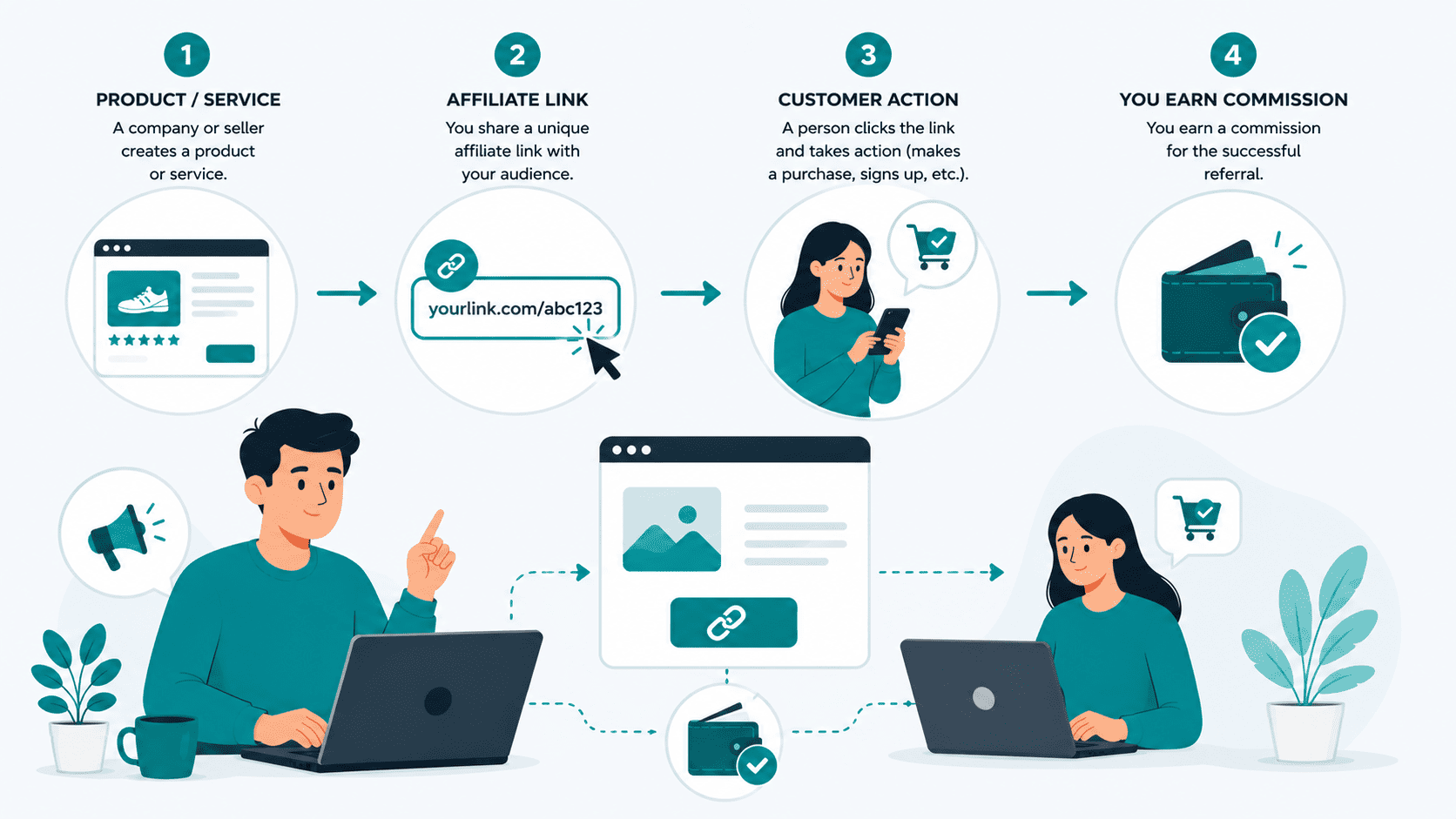
Affiliate marketing is a partnership model in which you recommend a product, service, or platform and receive a commission when someone makes a purchase or signs up through your unique referral link.
You do not create the product.
You do not manage delivery.
You do not own the company.
Your role is to connect people with something that may genuinely help them. When your recommendation leads to a measurable action, the company rewards you with a share of the revenue.
Put simply:
Affiliate marketing means earning a commission for referring customers to another company’s product or service.
How Affiliate Marketing Works in Practice
The process becomes much easier to understand when you break it into simple stages.
The Four Main Parts of the System
Most affiliate models involve four core participants.
1. The merchant
This is the company or brand selling the product or service. It could be a software platform, an online course, a hosting provider, a budgeting app, or a financial tool.
2. The affiliate
This is the person or business promoting the offer. The affiliate shares a unique tracking link and earns a commission when a defined action happens.
3. The customer
This is the person who clicks the link, explores the offer, and decides whether to buy or register.
4. The tracking system or affiliate network
This is the mechanism that records clicks, sales, and sign-ups, and attributes the commission to the correct affiliate.
A Realistic Example
Imagine that you use a budgeting app that helped you understand your spending habits and organize your monthly finances more clearly.
The company behind that app offers an affiliate program.
You join the program and receive a unique referral link. Then you write a blog post or record a video explaining your honest experience, perhaps with a title such as:
How This Budgeting App Helped Me Finally Understand My Spending
A reader finds your content, clicks the link, tries the app, and later upgrades to a paid plan. The tracking system registers that action through your referral link, and you receive a commission.
There is no mystery in it.
It is simply this sequence:
your recommendation → their decision → your commission
That is the operational core of affiliate marketing.
What Affiliate Marketing Is Not
This part matters just as much as the definition itself.
Affiliate marketing does not guarantee a salary.
It is not immediate income without work.
It is not a magical link that produces money on command.
It is not a respectable path if you promote products that people do not need or do not understand.
A healthier way to see it is this:
Affiliate marketing resembles building a small, content-driven business. You identify a need, create useful material,
recommend relevant tools, and earn only when trust and timing align.
That takes effort. It also takes patience.
Why People Are Drawn to Affiliate Marketing
Despite the noise around it, affiliate marketing does have legitimate advantages when approached with discipline and integrity.
Low barrier to entry
You do not need to manufacture a product, rent storage, hire a support team, or manage shipping logistics. In many cases, a laptop, internet access, and a clear topic are enough to begin.
Flexible structure
It can be built gradually. Some people work on it in the evenings, others on weekends, and others as part of a broader content or publishing business.
Long-term content value
A thoughtful article, comparison guide, tutorial, or video can continue attracting readers long after it is published. One useful piece of content may generate clicks and commissions months later if it continues answering a real question.
Opportunity to build trust
When your recommendations are careful and honest, affiliate marketing can strengthen your reputation rather than weaken it. Done properly, it is less about selling and more about helping people make clearer decisions.
You can also review the FTC guidance on deceptive income claims and misleading online offers.
The Less Comfortable Reality
There is another side to this model, and it should not be ignored.
Income can be inconsistent
Affiliate earnings are often uneven. One month may be encouraging, the next may be quiet. This is not the kind of income most beginners should rely on to cover essential living costs.
You do not control the platform
A company can reduce commission rates, change its terms, or close its affiliate program entirely. A social platform or search engine can also shift its algorithm, which may reduce your reach overnight.
Competition is real
Popular niches such as finance, software, education, and productivity attract many affiliates. If your content lacks originality, practical value, or trustworthiness, it will struggle.
Results often take time
Many beginners underestimate the learning curve. Content creation, audience understanding, SEO basics, trust-building, and offer selection all take time to develop.
Ethical pressure can distort judgment
Some programs pay high commissions, which can tempt people to recommend offers that are flashy but not truly helpful. That decision may bring a short-term gain, but it often damages long-term credibility.
Understanding these limitations does not make affiliate marketing less worthwhile. It makes your expectations more stable and your decisions more intelligent.
Is Affiliate Marketing Right for You?
Affiliate marketing may suit you if:
- You are willing to learn gradually.
- You want to create useful content.
- You care about credibility and transparency.
- You are comfortable building something step by step rather than chasing instant results.
- You see it as part of a broader financial strategy, not a desperate solution.
It may be a poor fit if:
- You urgently need a fast and guaranteed income.
- You dislike writing, explaining, reviewing, or creating content.
- You do not want to learn even basic digital skills.
- You are willing to promote almost anything simply because it pays more.
There is no shame in deciding that affiliate marketing is not for you. In fact, that clarity can save you time, money, and frustration.
How to Start in a Safer and Smarter Way
If you want to explore affiliate marketing without falling into the usual traps, begin with a steadier approach.
1. Start with people, not products
Ask yourself who you want to help.
Are you speaking to beginners in personal finance? Students? Freelancers? Parents trying to manage household budgets? People who want to organize money more carefully?
A clear audience makes better content possible.
2. Focus on problems first
Do not begin by hunting for the highest-paying offer.
Begin with friction points.
What confuses your audience?
What wastes their time?
What creates stress?
What do they need to solve, understand, compare, or simplify?
Useful affiliate content grows out of practical problems.
3. Choose products you can recommend honestly
The strongest affiliate recommendations usually come from personal use, careful testing, or deep research. If you would not suggest a product to a friend, it probably should not appear in your content.
4. Study the affiliate program carefully
Before joining, check:
Commission structure
Payment terms
Cookie duration
Approved traffic source
Promotional restrictions
Minimum payout rules.
A program may look attractive at first glance and still be a poor fit once you read the details.
5. Publish one honest piece of content
You do not need a huge content machine at the beginning.
You can start with:
- a beginner-friendly blog post;
- a practical tutorial;
- a product comparison;
- a short video review;
- a clear explanation of who a tool is for and who it is not for.
Clarity beats hype.
6. Be transparent about affiliate links
Tell people when a link is an affiliate link. Not because it sounds polite, but because transparency is part of responsible publishing.
A simple disclosure builds trust and removes unnecessary ambiguity.
7. Treat the early stage as training
The first months should not revolve around chasing a specific income target. They should revolve around learning:
- what questions your audience asks;
- what type of content performs well;
- what offers match your values;
- what style of communication feels natural and trustworthy.
That foundation matters more than early vanity metrics.
What is affiliate marketing in simple words? It is a way to earn a commission by recommending a product or service through a special referral link.
Affiliate Marketing and Financial Responsibility
One of the biggest mistakes beginners make is treating affiliate marketing as an emergency rescue plan.
It is much healthier to view it as a gradual skill-based income channel that may support a broader financial life. In that sense, it connects naturally with financial literacy.
A responsible approach looks like this:
- you do not spend money recklessly chasing shortcuts;
- you avoid offers you do not understand;
- you do not rely on unstable income to solve urgent money problems;
- you build slowly, test carefully, and keep expectations grounded.
That mindset protects both your finances and your reputation.
That foundation matters more than early vanity metrics.
If you are still asking what is affiliate marketing, the simplest answer is this: you help connect people with a useful offer and earn a commission when a tracked action happens.
Final Thoughts
Affiliate marketing is neither a miracle nor a scam by default. It is a tool. Like any tool, its value depends on how it is used.
Used carelessly, it becomes noise, pressure, and false promises.
Used thoughtfully, it can become a meaningful part of a long-term online business.
You do not need to imitate the loudest voices online.
You do not need to pretend success happens overnight.
You do not need to recommend products that feel wrong.
You can choose a calmer path:
learn the basics,
understand the risks,
recommend useful solutions,
and build trust one step at a time.
That is slower. But it is also far more durable.
Once you understand the basics, the next step is learning how to choose your first affiliate program safely.
It also helps to understand the affiliate marketing mistakes beginners should avoid before moving too fast.
Frequently Asked Questions
What is affiliate marketing in simple words?
Affiliate marketing is a way to earn a commission by recommending another company’s product or service through a special referral link.
How does affiliate marketing really work?
You join an affiliate program, receive a unique referral link, share that link through helpful content, and earn a commission when someone makes a qualifying purchase or signs up through it.
Is affiliate marketing good for beginners?
Affiliate marketing can be a good option for beginners, especially if they are willing to learn content creation, basic marketing, and how to recommend useful products honestly.
Is affiliate marketing easy money?
No. Affiliate marketing takes time, consistency, trust, and practical learning. It is not a guaranteed or instant income source.
Do I need a website to start affiliate marketing?
A website is not always required, but it is one of the best long-term options because it helps you build search traffic, structure your content, and create a more stable online presence.
What is the safest way to start affiliate marketing?
The safest way is to start with a clear audience, solve real problems, choose products carefully, and be transparent about affiliate links.