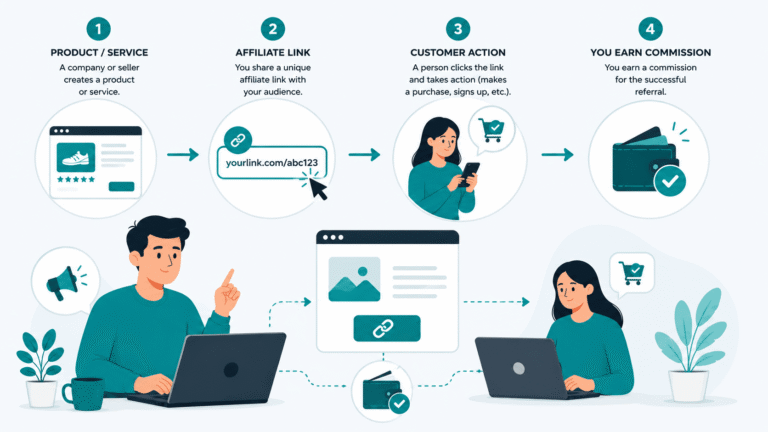

How Affiliate Marketing Works in Practice
Affiliate marketing often sounds more mysterious than it really is. Many beginners hear about referral links, commissions, platforms, and content strategies, but still do not clearly understand what actually happens in practice.
The truth is much simpler. Affiliate marketing is not magic, and it is not passive money by default. In real life, it works like a structured recommendation process: a company offers a product, an affiliate shares that product with the right audience, a person takes action, and a commission may be paid.
If you are new to the topic, it also helps to start with our guide on what affiliate marketing is and how it really works.
This article explains how affiliate marketing works in practice, step by step, so you can understand what it looks like in the real world and what beginners should realistically expect.
Why Practice Matters More Than Theory
A definition is useful, but it only goes so far. Many people understand affiliate marketing better when they see how the process plays out in a realistic situation.
In theory, affiliate marketing is simple: promote a product and earn a commission. In practice, the real questions are more specific:
- Who creates the product?
- How does the affiliate get the link?
- Why does a customer click?
- What action actually counts?
- When is a commission paid?
- What can go wrong?
Understanding these practical details helps beginners avoid confusion and unrealistic expectations.
The Four Main Parts of the System
To understand how affiliate marketing works in practice, it helps to break it into four basic parts.
The merchant
The merchant is the company or brand selling the product or service. It could be a software platform, an online course, a hosting provider, a budgeting app, or a financial tool.
The merchant creates the product, sets the rules of the affiliate program, defines commission rates, and decides which actions qualify for payment.
The affiliate
The affiliate is the person or business promoting the offer. The affiliate does not create the product. Instead, the affiliate helps connect the right audience with something useful.
This usually happens through:
- blog articles,
- comparison pages,
- tutorials,
- email newsletters,
- YouTube videos,
- or social media content.
The customer
The customer is the person who clicks the link, explores the offer, and decides whether to buy or register.
The customer is the most important part of the system. Without trust, relevance, and timing, the click usually goes nowhere.
The commission action
A commission is paid only when a specific action happens. That action depends on the program.
Examples include:
- a purchase,
- a free trial signup,
- a paid subscription,
- a qualified lead,
- or another tracked conversion.
Not every click becomes a commission. That is one of the first practical truths beginners need to understand.
A Simple Real-Life Example
Imagine that you use a budgeting app that genuinely helped you organize your monthly finances more clearly.
The company behind that app offers an affiliate program. You join the program and receive a unique referral link. Then you write a blog post or record a video explaining your honest experience, perhaps with a title such as:
How This Budgeting App Helped Me Finally Understand My Spending
A reader finds your content, clicks the link, tries the app, and later upgrades to a paid plan. The affiliate platform records that tracked action and attributes it to your referral link. If the action meets the program terms, you receive a commission.
That is how affiliate marketing works in practice:
your recommendation → their click → their decision → your commission
It is not instant. It depends on trust, content quality, audience fit, and timing.
What Happens Step by Step
In a beginner-friendly form, the process usually looks like this:
- You join an affiliate program.
- You receive a unique referral link.
- You create useful content around a real problem or need.
- A reader or viewer clicks your link.
- The person lands on the company’s page.
- The person takes a tracked action.
- The system records the action.
- A commission may be paid according to the program terms.
This practical sequence is the operational side of affiliate marketing. Once you understand these stages, the model becomes much less intimidating.
This is the clearest way to see how affiliate marketing works in practice without hype or unrealistic expectations.
What Affiliate Marketing Is Not
It is just as important to understand what affiliate marketing is not.
Affiliate marketing is not:
- guaranteed income,
- a salary,
- a magical link that produces money,
- instant results without work,
- or a good strategy when the product is low quality or misleading.
Many beginners run into trouble when they mix up affiliate marketing with unrealistic online income promises.
A better way to see it is this: affiliate marketing is a content-driven recommendation model. It works best when you understand the audience, explain the product clearly, and recommend something useful.
Why People Are Drawn to Affiliate Marketing
There are good reasons why beginners find affiliate marketing appealing.
Low barrier to entry
You do not need to create your own product or manage shipping. In many cases, you can start with a website, a content platform, or a YouTube channel.
Long-term content value
A strong article, tutorial, or review can continue helping readers over time. One useful piece of content may generate visits months later if it keeps answering a real question.
Opportunity to build trust
Done carefully, affiliate marketing can strengthen your credibility rather than weaken it. The key is honesty, transparency, and relevance.
Flexible direction
You can build around topics that matter to your audience, such as beginner finance, budgeting tools, educational platforms, software, or simple online business resources.
What Beginners Should Watch Out For
Even when affiliate marketing works in practice, it still has risks and weak points.
Promoting products you do not understand
If you cannot explain what the product does, who it is for, and why it matters, your content will sound generic and weak.
Choosing programs only for commission size
A higher commission is not always better. If the offer does not fit your audience, it will usually perform badly.
You can also read our guide on how to choose your first affiliate program safely.
Expecting fast results
Affiliate marketing often takes time. Traffic, trust, and conversions usually grow gradually, not overnight.
Ignoring trust signals
Weak websites, vague promises, unclear refund terms, and aggressive marketing are all warning signs.
If you want a safer long-term path, it also helps to understand the affiliate marketing mistakes beginners should avoid.
How to Start in a Safer and Smarter Way
If you want to explore how affiliate marketing works in practice without falling into hype, start with a simpler process.
1. Start with people, not products
Think first about who you want to help. Are they beginners in personal finance? Students? Freelancers? Parents trying to organize household budgets?
2. Focus on a real problem
What does your audience struggle with? Confusion, scams, lack of structure, low confidence, unclear next steps?
Useful affiliate content usually grows out of practical problems.
3. Choose products you can explain honestly
The strongest recommendations come from direct experience, careful research, or deep understanding.
4. Create clear, useful content
In practice, affiliate marketing works best when the content is helpful even if the reader does not buy immediately.
5. Think long term
The goal is not to pressure people. The goal is to become a useful guide.
Final Thoughts
Affiliate marketing in practice is much less dramatic than people often imagine. It is usually a slow, trust-based process built on helpful content, relevant recommendations, and tracked actions.
Used responsibly, it can become part of a stable long-term online business. Used carelessly, it becomes noise.
That is why clarity matters. Once you see the process step by step, affiliate marketing becomes easier to understand and easier to approach wisely.
Once you understand how affiliate marketing works in practice, it becomes easier to build a calmer and more realistic long-term strategy.
FAQ
What is affiliate marketing in practice?
In practice, affiliate marketing means joining a program, receiving a referral link, creating useful content, and earning a commission when a tracked action happens.
Do affiliates get paid for every click?
No. In most programs, affiliates are paid only when a specific action happens, such as a purchase, signup, or qualified lead.
Can beginners do affiliate marketing?
Yes, but beginners usually do better when they focus on trust, simple explanations, and relevant products instead of chasing fast results.
Is affiliate marketing passive income?
Not by default. Some content may continue working over time, but affiliate marketing usually requires learning, content creation, and steady improvement.
What is the easiest way to understand affiliate marketing?
The easiest way is to look at a real example and follow the process step by step: product, link, customer action, tracked result, and possible commission.
You can also review the FTC guidance on deceptive endorsements and misleading online offers.