What Is Financial Literacy and Why Does It Matter?
Financial literacy can sound like a serious topic at first.
Financial literacy can sound like a serious topic at first.
Many people hear the phrase and immediately think about investing, banking terms, spreadsheets, financial charts, or people who have always been “good with money.”
But financial literacy is much more practical than that.
At its core, financial literacy means understanding how money works in everyday life.
It is about knowing how to manage income, expenses, savings, debt, risks, and financial decisions more thoughtfully.
You do not need to be rich to become financially literate.
You do not need to know everything about investing.
And you do not need to have a perfect financial life before you begin.
Financial literacy starts with basic awareness.
Ask yourself:
- where does your money come from?
- where does it go?
- what choices are helping you?
- what habits are creating stress?
- what could you improve step by step?
In this guide, we will explain what financial literacy means, why it matters, and how beginners can start building better money habits without feeling overwhelmed.
Ask yourself:
- Where does my money come from?
- Where does it typically go?
- Which choices are benefiting me?
- Which habits are causing pressure or stress?
- What can I improve one step at a time?
Table of Contents
In this guide
- What Is Financial Literacy?
- Why Financial Literacy Matters
- Core Financial Literacy Skills Beginners Should Know
- Financial Literacy Is Not About Being Perfect
- How Financial Literacy Helps in Real Life
- Financial Literacy and Online Income
- First Steps to Improve Financial Literacy
- Common Financial Literacy Mistakes Beginners Make
- Why Financial Literacy Supports a Better Quality of Life
- Final Thoughts
- FAQ
What Is Financial Literacy?
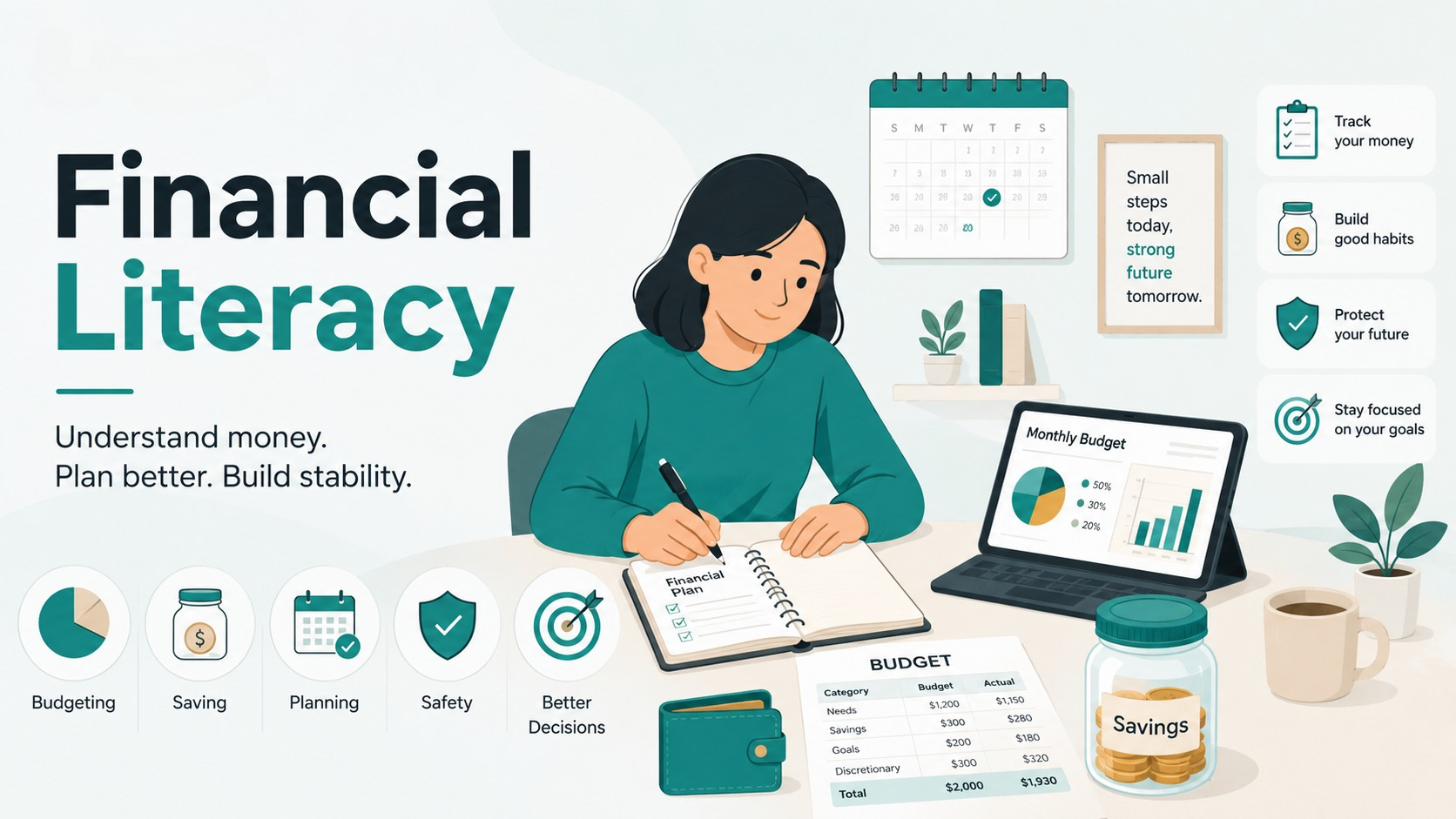
Financial literacy is the ability to understand and use basic money skills in real life.
This includes budgeting, saving, tracking expenses, understanding debt, building an emergency fund, recognizing financial risks, and making informed choices.
In simple terms, financial literacy helps you answer everyday questions like:
- can I afford this?
- where is my money going?
- am I saving enough for unexpected expenses?
- is this financial offer safe, or does it carry risks?
- do I understand the terms before I agree?
- am I making this decision with a clear mind, or because I feel pressure?
Financial literacy is not only about numbers.
It is also about habits, behavior, planning, and confidence.
A person can earn a good income and still feel stressed if they do not know how to manage money well.
At the same time, someone with a smaller income can create more stability over time by learning how to plan, save, and make thoughtful decisions.
That is why financial literacy matters, especially for beginners.
It does not give you control over everything.
But it can give you more awareness, more clarity, and a better starting point.
Why Financial Literacy Matters
Money affects many parts of everyday life.
It influences where we live, what choices we make, how we handle emergencies, how much stress we carry, and how prepared we feel for the future.
Financial literacy matters because it helps you make decisions with more clarity.
Without it, money can feel confusing even when income is coming in.
You may earn money but not know where it goes each month.
You may want to save but feel unsure where to start.
You may sign up for loans, subscriptions, courses, platforms, or investment offers without fully understanding the terms.
You may compare yourself to other people and feel behind, when what you really need is a simple plan.
Financial literacy does not solve every financial problem.
But it can help you pause before making emotional decisions.
It can help you notice warning signs.
It can help you understand that money is not only about income.
It is also about habits, systems, priorities, and daily choices.
For many beginners, this is the most important shift:
Financial literacy is not about being perfect with money. It is about becoming more aware.
Core Financial Literacy Skills Beginners Should Know
Financial literacy includes many different skills, but beginners do not need to master everything at once.
It is better to start with the basics.
Small, practical skills can already make your financial life feel clearer and more manageable.
Here are the core financial literacy skills worth learning first.
Budgeting
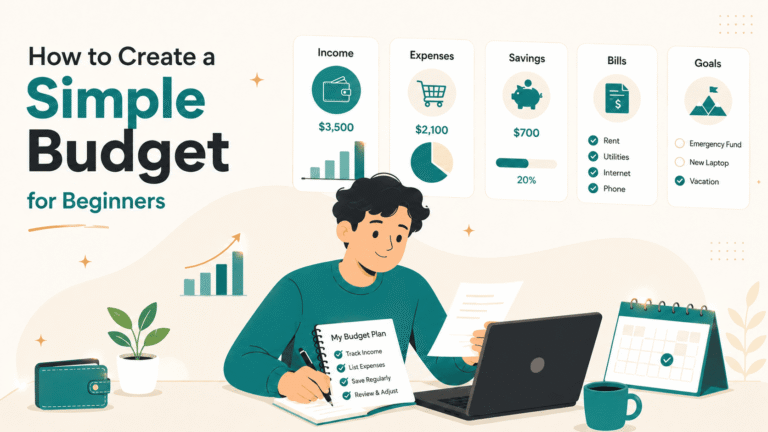
Budgeting means creating a simple plan for your money.
A budget helps you see how much money comes in, what goes out, and what can be saved or used more intentionally.
It does not have to be strict or complicated.
For beginners, a basic budget can answer three useful questions:
- what income do I have this month?
- which fixed expenses do I need to cover?
- how much can I save or use more thoughtfully?
A good budget does not make life feel smaller.
It gives your money direction.
Tracking Income and Expenses
Many people say that money “just disappears.”
Usually, it does not disappear.
It simply goes somewhere unnoticed.
Tracking your income and expenses helps you see the full picture.
You may notice small spending habits that add up faster than expected.
You may find forgotten subscriptions.
You may realize that food delivery, shopping, transport, or digital tools cost more than you thought.
This is not about criticizing yourself.
It is about collecting clear information.
Once you understand what is actually happening, it becomes easier to make better decisions.
Saving
Saving means setting money aside for future needs, goals, or unexpected situations.
It does not have to start with a large amount.
Even small savings can create a sense of progress.
For beginners, saving is not only about numbers.
It is also about building the habit of thinking ahead.
You can start with a small amount that feels realistic.
The important thing is consistency.
A small habit repeated over time can become a stronger financial foundation.
Emergency Fund
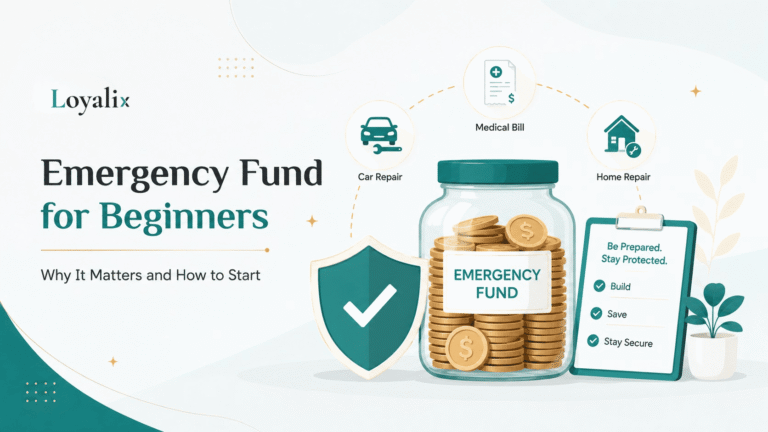
An emergency fund is money set aside for unexpected expenses.
This could include car repairs, medical costs, urgent travel, job changes, or other situations that interrupt normal life.
An emergency fund can reduce stress by providing a small financial buffer.
For beginners, even a small emergency fund is better than none.
You can start with a realistic first goal, such as saving enough to cover one small emergency.
Later, you can build from there.
Understanding Debt
Debt is money you owe.
Some debt may be planned and manageable.
Other debt can become stressful and expensive, especially when interest rates, fees, or repayment terms are not clearly understood.
Financial literacy helps you ask better questions before borrowing money:
- what is the total cost?
- what is the interest rate?
- what happens if I miss a payment?
- is this debt helping me or creating pressure?
- do I fully understand the terms?
Debt should not be treated casually.
Understanding debt helps you avoid decisions that may create long-term stress.
Recognizing Financial Risks
Financial literacy also helps you recognize risk.
Not every financial offer is safe.
Not every investment is suitable for beginners.
And not every online income promise is realistic.
When you understand the basics, you become more careful with offers that sound too good to be true.
This is especially important online, where people often see promises about fast money, secret systems, guaranteed returns, or effortless income.
A financially literate person learns to pause and ask:
- who is behind this offer?
- what are the real risks?
- are the terms clear?
- is there pressure to act quickly?
- do the claims actually sound realistic?
This kind of thinking protects not only your money, but also your confidence.
Financial Literacy Is Not About Being Perfect
One of the biggest misunderstandings about financial literacy is the idea that you must become perfect with money.
You do not.
Financial literacy is not about never making mistakes.
It is not about having a perfect budget every month.
And it is not about knowing every financial term before you begin.
It is about becoming more aware.
It is about noticing patterns.
It is about learning how to pause, ask better questions, and make more thoughtful decisions over time.
Some months will be easier than others.
Some plans will need to change.
That is normal.
The goal is not perfection.
The goal is progress, clarity, and better choices step by step.
How Financial Literacy Helps in Real Life
Financial literacy is useful because it connects directly to everyday life.
It is not just theory.
It can help you make better decisions in simple, practical situations.
It Helps You Understand Where Your Money Goes
When you track your money, you stop guessing.
You begin to see patterns.
Maybe small purchases are taking more than expected.
Maybe subscriptions are quietly reducing your income.
Maybe you spend more during stressful weeks.
This information is valuable.
It gives you a starting point.
When you know where your money goes, you can decide what to keep, what to reduce, and what no longer supports your goals.
It Helps You Reduce Money Stress
Money stress often grows when things feel unclear.
You may not know how much you owe, how much you spend, or what you can safely afford.
Financial literacy helps bring more clarity.
Even if the situation is not perfect, understanding the numbers can make the problem feel more manageable.
Clarity does not fix everything immediately. But it can help you feel less lost.
It Helps You Make Safer Decisions
Financial literacy helps you slow down before saying yes to offers, loans, subscriptions, online programs, investment platforms, or “quick money” promises.
You learn to read the terms, compare options, and ask better questions. That does not mean you will never make mistakes, but it can help you avoid many of the avoidable ones.
It Helps You Build Better Habits
Good financial habits are built through repetition.
Tracking money.
Saving regularly.
Planning purchases.
Checking terms.
Avoiding emotional spending.
These habits may look small, but they can change the way you feel about money over time.
Financial literacy helps you build those habits step by step.
Financial Literacy and Online Income
Financial literacy is also important if you are interested in online income.
For example,Affiliate Marketing can be one way to learn about building an additional income stream online.
But earning more money is only one part of the picture.
You also need to know how to manage that money wisely.
If someone earns extra income but spends it without a plan, the stress may not disappear.
This is why financial literacy and online income should work together.
One helps you create opportunities.
The other helps you use those opportunities more responsibly.
Financial literacy helps you think about questions like:
- how should I manage extra income?
- should I save part of it?
- what expenses support my long-term goals?
- what risks should I avoid?
- how can I make decisions without pressure?
At Loyalix, the goal is not only to talk about earning more.
The goal is to help beginners build a more stable, thoughtful, and realistic financial life.
Online income can be useful.
But it becomes more meaningful when it supports your long-term stability instead of creating more pressure.
First Steps to Improve Financial Literacy
If you are a beginner, you do not need a complicated system.
Start with simple steps.
Small actions are easier to repeat, and repeated actions are what slowly build better money habits.
Step 1: Track Your Money for One Month
Write down your income and expenses for one month.
You can use a notebook, a spreadsheet, a budgeting app, or simple notes on your phone.
For a simple budgeting example, you can also review this official guide on making a budget from Consumer.gov.
The tool does not matter as much as the habit.
The goal is to see where your money goes.
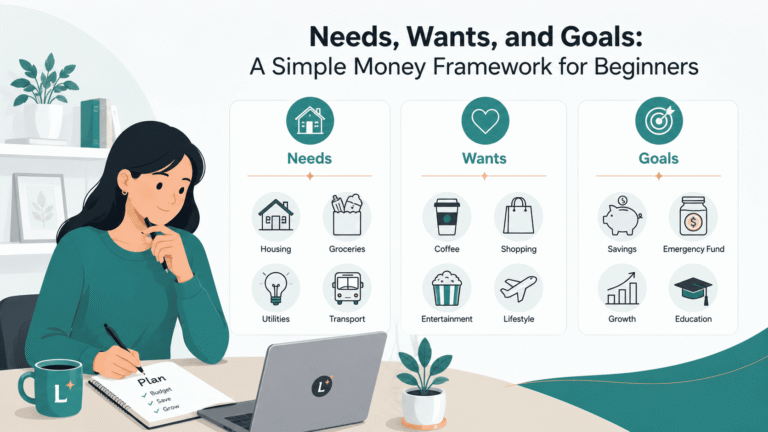
Step 2: Separate Needs, Wants, and Goals
Needs are essential expenses.
Wants are things that improve life but are not always necessary.
Goals are future-focused priorities, such as savings, debt repayment, education, or building a business.
This simple separation can help you make clearer decisions.
You do not have to remove every want from your life.
The point is to understand what each expense is doing for you.
Step 3: Build a Small Emergency Fund
Start with a realistic amount.
It does not need to be large at first.
Even a small emergency fund can help you avoid panic when something unexpected happens.
For beginners, the first goal can be simple: save enough to cover one small emergency.
Later, you can build from there.
Step 4: Review Your Subscriptions and Fixed Costs
Look at your monthly recurring expenses.
Some may be useful.
Others may no longer serve you.
Subscriptions, tools, memberships, apps, and automatic payments can quietly reduce your income over time.
Canceling or reducing unnecessary fixed costs can create more breathing room.
You do not have to cut everything.
Start by asking what still supports your real life and your goals.
.
Step 5: Learn Before You Commit
Before joining a financial platform, borrowing money, investing, or buying a course, take time to understand the terms.
Read carefully.
Compare options.
Avoid decisions made under pressure.
A good financial decision should still make sense after you slow down.
If something feels rushed, unclear, or too good to be true, it is worth taking more time before saying yes.
Common Financial Literacy Mistakes Beginners Make
Beginners often make money mistakes not because they are careless, but because no one taught them the basics.
Many people learn about money only after something becomes stressful.
A missed payment.
A confusing loan.
A subscription they forgot about.
An offer online that sounded better than it really was.
The goal is not to feel guilty.
The goal is to notice what can be improved and make better decisions next time.
Ignoring Small Expenses
Small expenses can feel harmless.
A coffee here.
A subscription there.
A small online purchase after a stressful day.
One small expense may not change much, but repeated small expenses can become a large part of your monthly spending.
Financial literacy helps you notice these patterns without shame.
When you see the pattern, you can decide what is worth keeping and what no longer supports your goals.
Living Without a Simple Plan
Without a plan, money decisions often happen emotionally.
You may spend based on stress, mood, urgency, or habit.
A simple plan helps you decide in advance what matters most.
It does not need to be perfect.
Even a basic monthly plan can help you feel more organized and less reactive.
Treating Credit as Extra Income
Credit cards and loans are not extra income.
They are borrowed money that must be repaid.
This is an important difference.
Using credit without understanding the cost, interest, fees, or repayment terms can create pressure later.
Financial literacy helps you slow down and ask whether borrowing really supports your situation or only delays the problem.
Believing Every Financial Promise Online
Online financial content can be useful, but it can also be risky.
Be careful with anyone promising guaranteed income, fast wealth, or secret methods that require no effort.
If you want to understand common warning signs more clearly, you may also read our guide on how to avoid financial scams online.
Healthy financial education should help you think more clearly.
It should not pressure you to act quickly.
If an offer makes you feel rushed, confused, or afraid to miss out, it is worth slowing down and researching more.
Why Financial Literacy Supports a Better Quality of Life
Financial literacy is not only about money.
It can also affect your quality of life.
When you understand your money better, everyday decisions can feel less confusing.
You may feel more prepared for unexpected expenses.
You may feel more confident when comparing offers, reading terms, or choosing what to avoid.
You may also feel less pressure to follow every trend, buy things emotionally, or compare your financial life to someone else’s.
This does not mean financial literacy removes all stress.
Life can still be unpredictable.
Income can change.
Expenses can appear suddenly.
Plans may need to be adjusted.
But financial literacy gives you tools to respond with more clarity.
It helps you ask better questions.
It helps you notice patterns.
It helps you build habits that support your real life, not just short-term comfort.
Over time, this can create a calmer relationship with money.
You may not control every situation.
But you can become more aware, more prepared, and more intentional with the choices you make.
Final Thoughts
Financial literacy is not about becoming a financial expert overnight.
It is not about having a perfect budget, a perfect income, or a perfect plan.
It is about understanding your money better than you did before.
For beginners, even one small step can make a difference.
Tracking your expenses for one month.
Reviewing one subscription.
Saving a small amount.
Reading terms before making a decision.
Pausing before trusting a financial promise online.
These actions may look simple, but they can slowly build more awareness and confidence.
Financial literacy gives you a clearer way to think about money.
It helps you understand your choices, reduce confusion, and make decisions that support your real life.
You do not need to fix everything at once.
Start with one area.
Learn slowly.
Adjust when needed.
And keep building better habits step by step.
At Loyalix, the goal is to help beginners understand money, online income, and financial decisions in a simple, realistic, and trustworthy way.
You can continue exploring more beginner-friendly guides in our Articles section.
FAQ
What is financial literacy?
Financial literacy is the ability to understand and use basic money skills in everyday life. It includes budgeting, saving, tracking expenses, understanding debt, recognizing risk, and making more thoughtful financial decisions.
Why does financial literacy matter?
Financial literacy matters because it helps you make clearer money decisions. It can reduce confusion, help you prepare for unexpected expenses, and make it easier to avoid risky financial offers.
Do beginners need to know everything about money?
No. Beginners do not need to know everything at once. It is better to start with simple skills, such as tracking your money, understanding your expenses, saving small amounts, and learning before making financial commitments.
What are the most important financial literacy skills?
Some of the most important financial literacy skills include budgeting, saving, tracking income and expenses, building an emergency fund, understanding debt, recognizing financial risks, and reading terms before you agree to anything.
How can I start improving my financial literacy?
You can start by tracking your income and expenses for one month. Then review your spending, separate needs, wants, and goals, build a small emergency fund, and learn to pause before making financial decisions under pressure.
Is financial literacy only about budgeting?
No. Budgeting is only one part of financial literacy. Financial literacy also includes saving, planning, understanding debt, avoiding scams, managing risk, and building better money habits over time.
How does financial literacy help with online income?
Financial literacy helps you manage online income more responsibly. Extra income can be useful, but it becomes more meaningful when you know how to save, plan, avoid risks, and use that money to support long-term stability.
Can financial literacy improve quality of life?
Yes. Financial literacy can improve quality of life by helping you feel more prepared, less confused, and more confident with money decisions. It does not remove every problem, but it gives you clearer tools to respond.