

What Is Financial Literacy and Why Does It Matter?
Money decisions are part of ordinary life. They appear when you pay a bill, choose a subscription, use a credit card, plan for a repair, compare an online offer, or decide whether you can afford a new commitment. You do not need advanced financial knowledge to handle every situation, but you do need a clear way to understand your options.
Financial literacy is the ability to understand and use basic money skills in real situations. It includes knowing what comes in, what goes out, what you owe, what you are saving, and what risks deserve a closer look. Just as importantly, it helps you pause before a decision and ask better questions.
This does not mean becoming perfect with money. It means building enough awareness to make choices that fit your income, responsibilities, and goals. A useful place to begin is with your own daily life:
- Where does your money come from?
- Where does it usually go?
- Which choices are helping you?
- Which habits create pressure or uncertainty?
- What small change would make next month easier?
In this guide, you will learn what financial literacy means, why it matters, which skills provide the strongest foundation, and how to begin without turning money management into another overwhelming project.
Table of Contents
What Is Financial Literacy?
Financial literacy is practical knowledge about earning, spending, saving, borrowing, planning, and protecting money. It is not limited to definitions or formulas. The real test is whether you can use what you know when a decision appears.
For example, understanding interest is useful when you compare two credit offers. Knowing your monthly expenses matters when you consider a new subscription. Recognizing that an urgent promise may be a warning sign can help you avoid a costly mistake. These are everyday applications of financial knowledge.
A financially literate person does not always choose the cheapest option or avoid every risk. Instead, they try to understand the cost, the terms, the alternatives, and the possible consequences before agreeing. They also know when a decision is outside their experience and deserves additional research or qualified advice.
Your level of knowledge can grow gradually. You may begin by tracking expenses, then learn how credit works, how to build an emergency reserve, or how to evaluate an investment. Each skill makes the next decision a little clearer.
Why Financial Literacy Matters
Money affects housing, food, transportation, health, family responsibilities, work, and plans. When the numbers are unclear, even a small decision can feel stressful. When you understand your basic financial picture, you can respond with more information and less guesswork.
That clarity is especially important when money is limited. A realistic plan can show which bills must be protected first, which expenses can change, and whether a new payment would create pressure elsewhere. It can also reveal that a problem is not poor discipline but a genuine gap between income and essential costs.
Basic money skills can help you:
- understand where your income is going;
- prepare for irregular or unexpected expenses;
- compare financial products and read important terms;
- recognize high-pressure or misleading offers;
- use debt more carefully;
- set priorities that reflect your real life;
- ask more specific questions when you need help.
These skills do not guarantee that every month will go according to plan. Income can change, prices can rise, and emergencies can happen. Their value is that they give you a structure for deciding what to do next.
Core Financial Literacy Skills Beginners Should Know
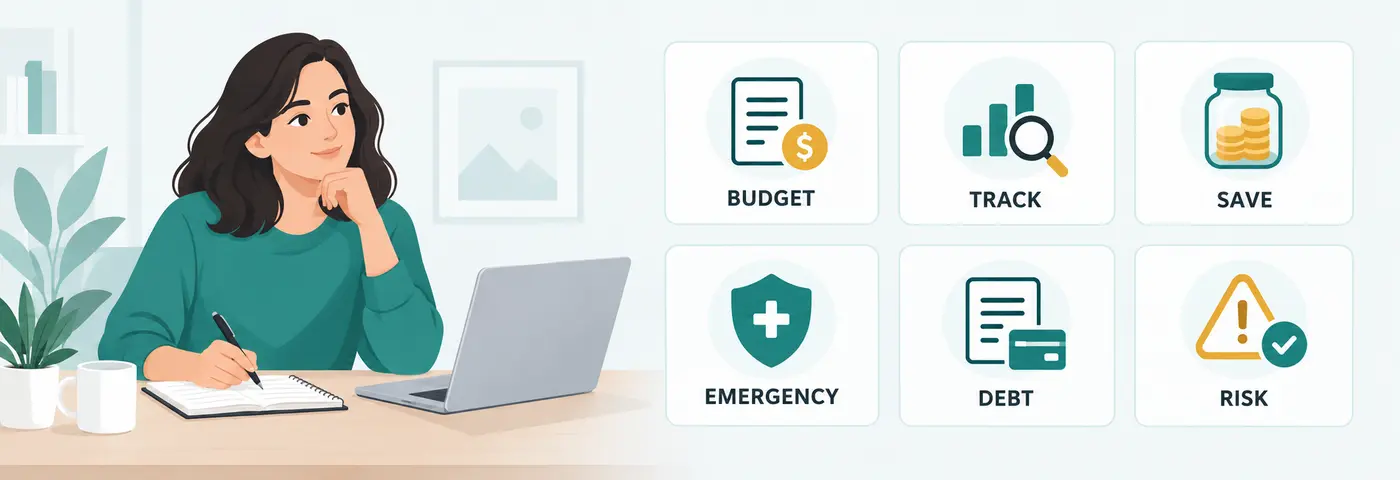
You do not need to learn every financial topic at once. The following skills cover many of the decisions beginners face most often:
Budgeting
A budget is a plan for how available income will cover expenses, savings, and goals. It does not need dozens of categories or strict rules. A simple beginner budget can begin with four questions: How much money is available? Which costs are essential? Which costs are flexible? What needs attention before the next payday?
The Consumer.gov budgeting guide also recommends listing income and expenses, subtracting expenses from income, and reviewing the result regularly. The purpose is not to create a perfect spreadsheet. It is to see whether your plan is realistic before the month decides for you.
Tracking Income and Expenses
A budget is based on estimates; tracking shows what actually happened. Record income, bills, card purchases, cash spending, subscriptions, and small online payments for at least two to four weeks. The method can be a notebook, spreadsheet, banking app, or phone note. What matters is consistency. If you want a simple process, use the Loyalix guide to track your spending.
Suppose you expect to spend $300 on flexible purchases but the record shows $465. That difference is useful information. It may come from delivery fees, unplanned shopping, a forgotten subscription, or an estimate that was never realistic. Tracking replaces a vague feeling with a specific pattern you can address.
Saving
Saving means setting aside money for future needs instead of treating every available dollar as current spending money. The amount may be small at first. A regular $5 or $10 transfer can be more useful than waiting for a perfect month that never arrives.
Give each savings category a purpose: an annual bill, a planned purchase, education, travel, debt reduction, or a larger long-term goal. Named goals are easier to protect because you know what the money is meant to do.
Emergency Fund
An emergency fund is money reserved for an unexpected cost that affects your health, safety, essential obligations, or ability to earn. It can reduce the need to rely immediately on high-cost credit when a car, appliance, or medical expense cannot wait. The first target does not have to be several months of expenses. A smaller, realistic buffer is a valid beginning. Learn how to start an emergency fund for beginners and increase it as your circumstances allow.
Understanding Debt
Debt is not simply the amount borrowed. It also includes interest, fees, payment dates, the length of the agreement, and the consequences of missing a payment. Before accepting credit, look for the total cost, not only the monthly payment. A smaller payment can be attached to a longer term and a higher overall cost.
If debt is already difficult to manage, begin by listing every balance, minimum payment, interest rate, and due date. This does not solve the problem by itself, but it creates an accurate starting point. For serious or urgent debt concerns, seek help from a reputable nonprofit counselor or a qualified professional in your country.
Recognizing Financial Risks
Risk appears in many forms: guaranteed-return claims, pressure to act immediately, hidden recurring charges, unclear cancellation rules, requests for sensitive information, or a product you do not understand. A professional-looking website or social media profile is not proof that an offer is safe. Before paying, check the company, terms, refund policy, independent reviews, and contact details. If something feels rushed or unusually profitable, pause and review the Loyalix guide on how to avoid financial scams online.
Financial Literacy Is Not About Being Perfect
Money habits are shaped by income, family responsibilities, health, location, past experience, and access to reliable information. A system that works for one person may be unrealistic for another. That is why good financial education should help you think, not make you feel ashamed.
You may forget to record a purchase, use savings for a real emergency, underestimate a category, or change a goal. These are not reasons to abandon the plan. They are reasons to update it. A budget is useful because it can respond to real life, not because it remains unchanged.
Progress often looks ordinary: opening a bill instead of avoiding it, canceling one unused service, asking what a fee means, or waiting a day before an expensive purchase. These choices may feel small, but they strengthen the habit of making decisions deliberately.
How Financial Literacy Helps in Real Life
It Helps You Understand Where Your Money Goes
Without a record, it is easy to underestimate spending. Regular bills are visible, while groceries, transport, fees, small card payments, and subscriptions can blend into the month. A simple review shows which categories use the most money and which ones change unexpectedly.
This information may confirm that your spending is reasonable, or it may reveal an expense you no longer value. Either result is helpful because the next decision is based on evidence rather than guilt.
It Helps You Reduce Money Stress
A plan cannot remove every financial concern, but it can reduce uncertainty. Knowing the amount due, the date, and the available options is usually less stressful than avoiding the issue. Even when the numbers are difficult, clarity helps you decide whether to adjust spending, contact a provider, ask for help, or postpone a commitment.
It Helps You Make Safer Decisions
Financial knowledge creates useful pauses. Instead of responding immediately to a sales message, loan offer, investment promise, or online opportunity, you can check the terms and ask: What will this cost in total? What happens if I change my mind? How does the company make money? What evidence supports the claim?
Those questions do not eliminate risk, but they can expose information that a persuasive headline leaves out.
It Helps You Build Better Habits
Useful habits are usually simple enough to repeat: reviewing accounts once a week, paying bills on a schedule, transferring a small amount to savings, and checking subscriptions once a month. Repetition matters more than an ambitious system that is abandoned after a few days.
Financial Literacy and Online Income
Online income can come from freelance work, digital products, affiliate commissions, content, services, or other projects. It can be valuable, but it may also be irregular. A strong month should not automatically be treated as a permanent increase in income.
Keep online earnings and related expenses clearly recorded. Note platform fees, software, advertising, refunds, equipment, and payment dates. Depending on where you live and how the income is earned, you may also need to plan for taxes or business obligations. Check the rules that apply to you rather than relying on a general social media answer.
This is particularly important when you are learning what affiliate marketing is and how it works. Commission reports can change because of returns, validation, attribution rules, or payout thresholds. Treat expected earnings as unconfirmed until the program approves and pays them.
Avoid buying tools, courses, or subscriptions simply because a creator says they are essential. Start with the smallest setup that supports your real work, record the cost, and evaluate whether it produces a measurable benefit.
First Steps to Improve Financial Literacy
Step 1: Track Your Money for One Month
Write down all income and spending for one month. Include automatic payments and small purchases, not only large bills. At the end of each week, check your record against your bank or card activity. The goal is accuracy, not judgment.
Step 2: Separate Needs, Wants, and Goals
Sort your expenses into three broad groups. Needs protect daily life and essential responsibilities. Wants are flexible choices that add comfort or enjoyment. Goals direct money toward future stability or progress. The categories are personal, so use the needs, wants, and goals framework as a guide rather than a rigid rule.
Step 3: Build a Small Emergency Fund
Choose a first target that is useful and possible. It might cover a prescription, urgent transport, a basic repair, or another common surprise in your life. Keep the money separate from routine spending if you can, and add to it on a regular schedule.
Step 4: Review Your Subscriptions and Fixed Costs
List every recurring payment, including annual charges divided by month. Check whether you still use each service, whether the price has changed, and whether a lower plan would meet the same need. Do not cancel essential insurance or services without understanding the consequences, but remove costs that no longer provide value.
Step 5: Learn Before You Commit
Before signing, subscribing, borrowing, or investing, read the terms that affect price, renewal, cancellation, access, and refunds. If you cannot explain how the product works and what could go wrong, wait. A short delay is often less expensive than reversing a rushed decision.
Common Financial Literacy Mistakes Beginners Make
Many financial mistakes begin with ordinary habits rather than one dramatic decision. Recognizing these patterns early can help you respond with practical changes instead of guilt or panic.
Ignoring Small Expenses
Small purchases are not automatically a problem, but frequent ones can quietly use money intended for something else. Look at the monthly total before deciding what matters. If one category is crowding out a priority, choose a realistic change instead of banning everything. The guide on how to reduce variable expenses without feeling restricted offers practical examples.
Living Without a Simple Plan
When money has no plan, the loudest expense often wins. A basic monthly outline gives essential bills, flexible spending, and goals a place before the balance becomes too low. The plan can be brief; it only needs to be clear enough to guide decisions.
Treating Credit as Extra Income
Credit increases what you can spend today, but it does not increase what you earn. The balance still has to be repaid, usually with interest or fees. Before using credit, identify the repayment source and check whether the payment will fit alongside your existing obligations.
Believing Every Financial Promise Online
Confidence, luxury images, follower counts, and testimonials can make weak claims look credible. Look for verifiable information, clear terms, realistic risk explanations, and a transparent business model. Be cautious when an offer promises guaranteed results, discourages questions, or says you must pay immediately.
Why Financial Literacy Supports a Better Quality of Life
Better money skills do not guarantee wealth or remove structural problems. They can, however, make everyday life more manageable. A clear view of income and obligations can reduce last-minute surprises. A small reserve can create time to respond to an emergency. Careful comparison can prevent an unsuitable contract.
Financial knowledge can also improve communication. When you know the numbers, it is easier to discuss household priorities, explain a limit, or ask a provider a precise question. Decisions may still be difficult, but they become more concrete.
The broader benefit is not control over every future event. It is greater readiness: knowing what you have, what matters now, what can wait, and where to look for reliable help.
Final Thoughts
Financial literacy begins with attention, not expertise. You do not need to master investing, build a complex spreadsheet, or change every habit at once. Start by making your current situation visible.
Today, open a notebook or phone note and record three numbers: your expected income for the month, the total of your essential bills, and the amount currently available. Then choose one action for the next seven days—track every purchase, cancel one unused subscription, read the terms of a financial product, or transfer a small amount to savings.
That action will not solve every money problem, but it will replace one area of uncertainty with useful information. Repeat the process, adjust it to your life, and build from what you learn. Good financial decisions are rarely created by one dramatic change. They are built through clearer choices made consistently over time.
Educational note:
This article provides general educational information and is not personalized financial, legal, tax, or investment advice.
Frequently Asked Questions
What is financial literacy?
Financial literacy is the ability to understand and use basic money skills in everyday life. It includes budgeting, saving, tracking expenses, understanding debt, recognizing risk, and making more thoughtful financial decisions.
Why does financial literacy matter?
Financial literacy matters because it helps you make clearer money decisions. It can reduce confusion, help you prepare for unexpected expenses, and make it easier to avoid risky financial offers.
Do beginners need to know everything about money?
No. Beginners do not need to know everything at once. It is better to start with simple skills, such as tracking your money, understanding your expenses, saving small amounts, and learning before making financial commitments.
What are the most important financial literacy skills?
Some of the most important financial literacy skills include budgeting, saving, tracking income and expenses, building an emergency fund, understanding debt, recognizing financial risks, and reading terms before you agree to anything.
How can I start improving my financial literacy?
You can start by tracking your income and expenses for one month. Then review your spending, separate needs, wants, and goals, build a small emergency fund, and learn to pause before making financial decisions under pressure.
Is financial literacy only about budgeting?
No. Budgeting is only one part of financial literacy. Financial literacy also includes saving, planning, understanding debt, avoiding scams, managing risk, and building better money habits over time.
How does financial literacy help with online income?
Financial literacy helps you manage online income more responsibly. Extra income can be useful, but it becomes more meaningful when you know how to save, plan, avoid risks, and use that money to support long-term stability.
Can financial literacy improve quality of life?
Yes. Financial literacy can improve quality of life by helping you feel more prepared, less confused, and more confident with money decisions. It does not remove every problem, but it gives you clearer tools to respond.