

Affiliate Marketing for Beginners: What to Do First
Affiliate marketing for beginners is often explained backward. People are shown commission screenshots, tracking links, and dashboards before anyone asks a more important question: who will your content help, and what decision will it make easier?
A referral link is only the technical connection between your content and an offer. It does not create trust, make a product relevant, or guarantee that a commission will be approved. Those results depend on the quality of the recommendation, the program’s rules, the reader’s choice, and whether the qualifying action is tracked correctly.
That is why a sensible beginning is smaller than it may appear online. You need one defined audience, one useful problem to address, one main publishing platform, and a short list of content ideas. You do not need ten programs, expensive software, or a presence on every social network.
This guide turns the first month into a practical sequence. You will learn how to choose a direction, build a small content base, evaluate a program, disclose affiliate relationships, and review early results without treating affiliate marketing as guaranteed income.
Educational note: This article provides general educational information. Affiliate program terms, disclosure duties, tax rules, and platform policies vary by country, program, and channel. Review the requirements that apply to your audience and situation.
Table of Contents
Affiliate Marketing for Beginners: What You Need Before You Start
If the model itself is still unclear, begin with what affiliate marketing is and how it really works. In simple terms, a publisher recommends another company’s product or service through a trackable link. If the referral produces an eligible action and satisfies the program’s conditions, the publisher may receive a commission.
The word may matters. A click does not automatically create a payment. The order may be returned, the action may be ineligible, another channel may receive attribution, or the referral may not be recorded. The advertiser or network applies the agreement, validates the event, and decides whether the commission is approved.
Your first job is therefore not to place as many links as possible. It is to create a useful reason for a reader to consider an offer. A strong beginner article might explain how to compare options, complete a task, avoid a mistake, or decide whether a product is suitable. The affiliate link supports that explanation; it should not control it.
A healthy starting point also respects your finances. Hosting, software, courses, advertising, and design tools can become expensive quickly. Set a small budget you can afford without using money needed for bills, debt payments, food, housing, or emergency savings. Treat possible commissions as uncertain until they are approved and paid.
Step 1: Choose One Audience and One Problem
A broad topic such as “make money online” does not tell you what to write or whom to help. A useful starting direction combines a specific audience with a recognizable problem.
For example, “website tools” is broad. “Affordable website tools for first-time bloggers” is clearer. “Productivity” is broad. “Simple planning tools for solo creators who struggle to publish consistently” gives you a reader, a problem, and a reason for certain products to appear in the content.
You are not signing a permanent contract with a niche. You are creating a working boundary for the next group of articles. The direction can become narrower or wider when real reader questions show you where the value is.
Use the Loyalix beginner-safe niche checklist if you need a structured way to connect your interests, audience needs, content possibilities, and realistic product categories.
Before moving on, write one sentence:
- I help [type of person] understand or solve [specific problem] through [content format].
If the sentence is still vague, do not search for programs yet. Clarify the reader and problem first; the product search becomes much easier afterward.
Step 2: Select One Primary Content Platform
Choose the platform where you can create useful content consistently, not the platform that currently seems most exciting. A website can support searchable guides, comparisons, and resource pages. YouTube may fit demonstrations and tutorials. A newsletter can serve an existing audience. Social platforms can help with discovery, but they also have changing formats, algorithms, and link rules.
You do not have to build all of them at once. One primary platform and one supporting channel are enough to start. For example, you might publish complete guides on a website and use short social posts to introduce a single idea from each guide.
Before choosing, check whether the affiliate programs you may later consider permit that promotional method. Some programs accept websites but restrict email, coupon sites, paid search, direct linking, or particular social platforms. A channel is only useful when you can maintain it and the program allows it.
Think about the reader’s task. A detailed software comparison is easier to explain in a long-form article or video than in a short caption. A visual tutorial may need screen recording. A simple checklist may work well as an article, carousel, or downloadable resource. Choose the format that helps the reader understand, not merely the format that gives you a place to paste a link.
Step 3: Build a Small Content Base Before Applying
Many beginners apply to programs before their website or channel shows what they actually publish. That can make an application hard to evaluate and leave the creator with links but no useful context.
Create a small foundation first. Three to five strong pieces are more valuable than twenty rushed posts. They should make the audience and topic obvious, answer real questions, and demonstrate the style of recommendation you plan to use.
A practical starter set can include:
- one beginner guide that explains the main problem;
- one step-by-step tutorial that helps the reader complete a task;
- one comparison or decision guide that explains important differences;
- one mistakes or safety article that prevents a poor decision; and
- one supporting FAQ or glossary for common questions and terms.
Do not invent product experience. If you have not personally used a tool, avoid writing as though you have tested it. You may explain verified features, pricing, requirements, and public documentation, but the limits of your knowledge should remain clear.
Each article should remain helpful even if the reader does not buy anything. That standard protects the quality of the content and makes it easier to recognize when a recommendation is being forced into a topic where it does not belong.
Step 4: Find Affiliate Programs That Fit
Once the audience, problem, platform, and initial content are clear, search for programs connected to the solutions your readers may reasonably need. Begin with products and services already relevant to the content—not with a directory sorted by the largest commission.
A good fit has three parts: the product relates to your niche, it addresses a real audience need, and you can explain it accurately in your normal content format. If one part is missing, the recommendation may feel unnatural even when the commission rate looks attractive.
The guide on how to find affiliate programs that fit your niche and audience explains where to search, how to create a shortlist, and how to verify that a program is current.
Keep the first shortlist manageable. Record three to five possible programs and compare:
- the product’s relevance to the audience;
- the company and product reputation;
- the application requirements and supported regions;
- the promotional methods the program permits;
- the commission model, validation process, and payment schedule; and
- whether you can discuss both benefits and meaningful limitations.
If a program uses pressure, vague rules, or unrealistic earnings claims, pause and verify the company. The Loyalix online scam red-flags checklist can help you review warning signs before sharing personal details or paying for access.
Step 5: Read the Program Terms Carefully
An attractive program page is not the complete agreement. Before applying or publishing a recommendation, find the current terms and identify the rules that affect your content, tracking, payment, and continued participation.
If a term is unclear, ask program support instead of filling the gap with an assumption. Save the agreement or record the date you reviewed it. Programs can change commission rates, eligible products, attribution methods, promotional restrictions, and payout rules.
Use the affiliate program terms checklist to review the full agreement systematically. At minimum, check the following areas.
Tracking and Attribution
Find out what the link records, how long the tracking window may remain active, which attribution rule is used, and whether coupon codes, mobile apps, cross-device activity, or other channels can affect credit.
A longer cookie duration does not guarantee a commission. Later clicks, consent choices, browser restrictions, another eligible channel, returns, exclusions, and program-specific rules may change the outcome.
For a fuller explanation, read Affiliate Tracking and Attribution Explained for Beginners.
Commission and Validation Rules
Identify the action that earns a possible commission and the circumstances that may cause it to be declined or reversed. Look for rules covering cancelled orders, returns, self-referrals, duplicate leads, excluded products, existing customers, coupon use, and invalid traffic.
Payment Conditions
Check the payout threshold, validation period, payment frequency, supported payment methods, currency, fees, tax documentation, and what happens to a balance if the account becomes inactive or the program closes.
Promotional Restrictions
Review the rules for email, social media, paid advertising, brand-name bidding, domain names, discount claims, link shorteners, downloadable software, coupon content, and the use of logos or product images. A marketing method allowed by one program may be prohibited by another.
Step 6: Add a Clear Affiliate Disclosure
Readers should be able to recognize when you may receive compensation from a recommendation. A disclosure protects the reader’s ability to judge the content with the commercial relationship in mind.
For a U.S.-focused audience, the Federal Trade Commission explains that a material connection should be disclosed clearly and conspicuously. The wording should be easy to understand and placed where people are likely to notice it—not hidden only in a footer, terms page, profile, or group of hashtags.
Review the FTC resource Disclosures 101 for Social Media Influencers for official examples and current guidance. Rules may also depend on the reader’s location, your location, the platform, and the program agreement, so check the requirements that apply to your situation.
A simple article disclosure might say:
Affiliate disclosure: Some links in this article may be affiliate links. If you make a qualifying purchase through one of them, Loyalix may receive a commission at no additional cost to you. This does not affect how we evaluate or explain a product.
Place the disclosure before or near the first affiliate recommendation, where a reader will see it before deciding whether to use the link. If a page contains several recommendations, repeat or adapt the disclosure when necessary for clarity.
In video, the relationship should be understandable within the video itself, not only in a description that viewers may never open. On a short social post, use direct language rather than vague labels such as “collab” when the commercial meaning may not be obvious.
Step 7: Publish Useful Content With Context
An affiliate link should appear at the point where it helps the reader take a relevant next step. Before the link, explain the problem, the type of solution, who the product may suit, and the important conditions the reader should verify. After the link, continue helping the reader compare or act safely.
Avoid turning every article into a product list. Some of the most useful pages may contain no affiliate links at all. Definitions, safety guides, foundational tutorials, and decision checklists can build the understanding that later makes a recommendation meaningful.
When you do recommend a product, separate verifiable facts from opinion. Confirm current pricing and features on the official page. State when information can change. Do not copy the merchant’s claims without checking them, and do not promise a result the product cannot guarantee.
Balanced content is not negative content. A reader needs to know limitations such as learning curve, eligibility, recurring cost, regional availability, cancellation rules, or the need for an additional tool. Explaining those limits helps the right person make a more informed choice and helps the wrong person avoid an unsuitable purchase.
Step 8: Track Results and Improve
Early measurement should answer questions, not create pressure. A new website may have too little traffic for sales data to mean much. Begin with signals that show whether the content is being found and understood.
Track a small set of useful information: publication date, topic, search impressions, visits, engaged reading, link clicks, conversion events reported by the program, approved commissions, reversals, and the date each link was last tested. Keep program data separate from confirmed payments.
A page with traffic but few link clicks may need a clearer transition or a more relevant offer. A page with clicks but no approved conversions may have an audience mismatch, unclear product fit, weak purchase intent, or tracking limitations. A page with almost no impressions may need better search intent, internal links, or time to be discovered.
Do not change five things at once. Improve one element, record the date, and give the page enough time to produce new information. The goal is to learn which topics and formats help readers—not to force a commission from every visit.
A Realistic 30-Day Beginner Roadmap
The first month is not a deadline for earning. It is a short project for creating a clear, reviewable foundation.
Week 1: Define the Foundation
- Choose one audience and one problem.
- Write your one-sentence content direction.
- Select one primary platform and one content format.
- List ten real questions a beginner in that audience might ask.
- Set a small, affordable budget for essential tools only.
Week 2: Create a Small Content Base
- Publish one foundational beginner guide.
- Publish one practical tutorial or checklist.
- Draft one comparison, decision guide, or mistakes article.
- Add useful internal links between related pages.
- Check that every claim is accurate and supported by a reliable source.
Week 3: Research Programs
- Create a shortlist of three to five relevant programs.
- Verify each opportunity on the company or authorized network website.
- Compare product fit, terms, tracking, restrictions, and payment conditions.
- Remove programs that are unclear, unsuitable, or difficult to explain responsibly.
- Apply to one or two programs only when your content and platform are ready.
Week 4: Publish and Review
- Add a clear affiliate disclosure before or near the first recommendation.
- Test every link on desktop and mobile.
- Publish one article in which the recommendation fits naturally.
- Record the content, link, program, and review date in a simple tracker.
- Choose the next article from a real reader question, not from the size of a commission.
At the end of 30 days, success may look like a focused topic, several useful pages, one carefully reviewed program, working disclosures, and a simple tracking habit. That is a stronger foundation than a collection of random links.
What You Do Not Need to Prioritize Yet
Beginners are often sold complexity before they have enough information to use it. Delay purchases and projects that do not solve a current problem.
You probably do not need an expensive email platform before you have a clear reason to send email, advanced analytics before basic traffic exists, multiple premium design tools, paid advertising before you understand your audience, or a course library larger than the time available to use it.
You also do not need a perfect logo, a complicated funnel, daily posts on every platform, or a large list of affiliate programs. Those activities can create motion without improving the reader’s experience.
Invest when a real bottleneck appears. If a free tool creates unnecessary manual work every week, a paid upgrade may be useful. If you cannot explain which problem the purchase solves today, wait and keep learning from the tools and data you already have.
Common Beginner Mistakes
Choosing an Offer by Commission Size Alone
A high rate does not create audience fit. Begin with the reader’s problem and evaluate the commission only after the product is relevant and understandable.
Applying Before the Content Is Ready
An empty or unfocused platform gives a program little evidence of how you will promote the offer. Build a small, coherent content base first.
Joining Too Many Programs
Each program adds terms, links, dashboards, updates, and payment rules. One or two suitable programs are enough for the learning stage.
Publishing Links Without Context
A link without explanation gives the reader no reason to trust it. Explain the decision, the fit, and the limitations before asking anyone to act.
Hiding or Weakening the Disclosure
A disclosure should be obvious and understandable. It should not rely on vague wording or appear only after the reader has already encountered the recommendation.
Measuring Only Sales
Early content may need time to earn visibility. Search impressions, engaged visits, questions, and link clicks can show where to improve before commissions appear.
Buying Too Many Tools
Software does not replace audience understanding or useful content. Add a paid tool only when it solves a specific, recurring problem you can name.
For more examples, read 7 Affiliate Marketing Mistakes Beginners Should Avoid.
Final Thoughts
The strongest first step in affiliate marketing for beginners is not joining a program. It is defining whom you want to help and creating content that makes one real decision easier.
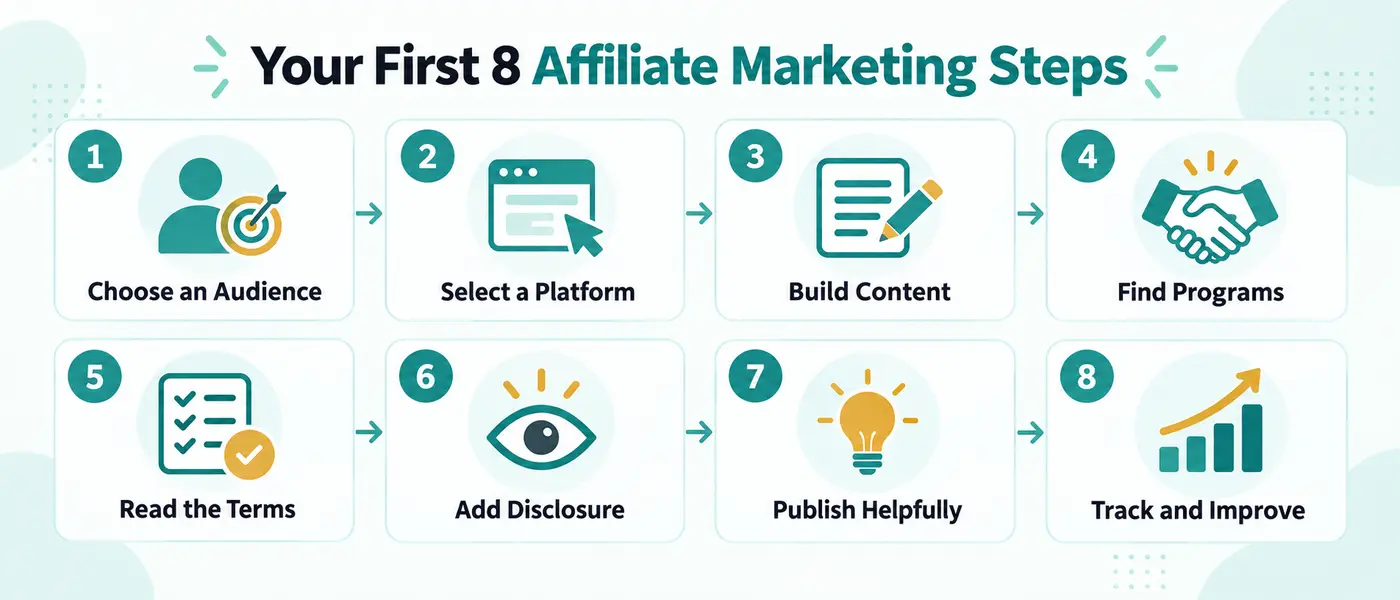
Build in a simple order: choose the audience, select one platform, publish a small content base, find relevant programs, read the terms, disclose the relationship, and review what happens. Each step gives the next one more context.
Affiliate marketing can support a long-term content business, but it is not guaranteed income. Tracking can fail, program terms can change, commissions can be delayed or reversed, and readers will make their own decisions. Keep essential finances separate from expected earnings and treat reported commissions cautiously until they are approved and paid.
You do not need to look established before you begin. You need to be accurate, transparent, and useful. Start small enough to review your work carefully. Let the reader’s needs—not the advertised commission—decide which products deserve a place in your content.
Frequently Asked Questions
Can I start affiliate marketing with no experience?
Yes. You can begin by learning the basic model, choosing a specific audience problem, and creating useful content. Do not claim experience you do not have, and do not treat affiliate marketing as guaranteed or immediate income.
What should a beginner do first in affiliate marketing?
Define who the content is for and which problem it will help solve. This decision guides the niche, platform, content topics, and affiliate programs you may later consider.
Do I need a website to start affiliate marketing?
Not every program requires a website. Some permit video, newsletters, podcasts, or social media. A website can provide more control over long-form content, but you must check the promotional methods allowed by each program.
How many affiliate programs should a beginner join?
One or two relevant programs are usually enough at the beginning. A small number makes it easier to understand the terms, test links, maintain accurate content, and notice changes.
Do I need a large audience before I apply?
Not always. Requirements vary. Some programs care more about content quality, topic fit, traffic source, and compliance than audience size. Review the current eligibility rules before applying.
How soon can a beginner earn an affiliate commission?
There is no reliable timetable. Results depend on traffic, audience fit, content quality, purchase intent, program rules, and correct tracking. A commission is not confirmed income until it is approved and paid.
What type of affiliate content should I create first?
Start with a foundational guide, tutorial, comparison, checklist, or mistakes article that answers a real audience question. The content should still be useful if the reader decides not to purchase.
Where should an affiliate disclosure appear?
Place a clear disclosure where readers will notice it before or near the affiliate recommendation. Do not rely only on a separate legal page, footer, or hidden description. Check the rules for your country, platform, audience, and affiliate program.