

How to Choose a Niche for Affiliate Marketing
Choosing a niche becomes easier when you start with a reader and a decision they need to make. A large market or an attractive commission tells you very little about whether you can create useful content for that person.
To choose an affiliate marketing niche, define an audience, identify a recurring problem, investigate the questions people ask, and check whether you can evaluate relevant products responsibly. Then test your direction with a small group of useful articles before committing to a large content plan.
This guide walks through that process with examples and a practical first research session. If you are still learning the business model, start with what affiliate marketing is and how it works.
Table of Contents
What a Niche Really Means
A niche gives your content a clear purpose: helping a particular group of people deal with a related set of problems. It guides which questions you answer, what evidence you collect, and which recommendations belong on your site.
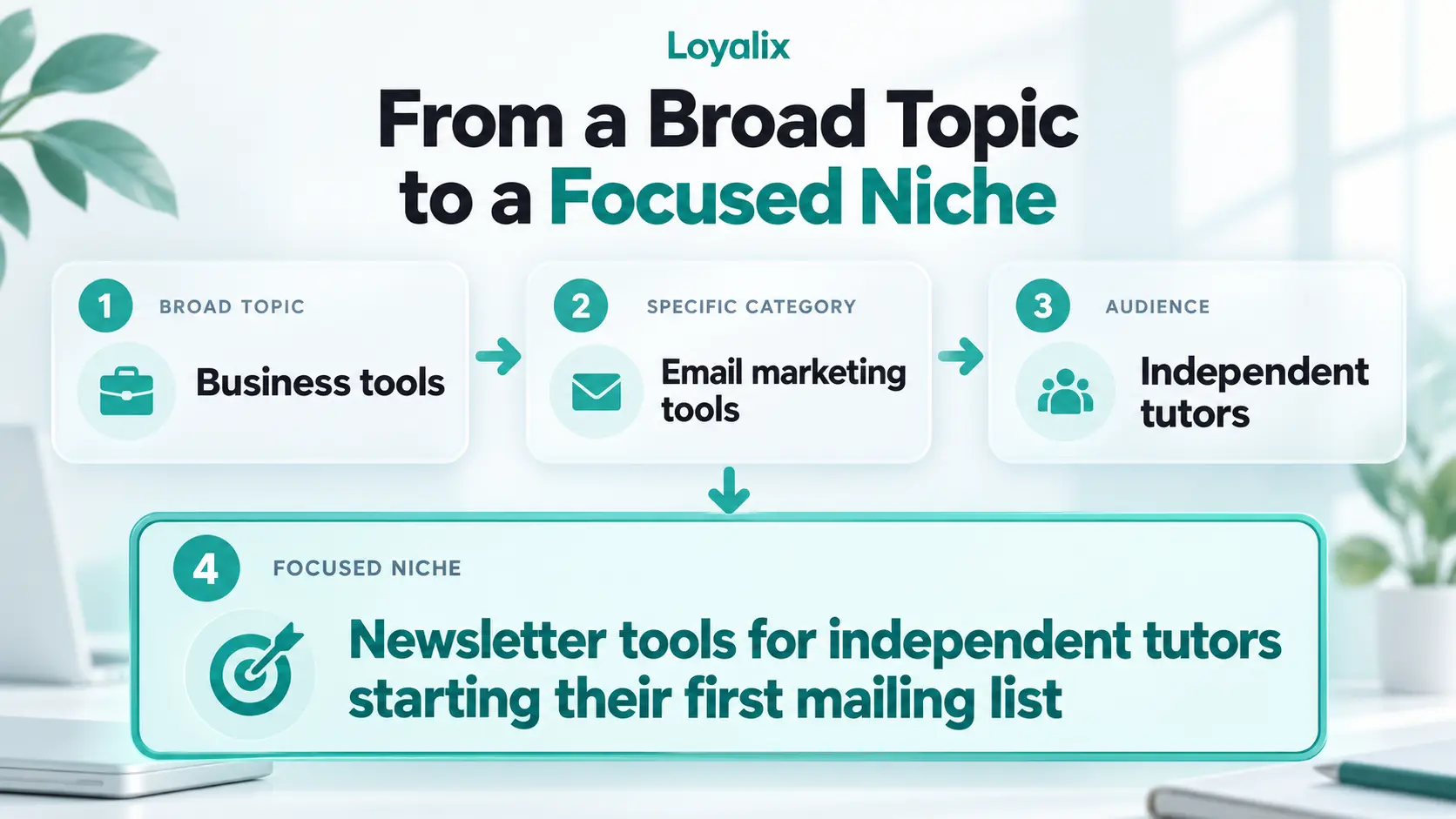
A useful starting formula is audience + recurring problem + context. For example, “business software” covers many unrelated needs.
“Simple newsletter tools for independent tutors starting their first mailing list” identifies a reader, a task, and a starting point.
That focus could support tutorials on creating a signup form, comparing sending limits, or exporting subscribers. Affiliate links may fit some of those decisions. Other articles may be entirely educational and need no product recommendation.
How Broad Should Your Niche Be?
Choose a scope that lets you understand your readers without trapping the site inside one product or feature. You can begin with a focused content cluster and expand when related questions become relevant.
| Starting idea | Main difficulty | A more useful direction |
|---|---|---|
| Online business tools | Readers have very different tasks, budgets, and experience. | Newsletter tools for independent tutors building their first mailing list. |
| Gardening | The topic spans many climates, spaces, and skill levels. | Container gardening for renters with small balconies. |
| One software discount | The site depends heavily on one offer and its changing terms. | Choosing and using that category of software for a defined audience. |
These examples show possible scope, not researched market opportunities. A narrow subject can still support substantial work if its readers face enough distinct decisions. A long list of slightly different article titles does not establish that depth.
Start With Three Possible Niches
Write down a short list before you choose a domain, buy tools, or apply to programs. Three candidates are enough for a manageable comparison; you do not need an exhaustive list.
Start from Experience
Consider a task you already handle. You may be able to show a real setup, explain an awkward step, or compare alternatives. Identify the limits of your experience as carefully as its strengths.
Start from a Recurring Problem
Look for a decision people make repeatedly: choosing a newsletter service, organising a small workspace, or keeping balcony plants alive in a particular climate. Define the circumstances that make the problem specific.
Start from an Interest You Can Investigate
An interest can become a workable direction when you can research it consistently and collect useful evidence. Check the time and cost of learning before assuming you can publish product comparisons.
For each candidate, describe the audience, the problem, and one article you could substantiate. If all three descriptions could apply to almost anyone, narrow the context before comparing them.
Compare Your Options With a Practical Checklist
Use the same questions for every candidate. Record what you know, the evidence behind it, and what remains uncertain. A simple “clear,” “uncertain,” or “not currently workable” is more useful than a precise-looking score based on guesses.
Can You Describe a Reader and a Specific Decision?
“Beginners” is a starting label, but it rarely tells you enough. A tutor sending a monthly update has different needs from an online store running daily promotions. Describe what the reader wants to do, their constraints, and what they need to understand before spending money.
Do Real Questions Appear Across More Than One Source?
Search suggestions, relevant discussions, product support pages, and existing search results can reveal useful wording and recurring problems. Record the question and its source. Check whether it reflects a task, a comparison, or a purchase decision.
These are research clues, not proof of search volume or willingness to buy. A discussion may be old or unrepresentative. If you use Google Trends, remember that its values show relative interest rather than absolute search counts; limited data can also leave a narrow topic without a useful chart.
Can You Produce Evidence Beyond a Product Description?
List what you could show: an actual workflow, original screenshots, a documented comparison, or a clearly explained limitation. Then estimate what access would cost. If meaningful testing requires several expensive subscriptions, that affects whether the niche fits your present resources.
When you have not tested a product, identify the basis of your assessment and avoid writing as though you used it. The guide to writing a trustworthy product review explains how to separate experience, research, and conclusions.
Can You Offer a Useful Angle Within Your Capacity?
Review the pages readers already find. Look for a specific task you could explain more clearly, a missing limitation, or an audience whose circumstances receive little attention. A market with established publishers is not automatically closed, and an apparent gap is not automatically an opportunity.
Ask whether you can maintain the content with the time, budget, and knowledge you actually have. For subjects that can materially affect health, finances, or safety, stronger expertise and source checking may be necessary. Learning in public does not justify unsupported advice.
Are There Relevant Products You Could Recommend Responsibly?
Check whether readers sometimes need a paid solution and whether credible alternatives exist. Keep useful free options in the comparison, even when they pay no commission. Record countries served, important limitations, and any doubts about the product.
Some useful topics have limited affiliate potential. That is a commercial constraint to recognise before building an affiliate-led project, not a reason to invent recommendations.
Can You Reach These Readers and Keep the Material Current?
Identify a plausible route to readers, such as answering specific search questions or contributing useful content on a platform you can maintain. Check community rules before sharing links. Note how often the products, prices, or underlying advice may need updating.
A One-Hour First Check Before You Commit
An hour can help you screen an idea and find unanswered questions. It cannot establish that a niche will rank, attract buyers, or earn income. Treat the session as a first check, then investigate the most important uncertainties.
Minutes 0–10: Define the Audience
Write one reader, one recurring problem, and the circumstances that matter. For the tutor example, the task might be sending a small monthly newsletter without a complex automation setup.
Minutes 10–25: Collect Questions and Inspect Results
Find a handful of distinct questions across search results and relevant discussions. Save their sources. Look at what the strongest pages already answer and what useful evidence you could add.
Minutes 25–40: Check Product Options
Inspect a few relevant products on their official sites. Note their purpose, current pricing structure, free options, and major limits. If affiliate terms are public, check whether your proposed content and audience could fit.
Minutes 40–50: Check Your Evidence and Costs
Choose one task you could demonstrate. Record the access, time, and expense it would require. Mark features you could only describe from documentation.
Minutes 50–60: Make a Provisional Decision
Choose “test this direction,” “research one uncertainty,” or “set it aside.” Write the reason. A promising idea with unavailable test access may need to wait.
Keep a short research record: candidate, audience question, source and date, product options, evidence you can create, unresolved issue, and next action. This gives you something concrete to review instead of relying on enthusiasm alone.
Common Niche Mistakes to Avoid
Choosing the commission before the audience
An advertised rate does not show whether your readers need the product, whether their purchases qualify, or whether your content can help them decide. Begin with the reader’s task and investigate the complete offer.
Treating suggestions or an idea count as validation
Thirty possible titles can still describe the same question repeatedly. A search suggestion can reveal wording without proving a viable market. Look for distinct needs, credible sources, and a realistic way to provide useful answers.
Building everything around one brand
A brand-focused tutorial series can be helpful, but relying entirely on one affiliate program creates a dependency. Offers, eligibility, products, and terms can change. Keep the audience’s wider problem visible and make room for alternatives.
Trying to cover every adjacent topic immediately
Start with a connected group of decisions. Add a neighbouring subject when the same readers need it, and you can cover it responsibly. The wider guide to affiliate marketing mistakes beginners should avoid explains how early choices affect content, programs, and tracking.
Write a Useful Niche Statement
For example: “I help independent tutors choose and use simple newsletter tools through setup walkthroughs, clearly documented comparisons, and explanations of plan limits.”
Use the statement to assess future ideas. An article about creating a signup form belongs naturally. A promotion for an unrelated investing app needs a separate justification; the existence of a commission is not enough.
Niche Examples and Their Trade-Offs
The following are illustrative directions to investigate, not researched recommendations or predictions of profitability.
Newsletter Tools for Independent Tutors
Content: a first signup form, subscriber exports, and small-list plan comparisons. Possible offers: email services or form tools. Trade-off: credible comparisons need test access and regular checks of changing limits.
Container Gardening for Balcony Renters
Content: choosing containers, arranging a small space, and documenting a growing season. Possible offers: relevant containers and gardening supplies. Trade-off: climate, seasonality, delivery regions, and your own growing conditions affect recommendations.
Small Home-Office Setups for Freelancers
Content: measuring limited desk space, comparing equipment dimensions, and showing cable organisation. Possible offers: suitable desk accessories. Trade-off: physical testing can cost money, and comfort or health claims need careful support.
Notice how the evidence changes between niches. A software walkthrough needs a reproducible workflow; a gardening article may need observations across a season. Choose a direction whose evidence you can reasonably collect.
Check Affiliate Programs Before Building Around Them
Once a candidate looks workable, use a separate program check. A suitable product may have no affiliate program, a closed application process, or terms that do not fit your site.
- Confirm that the product serves the audience and is available where relevant readers live.
- Read application requirements, qualifying actions, attribution rules, payout conditions, and promotion restrictions.
- Check whether you can describe limitations and alternatives honestly while following the agreement.
- Keep a record of the official source and date. Finding a publicly listed affiliate program does not mean you have been accepted into it.
Start by finding affiliate programs that fit your niche and audience, then use the guide to reading affiliate program terms for a detailed review.
You can publish useful educational content and link to official product information before approval. Add an affiliate link only when participation and the proposed placement are permitted, with a clear disclosure of the relationship.
Build a Small Content Pilot
Before planning months of publishing, create a small connected group of articles. A practical pilot could contain three different reader tasks:
- Understand the problem. Example: “What Does a Tutor Need Before Starting a Newsletter?”
- Complete one task. Example: “How to Create a Simple Newsletter Signup Form.”
- Make a decision. Example: “How to Compare Email Tools for a Small Tutoring Business.”
These are illustrative titles, not three versions of the same article. Use the pilot to learn whether you can produce useful evidence, keep the articles distinct, and maintain a manageable workload.
Record publication dates, the questions covered, and any relevant feedback or search queries as they become available. A new site may have little data; a short period without traffic is not a reliable verdict on the niche. Revisit the question, content quality, and route to readers before changing direction.
For the next planning stage, use the affiliate marketing content plan to organise a connected publishing sequence.
Choose a Direction You Can Test
A workable starting niche gives you a recognizable audience, useful questions to answer, and an affordable way to gather evidence. Its commercial opportunities should support that work without deciding every topic you publish.
Your next step: compare a short list using the same checklist, record the biggest uncertainty, and outline one article you can substantiate. You can refine the scope as you learn more about the people you want to help.
Frequently Asked Questions
How do I choose a niche for affiliate marketing as a beginner?
Define an audience and a recurring problem, investigate real questions, check your ability to create useful evidence, and review relevant product options. Test the direction with a small content pilot before committing to a large publishing plan.
What makes an affiliate niche profitable?
Revenue depends on reaching relevant readers, helping with real decisions, suitable offers, eligible tracked actions, costs, and program terms. A high commission or a popular topic alone does not establish profitability, and income is not guaranteed.
Should I choose a niche based on passion or profit?
Consider interest, knowledge, audience needs, evidence you can produce, and commercial fit together. Interest can support continued learning, but it does not prove demand. An attractive offer does not make a topic suitable if you cannot cover it responsibly.
How narrow should my affiliate marketing niche be?
Choose a scope that makes the audience and its decisions clear while leaving room for distinct useful articles and alternatives. There is no universal requirement to list 30 topics. Check whether the questions are genuinely different and feasible for you to cover.
Can I change my niche later?
Yes. You can refine the audience or expand into related needs as you learn. For an existing site, review useful content, reader expectations, and actual performance before deleting pages or changing URLs. A gradual adjustment may be more practical than starting over.
How do I know whether a niche has demand?
Look for recurring questions across relevant discussions, search results, support resources, and direct audience feedback. Treat suggestions and Google Trends as clues rather than proof of sales or exact search volume. Keep sources and dates so you can review your assumptions.
Can I validate an affiliate niche in one hour?
You can use an hour for an initial screen: define the audience, collect questions, inspect product options, and estimate the evidence you could create. Meaningful validation usually requires further research, published work, and feedback. The session cannot predict rankings or income.
Final Thoughts
Choosing a niche for affiliate marketing starts with understanding who you want to help and which decisions they need to make. Look for recurring questions, relevant product options, and a realistic way to create useful content within your time and budget.
Before committing to a large publishing plan, test one direction with a small group of connected articles. Keep a record of your sources, the evidence you can provide, and the questions that still need research. Use what you learn to refine your focus.