

How to Write a Trustworthy Product Review Without Hype
A product review can help a reader avoid an expensive mistake, understand an unfamiliar tool, or confirm that a service fits a real need. It can also lose trust quickly when it sounds more certain than the evidence allows. A page filled with praise, repeated feature lists, and urgent buttons may look like a review, but it does not help someone make an informed decision.
A trustworthy product review explains what was evaluated, how the evaluation was performed, what evidence supports the main claims, and where the product has limits. It distinguishes documented facts from personal experience and editorial judgment. If affiliate links or another commercial relationship are involved, the review makes that relationship easy to notice.
This guide provides a repeatable process for reviewing software, online services, memberships, and other products. It is written for beginners, but the same standard can support future Loyalix reviews and comparisons. The aim is not to remove every opinion. A useful review needs judgment. The aim is to show readers where that judgment came from and which conditions might change the conclusion.
Table of Contents
What Makes a Product Review Trustworthy
A trustworthy review helps a reader answer a practical question: does this product fit my situation, priorities, and constraints? The answer may be yes, no, or only under certain conditions. The review earns trust by making those conditions visible.
Google recommends evaluating products from a user perspective, showing knowledge of the subject, providing evidence of first-hand experience, using measurements where they are useful, explaining differences from alternatives, and discussing benefits and drawbacks based on original research. These principles support readers even when search visibility is not the main goal.
A review also has a distinct job within an affiliate content system. Our guide to affiliate content types explains the difference between reviews, comparisons, tutorials, and resource pages. A review evaluates one product closely. It should not become a general tutorial with a few opinions added at the end, or a comparison that uses different criteria for every option.
Readers should be able to identify five things without guessing:
- what product, version, plan, and date the review covers
- whether the reviewer used, tested, researched, or only observed the product
- which criteria shaped the evaluation
- which strengths and limitations matter for the intended reader
- whether money, free access, gifts, or affiliate commissions are connected to the recommendation
Start With a Real Reader Question
Do not begin with the product page. Begin with the decision the reader needs to make. A broad question such as “Is this tool good?” creates a vague review. A specific question creates useful boundaries.
For example, a beginner may want to know whether a website builder is manageable without coding, whether the free plan is enough for a first project, or whether important work can be exported before cancellation. A small business may care more about user roles, support, invoices, data handling, and predictable renewal costs. The same product can produce different conclusions for those readers.
Write one primary reader question before you test anything. Then record the reader, use case, budget range, required features, important limits, and alternatives already available. This prevents the review from rewarding features that look impressive but do not solve the reader’s problem.
Product relevance should also be established before the review begins. How to Find Affiliate Programs That Fit Your Niche and Audience explains why audience fit comes before commission size. The same rule applies here: a product should appear because it answers a real reader need, not because it offers an attractive payout.
Define Your Relationship With the Product
The most serious error in a review is not an imperfect opinion. It is allowing readers to assume experience that did not happen. State the relationship accurately and use language that matches it.
| RELATIONSHIP | WHAT IT MEANS | REQUIRED WORDING |
|---|---|---|
| Used in normal work | You used the product for real tasks over a meaningful period. | Describe the tasks, period, plan, and limits of your experience. |
| Structured test | You created an account and completed a defined test. | Name the test date, version, plan, tasks, and environment. |
| Limited trial | You explored part of the product but could not test important areas. | Explain what was and was not available. |
| Documented overview | You relied on official pages, terms, demonstrations, or support answers. | Do not call it a hands-on review or imply personal use. |
| Sponsored or gifted access | The company provided money, access, a product, travel, or another benefit. | Disclose the benefit clearly and explain whether the company had editorial control. |
Free access does not remove the need for transparency. A free license, extended trial, early access, gift, discount, payment, or affiliate relationship may affect how readers interpret the recommendation. Record the arrangement before writing so the disclosure does not become an afterthought.
Build a Review Method Before Writing
A review method is a short plan that defines what will be checked and how evidence will be recorded. It keeps the evaluation consistent and reduces the temptation to change the criteria after seeing the result.
Use criteria that match the reader question. A beginner-focused software review may include setup, completion of the core task, instructions, pricing clarity, export, support, privacy controls, downgrade, and cancellation. A physical product may require different measures such as dimensions, durability, comfort, maintenance, compatibility, or return conditions.
| AREA | QUESTION | EVIDENCE TO RECORD |
|---|---|---|
| Setup | Can the intended reader create and configure the account? | Steps, time, verification requirements, blocked points |
| Core task | Can the product complete the job the reader cares about? | Defined task, result, errors, required workarounds |
| Usability | Can a beginner find and repeat the main workflow? | Navigation notes, documentation used, repeated task |
| Limits | What blocks normal use or requires an upgrade? | Usage caps, missing features, plan restrictions |
| Cost | What will the reader realistically pay? | Plan, billing cycle, tax, add-ons, renewal, overage |
| Data and access | What information does the product receive and who can control it? | Permissions, roles, retention, export, deletion information |
| Support | Can a specific problem be resolved? | Documentation result, response channel, dated support test |
| Exit | Can the reader downgrade, export, and cancel safely? | Export opened, cancellation route, post-cancellation access |
Do not turn the criteria into a decorative score. A numerical rating is useful only when the method explains what the number means and applies it consistently. In many beginner reviews, a clear conclusion with evidence is more honest than a precise-looking score.
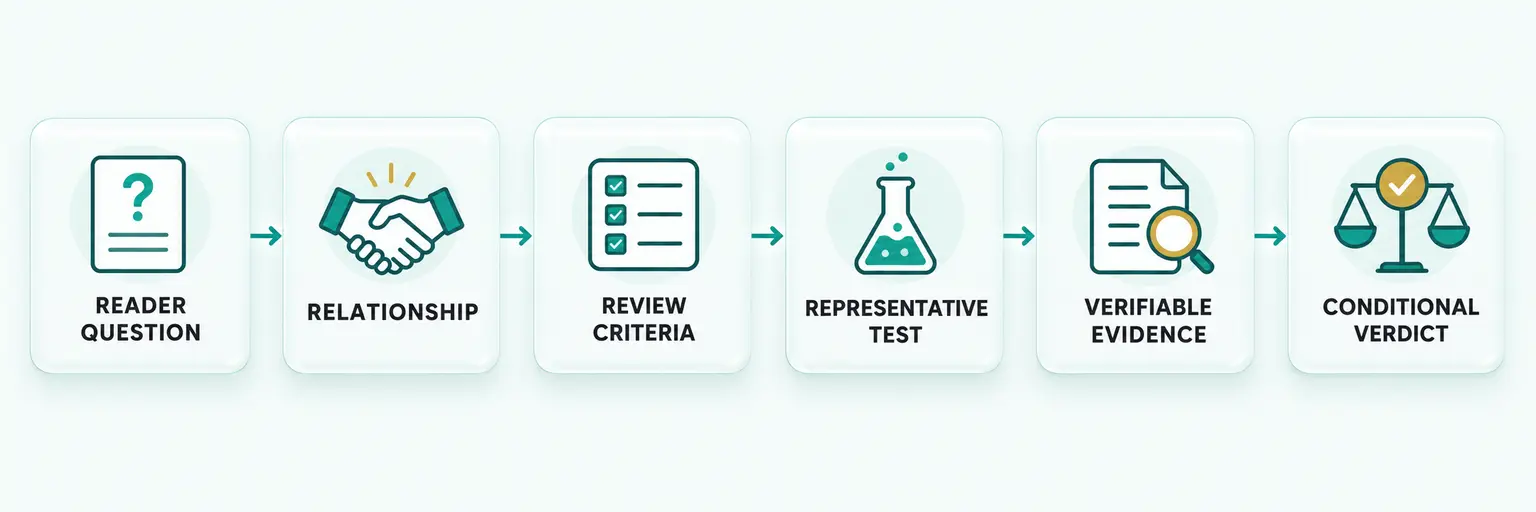
Test the Product With Representative Tasks
A feature list shows what the provider says is available. A test shows what happened when a reader-like task was attempted. Choose tasks that reflect normal use rather than unusual demonstrations designed to make the product look impressive.
A structured software test can include four parts:
- one normal task that represents the main use case
- one edge case that may expose a limit
- one incomplete or incorrect input to see how the product responds
- one repeated task to check whether the result is reasonably consistent
Record the date, device, browser or operating system when relevant, account type, plan, input, output, time required, errors, and any help used. Hide personal information, account identifiers, customer data, and security details before capturing screenshots.
Do not test only the polished path shown in a company demonstration. Try the steps a beginner must actually complete. If the product needs an integration, payment method, domain, data import, or verification step, that requirement belongs in the review because it changes the real workflow.
Separate Facts, Experience, and Editorial Judgment
Readers need to know which statements can be verified, which describe one test, and which express an evaluation. Mixing these categories creates false certainty.
Documented Facts
Documented facts include current plan names, listed features, supported platforms, usage limits, renewal periods, official policies, and published technical requirements. Link to the source and add a checked date when the detail can change. Do not copy a marketing claim as though Loyalix independently proved it.
Observed Experience
Observed experience describes what happened during a real use period or structured test. Use boundaries such as “during our test,” “on the free plan checked on 2 October 2026,” or “in this workflow.” A successful result on one device, project, or account does not prove that every user will receive the same result.
Editorial Judgment
Editorial judgment explains what the evidence may mean for the intended reader. Phrases such as “may suit,” “is easier to justify when,” or “may be a poor fit for” preserve the conditions behind the conclusion. Avoid guaranteed outcomes, universal claims, and labels such as “best” unless you clearly define the comparison set and criteria.
Use a Simple Claim Check
Before publishing an important statement, ask:
- Is this a provider claim, an observed result, or our judgment?
- What evidence supports it?
- What date, plan, version, region, or condition limits it?
- Could a reasonable reader understand it as a guarantee?
- Does the linked source say the same thing?
Explain Who the Product Is For
A review becomes more useful when it identifies fit instead of searching for one universal verdict. Describe the reader most likely to benefit, the conditions that make the product practical, and the cases where another approach may be safer or simpler.
A clear fit statement can address experience level, project size, budget, required features, team structure, region, language, data sensitivity, and tolerance for manual work. It should also identify a “not for” group. For example, a simple tool may suit a solo beginner but be a poor fit for a regulated team that needs detailed roles, audit logs, and contractual controls.
Avoid identity-based assumptions that are unrelated to the product. Focus on the task and constraints. “Suitable for beginners who need one landing page” is useful. “Perfect for everyone starting a business” is not.
Review Pricing, Terms, and Total Cost
The visible monthly price rarely explains the full decision. Record the currency, tax treatment, billing cycle, renewal amount, user limits, usage caps, storage, add-ons, overage fees, required integrations, and support level. If the price is promotional, show when the normal rate begins.
Explain which plan was tested and which features were confirmed only through official documentation. Do not present a premium feature as tested when the review used a free account. If a company changes prices by region or account type, say so rather than publishing one number as universal.
For a focused plan decision, link readers to Free vs Paid Business Tools. When affiliate terms affect the recommendation, use How to Read Affiliate Program Terms Before You Join as the internal standard for checking restrictions, attribution, payout conditions, and change notices.
Use a dated total-cost example only when the inputs are clear. A helpful calculation may include the base plan, tax, required add-ons, expected usage, extra users, migration work, and internal review time. Do not call a product “cheap” or “expensive” without explaining the relevant use case and comparison.
Show Strengths, Limitations, and Alternatives
Balanced does not mean inventing one weak criticism for every benefit. It means reporting the material evidence that could change the decision. A limitation deserves attention when it affects the core task, cost, data, access, support, reliability, or exit process.
Describe strengths with the same precision. Replace “excellent support” with what was tested: which channel was available, what question was asked, how long the response took, and whether the answer solved the issue. Replace “easy to use” with the steps a beginner completed and the help required.
Alternatives help readers understand the boundary of the recommendation. Include another product, a free plan, a manual process, an existing tool, or the option to delay the purchase. Explain the trade-off rather than naming competitors only to create another affiliate link.
If the product failed an important task, report the failure fairly. Recheck the instructions, repeat the test when reasonable, record the environment, and ask support if the result could reflect a setup error. Do not remove the result merely because it weakens the recommendation.
Use Evidence Readers Can Verify
Evidence should support the claims that matter most. It does not need to turn the article into a technical report. Use the smallest amount of evidence that lets a reader understand and verify the conclusion.
- Original screenshots that show the tested workflow without exposing private data
- Dated notes about the plan, version, device, task, and result
- Measurements that match the decision, such as time, steps, limits, or export fields
- Links to official pricing, documentation, terms, privacy information, and support pages
- A short explanation of what could not be tested
Use company-provided images only when the license or permission allows it, and label them when necessary. Do not present a polished promotional screenshot as evidence of your own experience. If an image contains results, verify that the surrounding text explains the date and conditions.
Keep an evidence file for each review. It can contain source URLs, screenshots, test notes, support messages, plan details, disclosure information, and the next review date. This makes later updates faster and reduces the risk of leaving an unsupported statement on the public page.
Add a Clear Affiliate Disclosure
A disclosure should help a reader understand the commercial relationship before the recommendation can influence the decision. A disclosure page in the footer may provide useful detail, but it does not replace a clear notice near the review or affiliate links when applicable.
The U.S. Federal Trade Commission explains that material connections should be disclosed clearly and conspicuously. Its guidance also warns that a platform’s built-in disclosure tool may not always be sufficient. The European Commission’s Influencer Legal Hub explains that affiliate marketing and other advertising relationships must be disclosed under applicable EU consumer rules. Requirements can differ, so use current official guidance for the audience, platform, and country involved.
A plain example for a Loyalix article is:
Disclosure:
This article contains affiliate links. Loyalix may earn a commission if you purchase them. Our evaluation is based on the criteria and evidence explained in this review.
Adjust the wording when the company provided free access, payment, a gift, early access, or editorial input. Place the disclosure where readers will notice it before or close to the first relevant recommendation. Check mobile visibility and repeat or adapt the disclosure for video, email, and social posts when necessary.
Write a Call to Action Without Pressure
A review may include a link to learn more, check current pricing, start a trial, or compare alternatives. The call to action should match the conclusion and preserve the reader’s ability to pause.
Useful calls to action include: “Check the current plan limits,” “See whether the free plan covers your required task,” and “Compare the cancellation and export terms before upgrading.” Avoid false deadlines, guaranteed outcomes, unexplained scarcity, and repeated buttons that interrupt the evaluation.
For a broader trust-first approach, see How to Improve Affiliate Conversions Without Being Pushy. A reader who understands the fit, limits, and next step is more valuable than a click produced by anxiety.
Keep the Review Current
A review can become misleading even when it was accurate on publication day. Prices, plan names, features, ownership, support channels, integrations, privacy terms, affiliate conditions, and cancellation processes can change.
Add a “Checked on” date for changeable facts and schedule the next review. High-impact claims about price, availability, security, refunds, eligibility, data, or legal conditions deserve closer review than a general description. Update the article sooner when the provider announces a material change or readers report a problem.
The same discipline applies after joining an affiliate program. Use How to Monitor an Affiliate Program After You Join to track changes to terms, links, products, payouts, restrictions, and disclosure duties.
Keep a short update log with the date, source, affected claim, change made, and next review. If the product has changed so much that the original evidence is no longer representative, retest the core workflow rather than editing a few sentences around outdated conclusions.
Common Product Review Mistakes
Writing the Verdict Before Testing
Starting with a desired recommendation encourages selective evidence. Define the reader question and method first.
Repeating the Product Page
A feature list does not show how the product performs in a real workflow. Add original testing, analysis, or decision support.
Implying Experience That Did Not Occur
Research can support an overview, but it should not be described as hands-on use. State the relationship accurately.
Using Different Standards for Affiliate Products
Apply the same criteria whether a product pays a commission or has no affiliate program.
Hiding Material Limitations
Readers need the limits that may change their decision, especially around cost, data, access, reliability, and cancellation.
Using a Rating Without a Method
A score looks precise but can mislead when criteria, weights, and evidence are not explained.
Placing Disclosure Where Readers Miss It
A footer link or vague phrase may not explain the relationship before the recommendation. Use plain, visible wording.
Leaving the Review Unchanged for Years
Schedule updates and retest material workflows when the product changes.
Trustworthy Product Review Checklist
Use this checklist before publishing or updating a review:
Frequently Asked Questions
Can I write a product review without using the product?
You can write a documented overview based on reliable sources, but you should not call it a hands-on review or imply personal experience. Explain what was researched, what could not be tested, and which conclusions remain limited.
How long should I test a product before reviewing it?
There is no universal period. Test long enough to complete the main workflow, repeat important tasks, encounter realistic limits, check support or documentation, and understand export and cancellation. A narrow product may require a shorter test than a tool used in a complex business process.
Does using an affiliate link make a review biased?
An affiliate link creates a commercial incentive, but it does not automatically make the review unreliable. Disclose the relationship, use the same criteria for affiliate and non-affiliate products, preserve negative findings, and keep the recommendation tied to evidence.
Should every product review include a score?
No. A score is useful only when the criteria and meaning are clear and consistently applied. A conditional conclusion may be more informative than a number that looks precise but hides important trade-offs.
Do I need to include negative points in every review?
Include material limitations that could change the reader’s decision. Do not invent criticism to create artificial balance, but do not hide cost, usability, data, support, reliability, or cancellation problems.
Where should an affiliate disclosure appear?
Place it where readers can notice it before or close to the recommendation or affiliate link. A general disclosure page can provide more detail, but it may not replace a clear disclosure within the review. Check the rules that apply to the audience, country, and platform.
Can I use screenshots from the product company?
Check the provider’s license, media policy, terms, or permission before using company images. Original screenshots from your test can provide stronger evidence, but remove personal data, account details, customer information, and security-sensitive content.
How often should a product review be updated?
Review it when prices, features, terms, ownership, support, integrations, privacy information, or cancellation processes change. Also schedule periodic checks based on how important the product is and how often it changes.
What is the difference between a review and a comparison?
A review evaluates one product against a defined reader need and method. A comparison evaluates two or more options using the same relevant criteria. A review may mention alternatives, but its main purpose remains the close evaluation of one product.
Final Thoughts
A trustworthy product review does not require dramatic language or a perfect product. It requires a clear reader question, an honest account of the reviewer’s relationship with the product, a method that matches the decision, and evidence strong enough to support the main claims.
Test what matters—separate facts from experience and judgment. Explain the cost, limitations, alternatives, and exit conditions. Disclose commercial relationships where readers can see them. Then keep the review current as the product changes.
The final recommendation should be easy to explain: who the product may suit, under which conditions, and what the reader should check before deciding. That standard protects the reader and gives Loyalix a consistent foundation for future product reviews.