

Saving vs Investing: How to Decide What Comes First
A person can be responsible with money and still feel uncertain about one basic decision: should they save or invest it? People often present one choice as cautious and the other as ambitious. That framing is misleading.That framing is misleading. Saving and investing have different jobs, different risks, and different timelines.
Saving usually protects access and stability. It can support an emergency, a bill due soon, a planned purchase, or any goal where losing part of the money would create an immediate problem. Investing accepts uncertainty in exchange for the possibility of growth. It may suit longer-term goals when the money can remain invested through market changes and the owner can tolerate a loss.
The decision should therefore begin with the goal, not with a product, app, interest rate, or market prediction. One household may need to save for a repair, keep a separate emergency reserve, and invest for retirement at the same time. Each amount of money can have a different job.
This guide provides a calm framework for deciding what may come first. It covers goals, time horizon, access, emergency savings, debt, risk tolerance, risk capacity, inflation, and the practical questions to answer before opening an account or buying an investment.
EDUCATIONAL NOTE
This article provides general educational information and is not personal investment, financial, tax, or legal advice. Saving products, investment products, taxes, deposit protection, investor protection, and access rules vary by country and provider. Investing involves risk, including possible loss of principal. Verify current information and consider qualified help when a decision depends on your circumstances. |
Table of Contents
What Saving vs Investing Really Means
Saving and investing both move money away from immediate spending, but that similarity is only the beginning. The important difference is what happens next and what risks the goal can accept.
Saving Prioritizes Stability and Access
Saving generally means keeping money in a place designed for access and capital stability. Depending on the country and product, that may include a transaction account, savings account, term deposit, or another cash-equivalent arrangement. The return may be modest, and access may still be limited by notice periods, maturity dates, fees, or provider rules.
The value of savings is not measured only by the interest rate. Savings can prevent a financial shock from becoming debt, protect a fixed-date goal, and give a household time to make a careful decision. Money that must be available tomorrow performs an important job even when it is not producing the highest possible return.
Investing Accepts Uncertainty for Potential Growth
Investing means placing money into an asset or financial product that may produce income, rise in value, or both. The result is uncertain. The value can fall, income can change, fees can reduce returns, and the investment may be difficult or costly to sell when the money is needed.
The Loyalix guide to investing for beginners explains the basic structures, risks, costs, and research steps. This article focuses on the earlier decision: whether a particular goal is ready for investment risk at all.
Neither Choice Is Automatically Better
A savings account is not a failed investment account, and an investment portfolio is not a better emergency fund. The correct choice depends on the job. A low return may be acceptable when stability and quick access are essential. Market risk may be reasonable for a distant, flexible goal, but not for rent due next month.
A useful decision asks: What must this money do, when must it do it, and what happens if its value falls before that date?
Give Every Goal a Job and Date
Money becomes easier to organize when each goal has a purpose, approximate amount, target date, and level of flexibility. Without those details, ‘save more’ and ‘start investing’ remain intentions rather than decisions.
Define the Purpose
Write what the money is expected to support. Examples may include an emergency reserve, annual insurance payment, home repair, education, business equipment, future housing, retirement, or another long-term priority. Do not combine all goals into one balance simply because they share the word ‘future.’
Set a Time Horizon
The time horizon is the period before the money may be needed. A goal due in a few months has a very different relationship with risk from a goal that may remain invested for decades. The date does not need to be exact, but it should be realistic enough to guide the decision.
Record How Flexible the Goal Is
A flexible goal may be delayed, reduced, or funded from another source. A fixed essential goal may not have that freedom. This difference matters. Two goals with the same date can support different risks when the consequences of falling short are different.
The Loyalix one-year personal finance plan can help separate immediate obligations, annual costs, financial protection, and longer-term priorities before money is assigned to saving or investing.
| Goal question | Why it matters |
|---|---|
| What is the money for? | Defines the job and prevents one balance from serving incompatible purposes. |
| When could it be needed? | Shows how much time exists to handle access restrictions or market losses. |
| Is the date fixed? | A fixed deadline usually reduces the amount of uncertainty the goal can accept. |
| Can the goal be reduced or delayed? | Flexibility may increase risk capacity, but it does not remove investment risk. |
| What happens if the money is lower at the wrong time? | Connects the financial decision to the real consequence of loss. |
Build a Basic Financial Foundation First
An investment decision does not exist separately from bills, debt, dependants, income stability, insurance, and access to emergency cash. A portfolio may be suitable in theory and still create pressure when the rest of the financial system is fragile.
Understand Cash Flow
Before assigning money to any goal, identify what normally comes in, which expenses are essential, which costs change, and which obligations are already committed. A contribution is not sustainable if it requires borrowing, delayed bills, or repeated withdrawals.
If the available amount is unclear, first track your spending and build a simple budget for beginners. The goal is not to create a perfect budget. It is to confirm that the money is genuinely available after normal needs and obligations.
Build Accessible Emergency Savings
Emergency savings are a cash reserve for unplanned expenses or financial shocks. Their main qualities are stability, appropriate access, and separation from normal spending. They can reduce the need to use expensive debt or sell investments during a market decline.
The Consumer Financial Protection Bureau explains that even a small dedicated reserve can help a person recover from an unexpected cost. The appropriate amount depends on the household, income pattern, essential expenses, dependants, insurance, and available support; there is no universal number that fits everyone.
Use the Loyalix guide to an emergency fund for beginners to define what counts as an emergency, choose a starter target, and keep the reserve separate from planned expenses.
Review High-Cost Debt
High-interest debt deserves explicit review before extra investment risk is added. A debt balance can create a contractual cost, while an investment return is uncertain. Paying down expensive debt may provide a more predictable improvement than hoping to earn a higher market return.
Investor.gov’s saving and investing roadmap includes reviewing finances, paying off credit cards or other high-interest debt, and saving for a rainy day before moving deeper into investing. This is a sequence to evaluate, not a rule that every debt must disappear before any investment contribution. Interest rates, employer benefits, taxes, liquidity, and personal circumstances may change the analysis.
Protect Essential Obligations
Consider known bills, taxes, housing, insurance, healthcare, dependants, and other obligations that could require cash. Investing is not a substitute for money already assigned to an essential payment. If one unexpected expense would force an immediate sale, the investment amount may be too large or the cash reserve may be incomplete.
When Saving Usually Comes First
Saving often comes first when the goal needs access, stability, or a dependable amount. The word ‘first’ does not necessarily mean forever. It means the current job cannot responsibly accept market uncertainty.
The Money Is an Emergency Reserve
Emergency money needs to be available when the emergency occurs, not only when markets are calm. Investing it can create a double problem: the expense arrives while the investment is below its purchase value, and the owner must sell at an unfavorable time.
The Goal Is Near or the Date Is Fixed
Money for a near-term or fixed-date obligation often needs stability. Examples may include a tax payment, tuition due soon, a necessary vehicle replacement, a lease deposit, or a planned medical cost. A short timeline leaves less opportunity to respond to market losses.
A Loss Would Disrupt Essential Life
The emotional willingness to take risk is not enough. If a loss would threaten housing, food, transport to work, healthcare, minimum debt payments, or another essential obligation, the money may not have the capacity to be invested.
Income or Expenses Are Unpredictable
Irregular income, seasonal work, upcoming leave, uncertain housing costs, or major family changes can increase the value of accessible savings. A larger buffer may provide decision time. The amount should reflect the actual pattern rather than a generic formula.
The Product or Risk Is Not Understood
Saving while learning is a valid decision. Urgency is not a requirement for responsible investing. If the account, provider, fees, liquidity, tax treatment, or potential loss cannot be explained clearly, the next step may be research rather than purchase.
When Investing May Be Appropriate
Investing may become appropriate when the financial foundation is stable enough, the goal is sufficiently distant or flexible, and the investor understands that loss is possible. These conditions do not guarantee a positive result. They make the risk more deliberate.
The Goal Is Long Term
A longer horizon may give a diversified portfolio more time to experience market cycles and recover from temporary declines. Time does not eliminate risk. Companies can fail, issuers can default, products can close, fees can compound, and permanent loss is possible. A long date supports patience; it does not create certainty.
The Money Is Not Needed for Essential Costs
Investment capital should be money whose temporary decline would not interrupt normal obligations. If the same amount is expected to pay an upcoming bill, it already has another job.
The Investor Can Accept Both Volatility and Loss
Market prices move. A suitable plan considers not only whether a person dislikes those movements, but whether the goal can financially withstand them. The decision should still make sense during a decline, not only after a strong year.
The Product and Costs Are Understood
Before investing, understand what the product owns or promises, how returns may arise, what can cause a loss, which fees apply, how it can be sold, how the provider is regulated, and which documents describe the risks. A familiar brand or simple app does not replace this review.
Why Time Horizon Matters More Than Labels
People often use labels such as ‘short term,’ ‘long term,’ ‘safe,’ or ‘conservative’ without defining them. Those words can hide important differences. A goal five years away may be flexible for one person and non-negotiable for another. A product described as low risk may still have access limits, inflation risk, credit risk, or market value changes.
Investor.gov’s introduction to investing explains that time horizon and personal risk tolerance help shape investment decisions. It also identifies asset allocation and diversification as important approaches to managing risk.
Use the Earliest Realistic Need Date
Do not base the plan on the latest possible date if the money may reasonably be needed earlier. A long headline goal can contain shorter deadlines. For example, retirement may be decades away, but a planned home purchase or education cost may occur much sooner.
Recheck the Horizon as the Goal Approaches
A goal does not keep the same risk capacity forever. As the need date approaches, the consequences of a market decline may become more serious. Review the plan at set intervals and after material changes rather than waiting until the money is needed.
Separate Risk Tolerance From Risk Capacity
Risk tolerance and risk capacity are related but different. Confusing them can lead to an investment that feels acceptable but does not fit the goal.
Risk Tolerance Is the Willingness to Accept Uncertainty
Risk tolerance describes how comfortable a person is with price changes, uncertainty, and possible losses. Experience, personality, recent market conditions, and how the question is presented can influence it. Someone may feel confident during rising markets and much less comfortable during a decline.
Risk Capacity Is the Financial Ability to Absorb a Loss
Risk capacity concerns goals and overall financial position. A person may be emotionally willing to take risk but unable to accept a loss because the money supports a fixed essential need. Another person may have greater financial capacity but still prefer a conservative approach.
FINRA notes that investment choices should reflect objectives, needs, time horizon, and tolerance for market changes. A useful review therefore considers both the person and the purpose of the money.
Can You Save and Invest at the Same Time?
Yes. The decision is not always sequential. A person may save for emergencies and annual bills while making a smaller long-term investment contribution. The important condition is that each goal remains identifiable and the combined amounts fit the budget.
Use Separate Buckets for Separate Jobs
A practical system may include a spending account, emergency savings, sinking funds for known costs, and investment accounts for longer-term goals. Separation makes it easier to see which money can be accessed, which money has a fixed date, and which money is exposed to market risk.
Do Not Let a Small Investment Replace the Foundation
Starting with a small investment can support learning, but it does not remove the need for emergency savings or a realistic budget. The order should not be chosen only for motivation or fear of missing out.
Choose Contributions That Can Survive an Ordinary Month
A plan is more useful when it can continue through normal expense changes. Leave room to reduce or pause optional contributions when income changes. Avoid treating a missed investment contribution as a reason to use debt for essential costs.
Use a Goal-by-Goal Decision Framework
The following framework can be applied to each goal separately. It does not produce a universal product recommendation. It shows which questions must be answered before the money is moved.
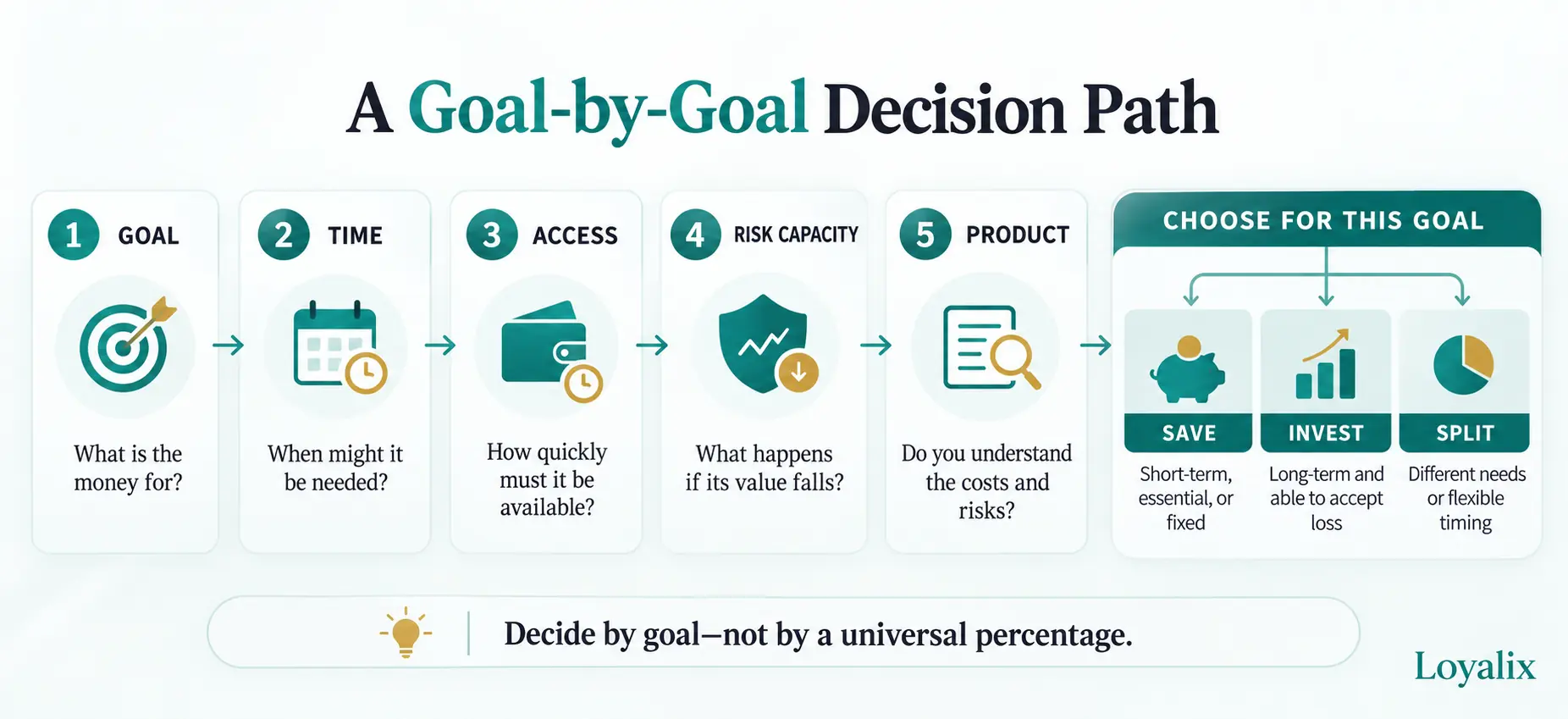
| Question | Saving may fit when… | Investing may fit when… |
|---|---|---|
| When is the money needed? | Soon, unexpectedly, or on a fixed date | The goal is longer term, and the date has some flexibility |
| How important is access? | Quick or predictable access is essential | The money can remain invested, and product liquidity is understood |
| What if the value falls? | A loss would disrupt the goal or essential life | The goal and wider finances can absorb a decline |
| What is the main purpose? | Protection, planned spending, or a near-term obligation | Potential long-term growth or income with accepted risk |
| Is the foundation ready? | Emergency savings or cash flow still needs strengthening | Normal expenses, emergency access, and key obligations are supported |
| Is the product understood? | Research is incomplete, or the risk is unclear | The product, fees, risks, access, and provider have been reviewed |
Saving vs Investing Examples
Examples make the framework easier to see, but they are not personal recommendations. Real decisions depend on the person, country, products, taxes, protections, and complete financial situation.
Example 1: An Emergency Car Repair
A worker depends on a car to reach work and has no other reliable transport. Repair costs could occur without warning. The money needs stability and fast access. Its job is emergency protection, so saving is more consistent with the goal than exposing it to market risk.
Example 2: A Fixed Payment Next Year
A household expects a large annual insurance or tax payment in twelve months. The date and amount are reasonably predictable. This is a planned expense, not an emergency and not long-term investment capital. A dedicated savings or sinking-fund approach keeps the purpose visible.
Example 3: A Flexible Goal Many Years Away
A person is building money for a goal that may be decades away, has accessible emergency savings, can continue paying normal obligations, and understands that market values can decline. Investing may be considered because the timeline and financial foundation can support uncertainty. The next task is to research account rules, diversification, fees, taxes, and suitable risk—not to assume any investment is automatically appropriate.
Example 4: Several Goals at Once
A family is rebuilding its emergency reserve, saving for a planned appliance replacement, and contributing toward a distant goal. It may use saving for the first two jobs and investing for the third. The split should follow the budget and risk capacity rather than a universal percentage.
Example 5: High-Cost Debt and Fear of Missing Out
A beginner has expensive revolving debt and wants to invest because markets have recently risen. The decision should not compare a guaranteed debt cost with an assumed investment return as if both were certain. Reviewing the debt, minimum emergency access, and cash flow may take priority while the person continues learning about investing.
Choose Where to Keep Savings
Once a goal is assigned to saving, the next question is where the money should be held. Do not choose only by the advertised rate. Review the complete product and the protection available in the relevant country.
Check Access and Withdrawal Rules
Confirm how quickly money can be withdrawn, whether notice is required, whether a term deposit can be broken, which fees apply, and what happens outside normal banking hours. Emergency access and planned-date access may need different products.
Check Protection and Provider Status
Deposit-protection arrangements vary by jurisdiction, provider, account type, currency, and balance. Verify the provider in the appropriate official register and read the current protection terms. Do not assume that every app balance, e-money product, investment cash balance, or digital wallet is protected like a bank deposit.
Check the Real Return and Conditions
Compare the stated rate with fees, introductory periods, balance limits, required deposits, tax treatment, and access restrictions. A higher rate may not improve the goal if the money becomes difficult to reach or the conditions are not met.
Review the Basics Before You Invest
Assigning a goal to investing is the start of the review, not the end. The investor still needs to understand the account, provider, product, costs, diversification, and exit process.
Understand What You Own
Identify whether the investment represents ownership, lending, a pooled fund, a derivative, a cryptoasset, property exposure, or another structure. Understand how a return may be produced and what could cause permanent loss.
Review Fees and Taxes
Account charges, fund expenses, transaction fees, currency conversion, advisory fees, spreads, withdrawal charges, and taxes can reduce results. Rules vary, so use current official documents and country-specific guidance rather than a general article for the final decision.
Check Diversification and Concentration
Owning several products does not guarantee diversification when they hold the same companies, sectors, countries, or risk factors. The Loyalix guide to diversification for beginners explains how to reduce dependence on one outcome without implying that diversification prevents every loss.
Verify the Provider and Exit Process
Check the provider’s legal entity, regulation, custody arrangements, complaints process, account recovery, transfer rules, and the steps required to sell or withdraw. Test access controls before significant money is added. A polished interface is not evidence that every risk has been reviewed.
Understand How Inflation Changes the Decision
Inflation can reduce purchasing power, so cash held for many years may buy less in the future. This is one reason people consider investing for long-term goals. It is not a reason to invest emergency money or money needed soon without considering market risk.
Cash Has an Inflation Cost and a Stability Benefit
The trade-off should be stated honestly. Cash may lose purchasing power after inflation, but it provides a stable nominal amount and access for the job it was assigned. That stability can prevent debt or a forced sale.
Investing Has Growth Potential and Loss Risk
Investments may outpace inflation over time, but the result is not guaranteed, and the path can include significant declines. The relevant comparison is not ‘cash earns less, so invest everything.’ It is ‘Which combination of stability, access, risk, and potential growth fits this goal?’
Common Saving vs Investing Mistakes
Choosing a Product Before Defining the Goal
A popular account or investment cannot determine when the money is needed or what loss the goal can accept.
Investing Emergency Money
This can force a sale during a decline and turn one financial shock into two problems.
Keeping Every Long-Term Goal in Cash by Default
Avoiding all market risk may create purchasing-power risk and make a distant goal harder to fund. The solution is education and appropriate planning, not automatic investing.
Using a Universal Time Rule
A timeline must be considered together with flexibility, importance, product risk, and the consequences of loss.
Ignoring High-Cost Debt
An uncertain return should not be treated as if it will certainly exceed a contractual borrowing cost.
Confusing Risk Tolerance With Risk Capacity
Feeling comfortable with volatility does not mean the goal can financially survive a loss.
Assuming Access Is Instant
Savings and investments can both have notice periods, settlement delays, transfer checks, withdrawal limits, or fees.
Chasing Recent Returns
A strong recent result does not establish that the product fits the goal or that the same return will continue.
Mixing All Goals in One Account
This hides how much money is available for emergencies, planned expenses, and long-term risk.
Never Reviewing the Decision
Income, expenses, family needs, goal dates, products, fees, and rules change. The role of the money should be reviewed too.
Saving or Investing Decision Checklist
Use this checklist for each goal before moving money:
- I wrote the specific purpose of the money.
- I recorded the earliest realistic date the money may be needed.
- I know whether the date and amount are fixed or flexible.
- I described what would happen if the balance were lower at that time.
- Essential bills and known obligations are covered.
- I reviewed my normal cash flow using real income and expense records.
- I assessed whether accessible emergency savings fit my current household risks.
- I reviewed high-cost debt and contractual borrowing costs.
- I separated emergency money, planned expenses, and long-term goals.
- I know how quickly the money must be accessible.
- I checked withdrawal rules, notice periods, settlement times, and fees.
- I verified the provider and the protection or custody arrangements that apply.
- If I am considering investing, I understand that some or all principal may be lost.
- I separated my emotional risk tolerance from the goal’s financial risk capacity.
- I understand what the investment owns or promises and how returns may arise.
- I reviewed fees, taxes, currency risk, liquidity, and the exit process.
- I checked concentration and diversification rather than counting products.
- I did not use a recent market return as a prediction.
- I chose save, invest, or split based on the goal rather than a universal percentage.
- I recorded the decision, owner, contribution plan, and next review date.
Remember: The right choice depends on the goal, access needs, risk capacity, costs, and current circumstances.
Frequently Asked Questions
Should I save or invest first?
Start by identifying the job and timing of the money. Saving usually comes first for emergencies, essential near-term needs, and fixed goals that cannot tolerate a loss. Investing may be considered for longer-term goals when the money can remain invested, the financial foundation is stable, and the risk is understood. One person may save and invest at the same time for different goals.
Do I need a complete emergency fund before investing?
There is no universal amount or sequence for every household. Review income stability, essential expenses, dependants, insurance, available support, high-cost debt, and the effect of an unexpected bill. A starter reserve and a small long-term contribution may sometimes be built together, but emergency money should remain separate from market risk.
How long should money stay invested?
There is no single minimum period that makes an investment safe. The suitable horizon depends on the goal, flexibility, product, expected withdrawals, fees, market risk, and the consequences of loss. A longer horizon may help manage temporary volatility, but it does not guarantee recovery or profit.
Is saving risk-free?
No financial choice is completely risk-free. Savings may face inflation, provider, currency, access, or policy risks. Deposit protection may reduce some provider risk, but coverage varies by country, institution, product, and balance. Verify the current rules that apply.
Can I invest money for a goal in two or three years?
The date alone is not enough to answer. Consider whether the goal is essential, whether the date can move, how much loss is acceptable, and what the chosen product can do over that period. A short or fixed horizon generally has less capacity for market risk.
Should I invest while paying off debt?
Compare the debt’s interest rate and terms with the uncertain nature of investment returns, while protecting essential cash access. High-cost debt deserves priority review. Employer benefits, tax rules, liquidity, and personal circumstances can affect the sequence, so qualified advice may be useful.
Can saving and investing use the same account?
Usually the goals are easier to manage when emergency cash, planned expenses, and invested money are clearly separated. Account structures vary, but the records should always show which money must remain stable and which money is exposed to market risk.
How often should I review the decision?
Review at a regular interval and after material changes to income, expenses, dependants, debt, insurance, goal dates, account terms, fees, tax rules, or market-risk capacity. Also review as a goal approaches and before renewing a restricted savings product or changing an investment plan.
Final Thoughts
Saving vs investing is not a contest between fear and ambition. It is a decision about matching money with a job.
Money for emergencies, essential near-term needs, and fixed obligations usually needs stability and access. Money for a longer-term, flexible goal may be able to accept investment risk when the wider financial foundation is ready, and the investor understands the product, costs, and possibility of loss.
The most useful question is not ‘Which option earns more?’ It is ‘What must this money do, when must it do it, and what happens if the plan does not work as expected?’
Answer that question for each goal, keep the goals separate, record the decision, and review it when life or the goal changes. A clear role for every amount of money is more valuable than a rule that pretends one choice fits everyone.