

How AI Can Support Affiliate Marketing Without Replacing Your Judgment
AI can make affiliate marketing work feel faster. It can organize notes, suggest questions, compare documents, outline an article, rewrite a difficult paragraph, or turn one long guide into several smaller content ideas.
That speed can be useful, but it can also create a false sense of completion. A polished answer may still contain an invented fact, an outdated price, a missing limitation, a weak disclosure, or a recommendation that does not fit the reader. The tool can produce language, but it cannot accept responsibility for what is published under your name.
Responsible AI for affiliate marketing therefore begins with a clear division of roles. AI may support the workflow. The publisher must define the reader’s problem, choose the evidence, test important claims, protect private information, disclose commercial relationships, and make the final editorial decision.
This guide explains where AI can be genuinely helpful, where stronger human review is required, and how to build a repeatable process that protects usefulness and trust. It does not recommend a particular AI product or promise that automation will improve traffic, rankings, conversions, or income.
EDUCATIONAL NOTE
This article provides general educational information and is not legal, regulatory, privacy, copyright, platform, or professional advice. Affiliate disclosure rules, AI transparency obligations, data protection requirements, program terms, and platform policies vary by country and can change. Check the current rules that apply to your audience, content, tools, and business.
Table of Contents
What AI for Affiliate Marketing Can and Cannot Do
AI for affiliate marketing is most useful when it supports a defined task inside a controlled process. It is less reliable when it is asked to decide what is true, what is fair, or what a particular reader should buy without adequate evidence and context.
A tool may help identify repeated questions across product documentation, group keywords by intent, summarize a long set of notes, create an outline, draft alternative headings, or flag places where a claim needs a source. These tasks can reduce routine effort and make a complicated project easier to review.
However, an AI system does not know whether a product was actually tested, whether a provider changed its terms this morning, whether a price applies in the reader’s country, or whether a confident sentence creates a misleading impression. It may also omit uncertainty because a direct answer sounds more complete.
| Affiliate task | How AI may assist | What the human must decide |
|---|---|---|
| Audience research | Group questions and themes | Which questions are real, relevant, and supported by evidence |
| Product research | Organize documents and comparison fields | Which sources are authoritative, current, and applicable |
| Content planning | Suggest outlines and content gaps | What the reader needs and why the article should exist |
| Drafting | Produce a first draft or alternatives | Which statements are accurate, useful, original, and fair |
| Editing | Flag repetition, unclear wording, or missing context | Whether the final meaning and voice are correct |
| Publishing | Prepare metadata or format variations | Whether disclosure, evidence, links, and risk checks are complete |
Keep Human Judgment at the Center
Human review is not a decorative final step. It connects the content to reality, responsibility, and the reader’s actual decision.
Judgment Requires Context
Affiliate content often involves trade-offs. A low-cost tool may suit a beginner but be too limited for a growing team. A program may offer a high commission but impose strict promotional rules. A feature may exist but only on a higher plan or in selected countries. These details cannot be judged responsibly from a generic product description alone.
The publisher must decide which limitations matter, which comparisons are fair, and what evidence is strong enough to support a recommendation. The same product can be a reasonable fit for one reader and a poor fit for another.
Responsibility Stays With the Publisher
The business remains responsible for the public result. If an AI-assisted article misstates a refund rule, invents personal experience, hides a material limitation, or places an affiliate disclosure where readers are unlikely to notice it, the existence of an AI tool does not transfer responsibility away from the publisher.
NIST's Generative AI Profile is a voluntary risk-management resource that encourages organizations to consider trustworthiness throughout the use and evaluation of generative AI systems. A small publisher does not need a complex governance department to apply the basic idea: define the task, identify the risks, test the output, record important decisions, and keep a human owner for publication.
Official resource: NIST Generative AI Profile
Start With the Reader's Real Problem
A weak AI workflow begins with a broad instruction such as ‘write an affiliate article about email software.’ A responsible workflow begins with the reader’s task.
Define who the reader is, what they are trying to decide, what they already know, what could cause harm or wasted money, and what evidence would help them move forward. This prevents the article from becoming a generic list built around keywords or commission opportunities.
Write a Short Decision Brief
Before using an AI tool, write a brief that a human editor could understand without additional explanation. Include the audience, question, scope, excluded claims, required sources, disclosure needs, and the action the reader should be able to take after reading.
- Audience: first-time affiliate publisher choosing an email tool.
- Reader decision: which criteria should be checked before paying for a plan.
- Required evidence: current pricing, plan limits, export options, cancellation terms, privacy information, and official support documents.
- Excluded claims: guaranteed income, guaranteed conversion improvement, or personal testing that did not occur.
- Desired result: a comparison method, not a forced recommendation.
If the brief is unclear, producing more text will not solve the problem. Clarify the decision before asking the tool for output.
Create an Approved Source Pack Before Prompting
AI tools can produce plausible statements from incomplete context. Reduce that risk by creating a small source pack before drafting.
Use Primary Sources for Changeable Facts
For prices, features, geographic availability, program terms, payout rules, data practices, and cancellation procedures, use current official pages whenever possible. Record the source URL and the date checked. A search result snippet, copied comparison table, or old review is not a reliable substitute for the provider's current documentation.
Independent sources may still be useful for user experience, complaints, or broader context, but they should not quietly replace the source that controls the rule or product detail.
Separate Facts From Working Notes
Label the material you give the tool. Distinguish official product facts, personal test notes, reader questions, editorial opinions, and unresolved items. This helps prevent a draft from turning uncertainty into a confident statement.
- Verified fact: the provider's current pricing page lists three plans.
- Observed experience: export took approximately four minutes during one test.
- Editorial judgment: the setup may feel complex for a first-time user.
- Unresolved: whether the feature is available to accounts registered outside the United States.
Use AI to Organize Research, Not Replace Evidence
AI can help turn a disorganized research folder into a reviewable structure. It can extract recurring criteria, create a list of unresolved questions, compare the wording of several documents, or suggest which claims need stronger support.
The output should point the editor back to evidence. It should not become the evidence.
Ask for Traceable Output
When possible, ask the tool to connect each proposed claim to the supplied source, identify missing information, and mark uncertainty explicitly. Do not ask it to fill gaps with general knowledge.
Example instruction:
Using only the approved source notes below, create a table with Claim, Supporting Source, Date Checked, and Unresolved Question. If a detail is missing, write ‘Not verified’ instead of completing it from memory.
Verify the Original Page
Even a correctly summarized note can become outdated. Before publication, open the original page and confirm the wording, scope, date, country, plan, and exceptions. Important details should survive a second review by someone who did not write the first draft whenever possible.
Plan Content Without Producing Empty Volume
AI can help identify related questions and organize a content cluster, but the goal is not to publish the largest possible number of pages. Every article should have a distinct reader need and enough original value to justify its existence.
Map the Reader Journey
A useful cluster may move from understanding the model to choosing a program, to reading terms, creating content, reviewing performance, and updating recommendations. AI can reveal gaps between those stages, while the publisher decides which gap is important enough to address.
For the foundation, link readers to what affiliate marketing means before introducing advanced tools or workflows.
Avoid Scaled Content With Little Added Value
Google’s current guidance says generative AI can help with research and structuring original content, but producing many pages without adding value may violate scaled content abuse policies. It also says you should manually fact-check and review AI-assisted material, including titles, descriptions, structured data, and image alt text.
Official resources: Google guidance on generative AI content and people-first content guidance.
Draft Without Inventing Experience
A draft becomes misleading when it implies use, testing, results, or expertise that the publisher does not have. Smooth language can make this error difficult to notice.
Use Three Clear Evidence Labels
During drafting, classify important statements as fact, experience, or editorial judgment.
- Fact: a verifiable detail from a current source, such as a published plan limit.
- Experience: something observed during a documented test, with enough context to understand the conditions.
- Editorial judgment: an interpretation, such as whether a workflow seems beginner-friendly for the defined audience.
AI may help rewrite any of these categories, but it should not convert one category into another. A researched overview must not become a hands-on review, and a general pattern must not become a claim about a specific customer result.
Use the Loyalix guide on how to write a trustworthy product review when AI is assisting with review content.
Keep the Human Voice
A useful final draft should sound like a responsible publisher, not a collection of generic assurances. Remove repeated transitions, unsupported adjectives, inflated benefits, artificial balance, and conclusions that were not earned by the evidence. Add the questions, caveats, examples, and practical detail that reflect the real reader and the actual review method.
Protect Affiliate Disclosures and Commercial Transparency
Affiliate disclosure and AI transparency answer different questions. An affiliate disclosure explains the commercial relationship. An AI note, when appropriate, explains how automation contributed to the content. One does not replace the other.
Keep the Affiliate Disclosure Clear
A disclosure should be easy to notice and understand before or close to the recommendation or affiliate link. Do not allow an AI rewrite to soften the disclosure into vague language such as ‘we may have partnerships’ when the practical point is that the publisher may earn a commission.
FTC guidance explains that readers may not automatically understand a blogger’s or creator’s financial relationship with a company. It emphasizes context and disclosures that are easy to notice, easy to understand, and difficult to miss. Requirements differ by jurisdiction, so use the FTC material as a relevant United States source rather than a universal rule for every country.
Official resource: FTC Endorsement Guides questions and answers
Review Whether AI Transparency Is Appropriate or Required
Not every use of spelling support or idea organization requires the same disclosure. The relevant question is what the tool did, whether the audience could be misled about authorship or evidence, what the platform requires, and what law applies.
For EU audiences, Article 50 of the AI Act creates transparency obligations for certain AI systems and AI-generated or manipulated content. European Commission guidance states that these obligations have applied since 2 August 2026. The scope depends on the role, system, content, and use case, so publishers should check the current official guidance rather than rely on a general label.
Official resource: European Commission guidelines on AI transparency obligations
Verify Product Claims, Pricing, and Program Terms
Changeable facts deserve stronger review because they can affect money, access, contracts, or reader expectations.
Check the Detail Behind Every Recommendation
- Which plan includes the feature?
- Does the price exclude tax, usage charges, or required add-ons?
- Is the offer available in the reader's country?
- Does the free trial require payment details?
- What happens to data after cancellation?
- Can commissions be reversed or withheld?
- Which traffic sources and claims does the affiliate program prohibit?
If a recommendation depends on any of these points, verify the current source and explain the limitation in plain language. Do not let AI compress several conditions into a simple promise.
Before recommending a program, review how to read affiliate program terms and record the version or date checked.
Do Not Treat a Vendor's Marketing Copy as Independent Evidence
A provider’s page can confirm what the provider says, but it may not prove comparative superiority, typical results, or suitability for every user. Keep product facts, advertising claims, independent evidence, and your own judgment separate.
Protect Privacy, Confidential Information, and Account Access
AI assistance becomes risky when the prompt contains information that should not leave the original system or team. Before uploading text, screenshots, analytics, contracts, support conversations, or customer records, check the tool’s terms, privacy settings, retention practices, permissions, and business requirements.
- Do not paste passwords, API keys, recovery codes, or private account links.
- Remove names, email addresses, customer identifiers, and payment details from examples.
- Do not upload confidential affiliate agreements or unpublished partner material without authorization.
- Limit access to the people and tools that genuinely need the information.
- Keep an approved source copy outside the AI conversation so the original evidence is preserved.
Before adopting a tool, use the Loyalix framework to evaluate AI business tools before paying and review export, deletion, access, support, and cancellation conditions.
Watch for Bias and Generic Recommendations
AI output may reflect gaps and patterns in its training data, the wording of the prompt, or the sources supplied. It may default to popular products, English-language markets, large companies, or familiar business models even when the reader’s situation is different.
Test the Recommendation Against the Reader
- Does it assume a country, currency, tax system, or payment method?
- Does it assume the reader has a large audience, paid tools, technical skills, or stable income?
- Does it ignore accessibility, language, data location, or customer support needs?
- Does it rank products because they are widely mentioned rather than because they meet the stated criteria?
- Does the recommendation change when commission information is removed?
A strong editorial check asks whether the same conclusion would be reached without an affiliate relationship. If the answer is no, the recommendation needs to be reconsidered or explained more carefully.
Use AI Carefully for SEO and Content Repurposing
AI can help compare search intent, suggest descriptive headings, shorten a meta description, or adapt a verified article into a newsletter or social post. These uses still need review.
Do Not Let Keywords Replace Meaning
A focus keyword should describe the page, not control every sentence. Repeating AI for affiliate marketing unnaturally will not make weak content more useful. The article should answer the reader's question with evidence, clear structure, and practical decisions.
Repurpose From the Approved Version
Create social posts, captions, emails, or video outlines only after the main article is approved. Otherwise, an early error can spread across several channels. Keep the central claim, disclosure, dates, and limitations consistent, while adapting length and format to each platform.
Review Metadata and Structured Elements
Titles, meta descriptions, image alt text, FAQ markup, and social preview text can also contain unsupported claims or outdated details. Treat them as published content, not as harmless technical fields.
Match Human Review to the Level of Risk
Not every AI-assisted task requires the same effort. Review should become stronger when an error could affect money, privacy, legal rights, safety, reputation, or a reader’s important decision.
| Review level | Examples | Minimum human check |
|---|---|---|
| Lower | Headline alternatives, formatting, non-factual summaries | Read for meaning, tone, duplication, and fit |
| Moderate | Article outlines, comparisons, SEO metadata, social adaptations | Check sources, context, originality, disclosure, and reader usefulness |
| Higher | Pricing, legal or tax material, financial claims, privacy statements, product performance, cancellation, safety | Verify against authoritative current sources and obtain qualified review when appropriate |
Build a Responsible AI Workflow
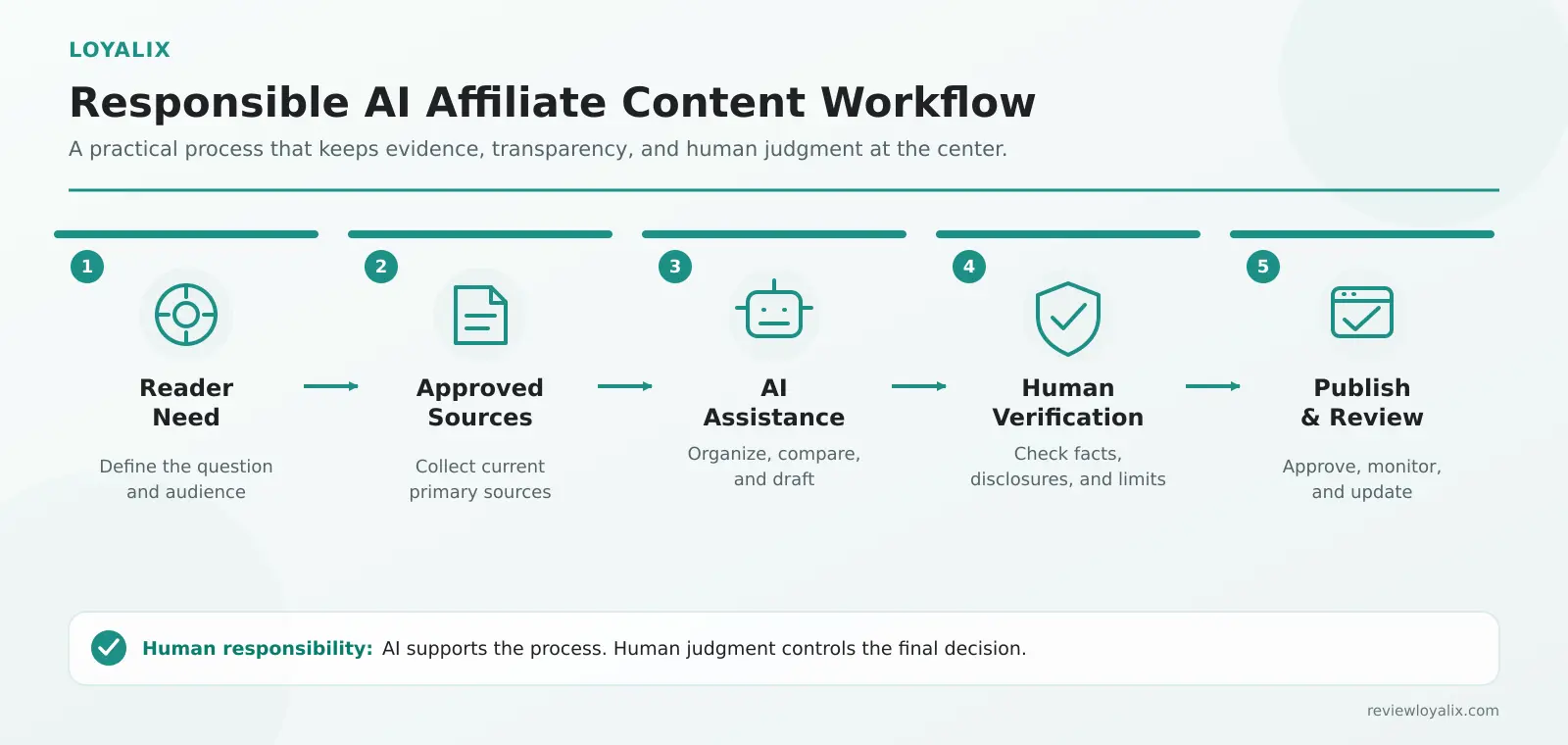
A repeatable workflow makes AI assistance easier to control. The following process can be adapted for an article, comparison, email, social post, or update.
Define the Reader and Decision
State who the content is for, the question it must answer, and the harm that an inaccurate answer could cause.
Set the AI's Role
Choose a narrow task such as organizing research, proposing an outline, or editing a verified draft.
Build the Approved Source Pack
Collect current primary sources, personal test notes, program terms, and known limitations.
Remove Sensitive Information
Exclude credentials, private contracts, identifiable analytics, customer data, and material you are not authorized to share.
Generate a Reviewable Output
Ask for traceable claims, uncertainty labels, missing information, and alternatives rather than a confident final answer.
Verify Facts at the Source
Open the original pages and confirm price, date, plan, country, eligibility, terms, and exceptions.
Add Human Evidence and Judgment
Insert real testing, relevant examples, limitations, and a conclusion tied to the defined reader.
Review Disclosure and Transparency
Confirm that commercial relationships and any necessary AI context are clear and appropriately placed.
Edit the Full Publication Package
Check the article, links, tables, images, alt text, metadata, FAQ, structured data, and social copy.
Publish With an Owner and Review Date
Record who approved the content, what sources were used, and when changeable facts should be checked again.
A Practical Prompt Pattern
A prompt does not make a workflow safe by itself, but a clear structure can reduce ambiguity.
Task:
Create a first draft explaining how a beginner should compare two email marketing tools.
Audience:
A small website owner with fewer than 1,000 subscribers and no automation experience.
Evidence rule:
Use only the attached official pricing, feature, export, privacy, and cancellation notes. Mark missing details as Not verified.
Output rule:
Separate verified facts, test observations, and editorial judgment. Do not imply personal use or guaranteed results.
Review rule:
List every claim that requires a human to reopen the source before publication.
Record Decisions and Keep Content Current
AI-assisted content can become outdated even when the original draft was carefully checked. Products, models, tool policies, prices, affiliate terms, disclosure guidance, and search policies can change.
Keep a simple content record with the article owner, publication date, AI-assisted tasks, sources checked, important limitations, affiliate relationship, and next review date. This is especially useful when several versions of a draft or several channels are involved.
Review After Material Changes
- A provider changes price, features, ownership, terms, or data practices.
- An affiliate program changes commission, attribution, traffic, or disclosure rules.
- A linked source moves, becomes outdated, or contradicts the article.
- A tool changes its model, retention options, export process, or access controls.
- A new legal or platform transparency requirement becomes relevant.
- Reader feedback reveals a misleading statement or missing limitation.
Do not change only the visible date. A meaningful update should include a real review of the information readers may rely on.
Common AI for Affiliate Marketing Mistakes
Publishing the First Polished Draft
Fluent language can hide unsupported claims, weak logic, and missing conditions.
Using AI Output as a Source
A generated answer may help identify questions, but the claim still needs appropriate evidence.
Inventing Hands-On Experience
A researched overview must not imply that the product was personally tested.
Uploading Private Material Without Review
Contracts, analytics, customer information, and account details may require authorization and stronger controls.
Choosing Products From Popularity Alone
Frequently mentioned products may not fit the audience, country, budget, or task.
Hiding Limitations to Protect a Commission
Commercial incentives should not remove facts that could change the reader's decision.
Treating Affiliate Disclosure as Optional Wording
The disclosure must communicate the relationship clearly in the relevant context.
Producing Many Thin Pages
Volume without distinct value can weaken usefulness, trust, and search quality.
Automating Every Channel Before Approval
An error can spread from the article into email, social media, structured data, and images.
Never Reviewing the Published Content
Changeable facts and links need an owner, evidence record, and review date.
Responsible AI Workflow Checklist
Download the Responsible AI Workflow
Use the printable one-page checklist to review research, evidence, privacy, disclosure, human approval, and post-publication updates before AI-assisted affiliate content goes live.
Frequently Asked Questions
Can AI write affiliate marketing content?
AI can help create a first draft, outline, comparison structure, or editing suggestions. The publisher still needs to provide appropriate sources, verify facts, distinguish experience from research, add material limitations, check disclosure, and approve the final result.
Is AI-generated affiliate content allowed in Google Search?
Google's guidance focuses on accuracy, quality, relevance, and value rather than banning content simply because AI was used. Generating many pages without adding value may violate scaled content abuse policies. AI-assisted content should be manually reviewed and fact-checked before publication.
Do I need to disclose that AI helped create an article?
There is no single answer for every use or country. Consider what the tool did, whether the audience could misunderstand how the content or evidence was created, what the platform requires, and which laws apply. AI transparency is separate from affiliate disclosure.
Can AI choose the best affiliate product for my audience?
AI may help compare products against defined criteria, but it does not independently know the audience, current terms, real product performance, or the consequences of a poor recommendation. The publisher should define the criteria, verify the evidence, and make the final judgment.
Can I use AI to summarize affiliate program terms?
Yes, as a starting point. Use the current official terms as the source, ask the tool to identify clauses and unresolved questions, and then verify the summary against the original document. Do not rely on the summary when a contractual detail affects promotion or payment.
What information should I avoid putting into an AI tool?
Avoid passwords, API keys, recovery codes, private account links, identifiable customer data, payment details, confidential agreements, unpublished partner material, and any information you are not authorized to share. Review the tool's current data practices before submitting business information.
Can AI help with affiliate SEO?
AI can support keyword grouping, search-intent analysis, headings, metadata, and content updates. It should not be used to create large amounts of thin content, repeat keywords unnaturally, or invent expertise. The final page should be designed to help the reader, not merely to attract search traffic.
Who is responsible for an error in AI-assisted content?
The publisher remains responsible for deciding what goes live under the business name. Tool terms and applicable law may affect liability, but operationally the safest approach is to keep a named human owner for evidence, approval, correction, and review.
Final Thoughts
AI for affiliate marketing is most valuable when it reduces routine effort without reducing responsibility.
Use it to organize, question, compare, outline, and improve. Do not ask it to replace evidence, invent experience, hide commercial incentives, or make the final decision for the reader.
A responsible workflow keeps the reader’s needs first, uses current sources, protects sensitive information, separates facts from judgment, preserves clear disclosure, and gives a human editor the final word.
The goal is not to publish more content because a tool can produce it. The goal is to use technology carefully enough that every published page remains useful, understandable, and worthy of trust.


