

Debt Repayment Methods: Snowball vs Avalanche for Beginners
Debt repayment methods can make a difficult financial goal easier to organize, but the order in which debts are paid is only one part of the decision. Before choosing a method, a person needs to know what is owed, which payments are essential, whether minimum payments are affordable, and what could happen if a secured or overdue obligation is ignored.
Two approaches are discussed most often. The debt snowball method directs extra money toward the smallest balance first. The debt avalanche method directs extra money toward the highest interest rate first. Both normally keep minimum or required payments going on the other debts while one selected balance receives the extra payment.
The difference is not simply emotional versus mathematical. A quick early payoff can reduce the number of accounts and make progress easier to see. Paying the highest-cost debt first can reduce interest and fees over time when the repayment schedule and account terms remain the same. The most useful method is the affordable one, appropriate for the debts involved, and realistic enough to continue.
This guide explains how each method works, where each approach may help, what neither method can solve, and how to build a debt repayment plan without sacrificing essential living costs or relying on unrealistic promises.
Educational Note
This article provides general educational information and is not personal financial, legal, credit, insolvency, or tax advice. Debt priorities, collection rules, limitation periods, secured-credit consequences, credit reporting, support services, and repayment options vary by country and agreement. If minimum payments are unaffordable, an account is disputed, legal action has begun, or essential housing and services are at risk, contact the creditor and an appropriate qualified local adviser promptly.
Table of Contents
What Debt Repayment Methods Actually Do
A repayment method provides an order for directing extra money after required payments and essential living costs have been addressed. It does not change the original contract, reduce an interest rate, stop collection activity, or create money that is not available. Its value is organizational: it turns several balances into one clear next target.
The Consumer Financial Protection Bureau describes two basic approaches: paying the smallest balance first and paying the highest interest rate first. Its debt action plan notes that each has advantages and disadvantages. This is important because debt repayment is not only a calculation. The plan also has to work with the person’s income, obligations, behavior, and ability to continue.
Neither method should be applied mechanically to every obligation. Mortgage or rent arrears, utilities, taxes, court obligations, secured credit, disputed debts, accounts in collection, and debts with special legal protections or consequences may need different treatment. The first question is therefore not ‘snowball or avalanche?’ It is ‘Is every debt accurately recorded, and which obligations require immediate attention?’
Start With a Complete Debt Picture
A repayment order is only as reliable as the information behind it. Begin with current statements, contracts, creditor messages, bank records, and credit information available in your country. Do not rely on memory or an old balance.
Record the Important Details
- Creditor or service provider name.
- Current balance and currency.
- Interest rate and whether it is fixed or variable.
- Required or minimum payment.
- Payment due date.
- Fees, penalty rates, or late-payment consequences.
- Whether the debt is current, overdue, disputed, in collection, or secured by an asset.
- Any promotional rate and the date it ends.
- The correct contact channel and account reference.
Reviewing real account and payment records is also a useful extension of the Loyalix guide on how to track your spending. A plan based on actual cash flow is more useful than one built around the amount you hope will be available.
Separate Different Debt Situations
Current unsecured balances can often be ordered by size or interest rate. Other situations should be separated before the comparison. An overdue housing payment may threaten the home. A missed utility bill may affect an essential service. A secured loan may place an asset at risk. A disputed collection account should be verified before payment. A tax, court, or government obligation may follow rules that ordinary consumer credit does not.
If a debt amount or collector is unfamiliar, ask for the information and documents available under the rules that apply where you live. Latvia’s Consumer Rights Protection Centre, for example, advises consumers to clarify the current amount, request documents supporting the debt when appropriate, and communicate about a realistic payment arrangement when immediate repayment is not possible.
Protect Essential Payments Before Extra Repayment
Paying extra toward one balance should not cause a missed rent or mortgage payment, loss of utilities, lack of food or medicine, inability to reach work, or failure to maintain required insurance. A debt strategy that creates a new emergency is not stable.
Start with the costs that protect housing, basic services, health, work, dependants, legal obligations, and the minimum payments needed to keep accounts current where possible. The exact priority order depends on local law and personal circumstances. This is one reason a generic payoff calculator cannot replace qualified advice when several payments are already overdue.
After essential costs and required payments are considered, identify the amount that can be sent consistently to one target debt. That amount might be modest. A smaller repeatable payment is more useful than an aggressive target that forces the person to borrow again before the month ends.
How the Debt Snowball Method Works
The debt snowball method ranks eligible debts from the smallest balance to the largest balance. Interest rate does not determine the order. The person continues making required payments on the other debts and directs the planned extra payment to the smallest balance.
The payment grows because money previously assigned to a completed debt is redirected rather than absorbed into everyday spending. The method does not require the extra amount to be large, but it does require the payment to be available and the account information to be current.
Strengths and Limitations of the Snowball Method
Potential Strengths
- A small balance may disappear sooner, creating a visible early result.
- The number of active balances and due dates may decline more quickly.
- The plan is simple to explain and monitor.
- A completed account may free a required monthly payment for the next target.
Important Limitations
- The smallest balance may not be the most expensive debt.
- Higher-rate balances can continue accumulating more interest and fees while waiting.
- A quick win does not make the method affordable if required payments exceed available income.
- The method can be interrupted if freed payments are spent rather than redirected.
The CFPB’s comparison explains the central trade-off: reducing small debts first may create quicker visible progress, but paying smaller balances before costly high-rate debts can lead to a higher total cost over the repayment period
How the Debt Avalanche Method Works
The debt avalanche method, also called the highest-interest-rate method, ranks eligible debts by interest rate from highest to lowest. The balance size does not determine the first target. Required payments continue on the other debts, and the planned extra amount goes to the highest-rate balance.
If two debts have the same rate, a person can use a secondary rule, such as paying the smaller balance first, choosing the debt with the least flexible terms, or selecting the one that removes a troublesome account. The rule should be recorded so the plan does not change each month impulsively.
Strengths and Limitations of the Avalanche Method
Potential Strengths
- The most expensive interest rate is addressed first.
- With the same balances, payments, rates, and schedule, the method generally reduces interest cost compared with paying lower-rate debts first.
- The repayment order follows a clear financial criterion.
- It can be especially useful when one unsecured balance is substantially more expensive than the others.
Important Limitations
- The first target may have a large balance and take longer to complete.
- Progress may feel less visible even while the plan is reducing cost.
- The method still fails if the monthly payment target is unrealistic.
- Rate changes, fees, new borrowing, or missed payments can change the expected result.
The avalanche method is often described as mathematically efficient, but that phrase depends on assumptions. The comparison only holds when payments are made as planned, no important contractual difference changes the decision, and the person can continue long enough to complete the plan.
Debt Snowball vs Debt Avalanche Comparison
| Question | Debt snowball | Debt avalanche |
|---|---|---|
| First target | Smallest eligible balance | Highest eligible interest rate |
| Main purpose | Create visible progress and reduce account count | Reduce the cost of high-rate debt first |
| Early milestone | Often sooner when a small balance exists | May take longer when the highest-rate balance is large |
| Potential total cost | May be higher when expensive debts wait | Often lower if rates and payments follow the plan |
| Best fit may be | A person who benefits from quick, concrete completions | A person who can stay focused on a longer first target |
| Main risk | Ignoring a costly balance for too long | Losing motivation before the first payoff |
| What both require | Accurate records, required payments, affordable extra money, and regular review | Accurate records, required payments, affordable extra money, and regular review |
The comparison is a decision aid, not a verdict. A lower theoretical interest cost is not helpful if the plan is abandoned. A quick payoff is not helpful if it leaves a high-cost or high-consequence obligation unmanaged. The choice should reflect both the numbers and the conditions required for the plan to continue.
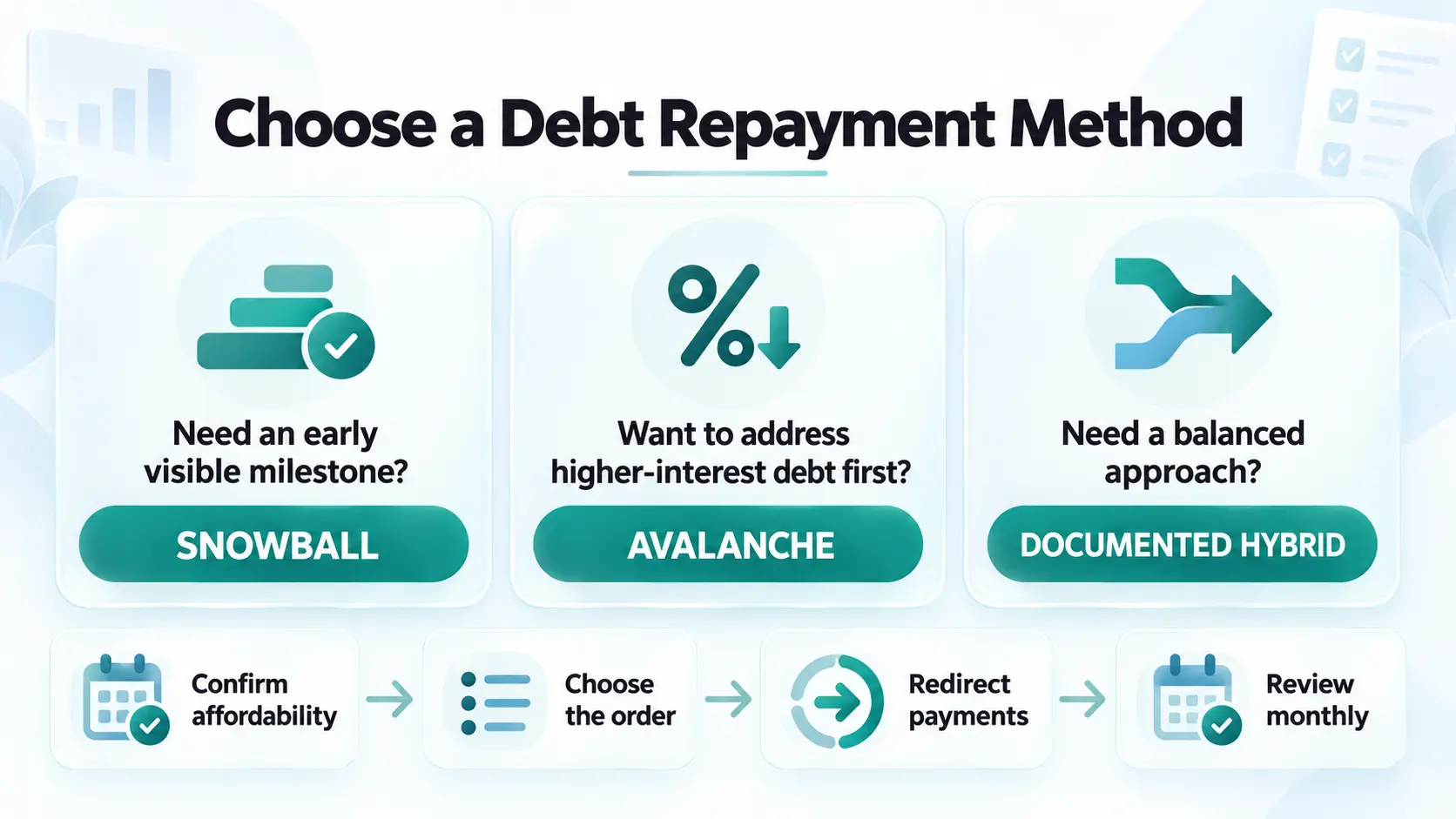
A Simple Repayment Example
Assume a person has the following four unsecured balances and can pay all required amounts plus one consistent extra payment. The figures are illustrative only and exclude fees, changing rates, taxes, and country-specific rules.
| Debt | Balance | Interest rate | Snowball order | Avalanche order |
|---|---|---|---|---|
| Store card | EUR 450 | 18% | 1 | 2 |
| Credit card | EUR 2,400 | 24% | 3 | 1 |
| Personal loan | EUR 5,800 | 9% | 4 | 4 |
| Medical balance | EUR 900 | 0% payment plan | 2 | 3 |
The snowball method begins with the EUR 450 store card because it has the smallest balance. The avalanche method begins with the EUR 2,400 credit card because it has the highest rate. Neither order should be selected before checking whether the zero-interest plan has conditions, whether any account is overdue, and whether all required payments are affordable.
How to Choose a Method You Can Continue
A useful choice is based on real behavior and real account terms, not on identity. You do not need to call yourself a snowball person or an avalanche person. You need a method that fits the current debt picture and can survive ordinary months.
- How large is the difference between the highest rate and the other rates?
- How long will the first payoff take under each method?
- Would closing one small balance materially simplify the monthly plan?
- Has motivation been the main obstacle, or has the main obstacle been affordability?
- Are any rates temporary, variable, or subject to a penalty increase?
- Would one debt create a more serious consequence if it remained unpaid?
- Can the same extra amount be maintained during lower-income or higher-expense months?
If the first target under the avalanche method can be completed within a reasonable period, the cost advantage and the motivational challenge may not be far apart. If the first target would take years while several very small balances create administrative pressure, the person may value a different sequence. Record the reason for the choice and set a review date rather than changing direction after every difficult month.
When a Hybrid Method May Be More Practical
A hybrid plan uses a deliberate exception rather than switching randomly. For example, a person may repay one very small balance first to remove an account, then use the avalanche order for the remaining debts. Another person may use the avalanche method but move a promotional balance forward before its low rate expires.
A hybrid method should still have a written rule. State which debt is the exception, why the exception matters, and what order will follow. Without that record, a hybrid plan can become a series of emotional changes that never directs enough money to one balance.
Build a Realistic Monthly Repayment Plan
Use Normal Cash Flow, Not the Best Month
Review several months of income and expenses, especially when earnings vary. Separate essential costs, required payments, irregular bills, and a small margin for unexpected expenses. The amount left after that review is the possible extra payment, not a guarantee.
Choose a Base Amount and an Optional Extra
A practical plan can use two numbers: a conservative base amount that can usually be paid and an optional extra amount for stronger months. This reduces the risk of designing the entire plan around overtime, bonuses, seasonal income, or temporary spending cuts.
Align Payments With Income Dates
Record each due date and the dates income normally arrives. If a due date repeatedly creates a timing problem, ask the creditor whether a different date is available and whether changing it affects fees, interest, or the current statement. Do not assume a change is automatic until it is confirmed.
Redirect Completed Payments
When a debt is repaid, update any automatic payment carefully, confirm the closing balance, and move the former payment to the next target. Avoid treating the completed payment as newly available spending before the wider debt plan is reviewed.
If flexible spending needs adjustment, the Loyalix guide to reducing variable expenses can help identify changes that remain realistic instead of cutting every enjoyable expense at once.
Emergency Savings While Repaying Debt
Debt repayment and emergency savings do not always need to happen in a rigid sequence. A person with no accessible buffer may repay a balance and then borrow again when a necessary repair or medical cost appears. A small reserve can reduce that cycle, while expensive debt still deserves attention.
There is no universal starter amount. Consider income stability, dependants, health needs, transport, insurance, available support, and the types of emergencies most likely to cause new borrowing. Keep emergency money separate from the extra debt payment and define what qualifies as an emergency.
The Loyalix guide on building an emergency fund explains how a small safety buffer can be developed gradually. The related saving vs investing guide can help separate money needed for stability from money intended for long-term market risk.
What to Do When Minimum Payments Are Not Affordable
Snowball and avalanche methods assume that required payments can continue. If that assumption is false, choosing a repayment order is not the first problem to solve. Contact creditors or service providers early, explain the situation accurately, and ask which hardship, due-date, reduced-payment, restructuring, or other options may be available under the agreement and local rules.
Before agreeing to a new arrangement, ask for the payment amount, duration, interest treatment, fees, missed-payment consequences, effect on the account, and total amount expected. Keep copies of communications and obtain important agreements in writing.
If the situation involves collection, disputed debt, threatened legal action, loss of housing or essential services, or several unaffordable obligations, seek appropriate local debt advice or legal help promptly. Consumer.gov notes that a reputable credit counselor should spend time understanding the full financial situation and should not promise an instant solution.
Be Careful With Consolidation and Debt Settlement
Consolidation Changes the Structure, Not the Behavior
A consolidation loan may combine several payments, but a lower monthly payment does not automatically mean a lower total cost. Check the interest rate, term, fees, security, variable-rate conditions, early-repayment terms, total repayment, and whether old credit lines will remain open. Extending the term can reduce the monthly payment while increasing the length and total cost of borrowing.
Debt Settlement Can Add Serious Risk
Debt settlement is different from an ordinary repayment order. Some companies encourage consumers to stop paying creditors while money is accumulated for possible settlements.The CFPB that this can lead to late fees, penalty interest, collection pressure, credit harm, lawsuits, expensive service fees, and settlements that do not cover every debt.
Do not pay a company because it promises to erase debt quickly, hide negative information, or guarantee a result. Verify the provider, understand fees and contracts, compare direct creditor communication and qualified nonprofit or public advice where available, and review the Loyalix guide on avoiding online financial scams before sharing account or payment information.
Common Debt Repayment Mistakes
Snowball or avalanche cannot solve a plan when required payments and essential costs already exceed normal cash flow.
Balance size and interest rate are not the only considerations when housing, utilities, secured assets, taxes, or legal duties are involved.
Statements, promotional periods, variable rates, fees, and collection amounts can change. Reopen the current source before making a decision.
A temporary rate or low monthly payment may become more expensive after a deadline, fee, or contractual change.
A plan with no room for irregular or urgent costs may create new borrowing when an unexpected expense appears.
Missed payments can trigger fees, rate changes, collection activity, credit consequences, or legal action.
Frequent switching prevents the plan from building momentum. Change the method only when facts or circumstances justify it.
Completing one balance will not improve the overall plan if the same account is immediately refilled.
A polished website or urgent sales call does not prove that a provider is legitimate or that the promised result is possible.
Rates, balances, income, fees, and priorities can change. A repayment plan needs a clear and regular review date.
Be cautious with any provider that promises guaranteed debt removal or demands sensitive information before proper verification. Learn more in How to Avoid Financial Scams Online .
Debt Repayment Decision Checklist
Use this checklist before choosing or changing a repayment method:
I listed every debt using current statements and verified account information.
ListI recorded each balance, rate, required payment, due date, fees, and status.
DetailsI separated current unsecured debts from overdue, secured, disputed, collection, tax, court, and essential-service obligations.
SeparateI protected housing, utilities, food, medicine, transport, insurance, dependants, and other essential needs.
ProtectI confirmed whether all required payments are affordable.
AffordI calculated the extra amount from normal cash flow rather than my best month.
AmountI checked promotional and variable rates and the dates they may change.
RatesI compared the first target and likely trade-offs under both methods.
CompareI chose snowball, avalanche, or a clearly documented hybrid rule.
ChooseI defined what will happen to each payment after a debt is completed.
RedirectI considered whether a small accessible emergency reserve is needed to avoid new borrowing.
ReserveI checked any consolidation offer for total cost, term, fees, security, and exit conditions.
ReviewI did not rely on a company that guarantees debt removal or asks for sensitive information without proper verification.
VerifyI know whom to contact if a payment becomes unaffordable or a debt is disputed.
ContactI recorded the plan owner, start date, target debt, payment amount, and next review date.
RecordRemember: A repayment order is useful only when the underlying payments are affordable and the debts are suitable for that method.
Frequently Asked Questions
Is the debt snowball or debt avalanche method better?
Neither method is universally better. The avalanche method generally prioritizes lower interest cost, while the snowball method may create earlier visible completions. The suitable choice depends on affordability, account terms, consequences, motivation, and whether the plan can be continued.
Should I pay the smallest debt first?
Paying the smallest eligible balance first may simplify the plan and provide a quick milestone. However, check whether another debt has a much higher rate or a more serious consequence before choosing the order.
Does the avalanche method always save money?
It usually reduces interest compared with paying lower-rate debts first when balances, rates, payment amounts, fees, and timing remain the same. Real results can change when rates vary, fees apply, payments are missed, or the plan is not completed.
Can I combine the snowball and avalanche methods?
Yes. A documented hybrid may repay one small balance first and then switch to the highest-rate order. State the exception and the rule that follows so the plan does not change impulsively.
Should I build emergency savings before paying extra on debt?
There is no universal sequence. A small accessible reserve may prevent a necessary expense from creating new borrowing, while high-cost debt may still need priority. Consider income stability, essential risks, available support, and the cost of the debt.
What if I cannot afford all minimum payments?
Contact creditors or service providers promptly and ask about available arrangements. Prioritize essential and high-consequence obligations, keep records, and seek qualified local debt or legal advice when arrears, collection, legal action, or housing risk is involved.
Should I use a consolidation loan?
Consolidation may simplify payments, but compare the total cost, rate, term, fees, security, variable-rate conditions, and effect of keeping old credit available. A lower monthly payment can still cost more over a longer term.
How often should I review a debt repayment plan?
Review it at least monthly and after a material change in income, expenses, rates, fees, account status, or household responsibilities. Also review the plan whenever a debt is completed or a creditor changes the terms.
Final Thoughts
Debt repayment becomes easier to manage when the next action is clear. The snowball method creates that clarity by targeting the smallest eligible balance. The avalanche method creates it by targeting the highest eligible interest rate. Both can work as organizing systems, but neither should override essential needs, contractual realities, or the need for qualified help when payments are already unaffordable.
Begin with accurate information. Protect essential obligations. Keep required payments current where possible. Choose an affordable extra amount and a repayment order you can explain. Then review the plan regularly instead of expecting one decision to remain correct forever.
The goal is not to follow a method perfectly. The goal is to reduce debt without creating new instability, understand the trade-offs, and make each payment part of a realistic long-term financial plan.