How to Choose a Niche for Affiliate Marketing: Beginner-Safe Checklist
Choosing a niche is one of the first important decisions in affiliate marketing. It is also one of the hardest for beginners.
Table of Contents
In this guide
- What a Niche Really Means
- The “Too Broad vs Too Narrow” Problem
- 3 Beginner-Safe Ways to Choose a Niche
- The Beginner-Safe Niche Checklist
- How to Validate a Niche in 60 Minutes
- Common Niche Mistakes Beginners Make
- A Simple Niche Statement Template
- Beginner-Friendly Niche Examples
- How to Connect Your Niche to Affiliate Programs
- FAQ
What a Niche Really Means
A niche is not just a topic.
A much better way to think about it is this:
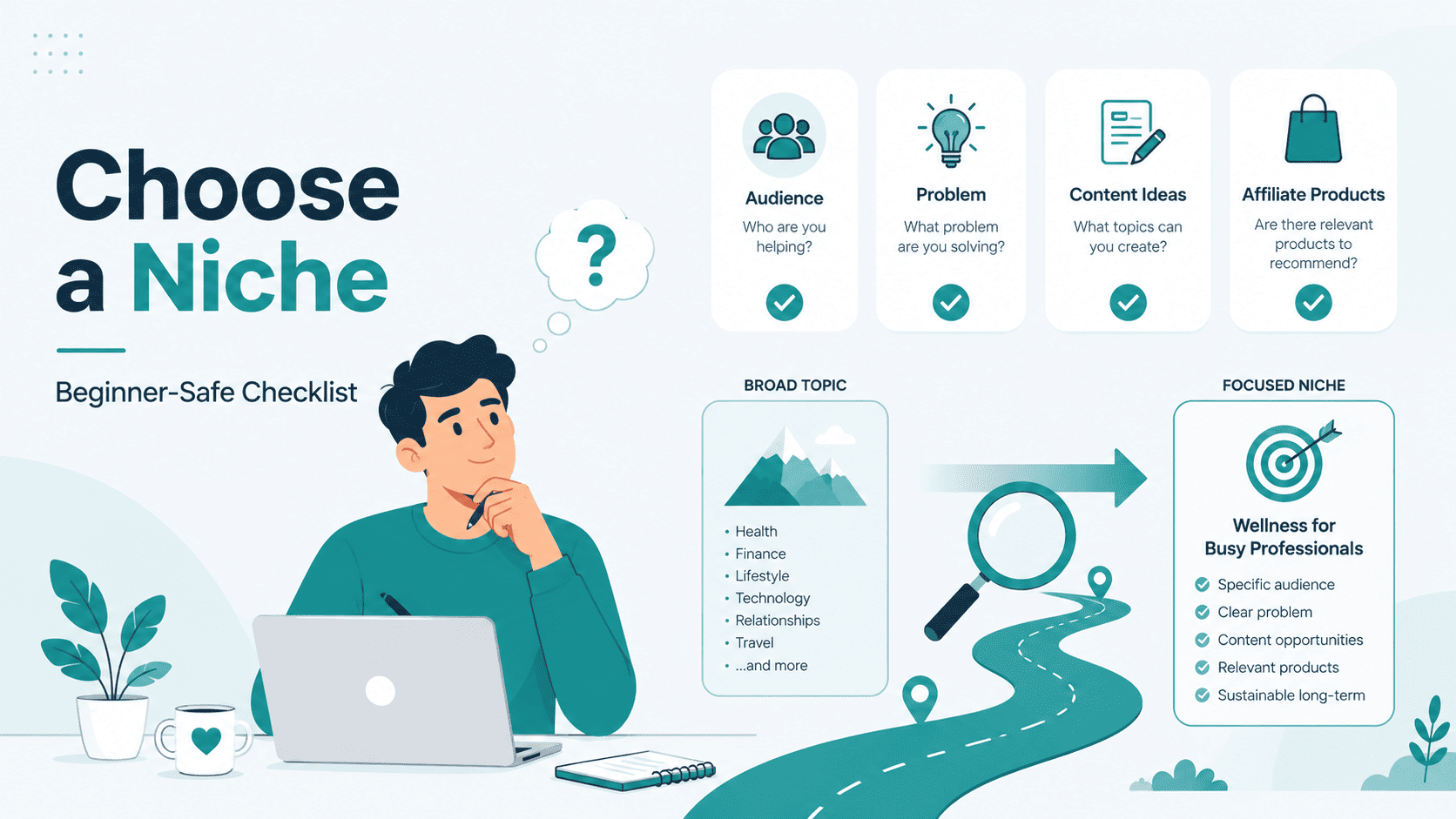
Audience + Problem + Outcome
In simple terms, your niche should answer three questions:
Who are you helping?
What are they struggling with?
What result do they want?
For example, “personal finance” is too broad. It includes budgeting, debt, savings, investing, taxes, credit, retirement, and much more.
But something like “simple budgeting tips for beginners who want to manage money better” is much clearer.
The same idea applies to affiliate marketing. “Online business” is too wide for most beginners. But “beginner-friendly affiliate marketing guides for people with no experience” gives you a much stronger starting point.
A clear niche helps you write more useful content, choose more relevant affiliate programs, and build trust with the right audience.
Here is a simple example:
Audience: beginners who want to start affiliate marketing
Problem: they do not know where to begin safely
Outcome: they want a clear and realistic starting path
That could lead to a niche like this:
Helping beginners start affiliate marketing safely through clear guides, honest program reviews, and practical first steps.
That is much stronger than simply saying, “My niche is affiliate marketing.”
Why? Because now you know exactly who your content is for, what they need help with, and what kind of articles make sense to create.
The “Too Broad vs Too Narrow” Problem
This is one of the most common beginner mistakes.
Some niches are too broad. They try to speak to everyone.
Examples include:
Make money online
Personal finance
Health and wellness
Digital marketing
These topics can work, but they are hard for beginners because they contain too many subtopics, different audiences, and mixed search intent.
Other niches are too narrow. They leave very little room to grow.
Examples include:
- One specific app feature
- One tiny product category
- One short-term trend
- One product only
A good beginner niche usually sits somewhere in the middle. It is narrow enough to feel clear, but broad enough to support many helpful articles.
A simple test is this:
Can you list at least 30 useful article ideas around the niche?
If yes, that is a good sign.
If no, the niche may be too narrow, too vague, or not developed enough yet.
3 Beginner-Safe Ways to Choose a Niche
There are many ways to pick a niche, but beginners often make the process harder than it needs to be.
A safer starting point usually comes from one of these three directions:
- a real problem people want to solve
- experience or knowledge you can explain clearly
- a genuine interest with real content potential
Let’s look at each one.
1. Problem-Solving Niches
A problem-solving niche is often the strongest option for beginners.
This kind of niche starts with something people are already struggling with. Your content helps them understand the issue, avoid mistakes, compare options, and move forward more safely.
Examples:
- how to start affiliate marketing safely
- how to avoid online scams
- how to budget with irregular income
- how to choose beginner-friendly tools
- how to understand personal finance basics
These niches work well because people actively search for answers when they are confused, uncertain, or trying to make a decision.
2. Experience-Based Niches
This also fits affiliate marketing naturally. When your content is helpful, recommendations feel like support, not pressure.
For example, if your audience wants to start affiliate marketing, you could write about:
That creates a logical content path. It feels much stronger than posting random promotions with no structure.
An experience-based niche is built around something you already know, have learned, or are learning right now.
You do not need to be a top-level expert. But you should be able to explain the topic honestly and clearly.
This works especially well for beginner-friendly websites.
For example, you might say:
“I am learning affiliate marketing step by step and sharing simple beginner-friendly guides along the way.”
That can be powerful when the content is useful, transparent, and realistic.
In fact, many readers connect more easily with someone who explains things clearly than with someone who sounds distant or overly advanced.
If you are even one or two steps ahead of your reader, you may still be able to help them a lot.
The key is honesty. Do not pretend to know more than you do. That creates pressure, weakens trust, and makes content harder to sustain.
3. Interest-Based Niches
An interest-based niche starts with something you genuinely enjoy learning about.
This matters because affiliate marketing is rarely a short project. It usually requires months or years of steady content creation. If you choose a topic only because it looks profitable, you may lose energy quickly.
Still, interest alone is not enough.
A strong interest-based niche should also have:
- real questions people ask
- enough content opportunities
- useful products or services
- long-term demand
For example, if you are interested in personal finance, you could narrow it into:
- budgeting for beginners
- financial literacy for online workers
- avoiding financial scams online
- simple money habits for people starting over
That is much clearer and more useful than simply saying, “I write about money.”
The Beginner-Safe Niche Checklist
Before you commit to a niche, it helps to slow down and test it.
You do not need a complicated system. You are not trying to predict the future perfectly. You are simply trying to avoid obvious mistakes and choose a direction that makes practical sense.
Here is a beginner-safe checklist you can use.
1. Is the audience clear?
You should be able to describe your audience in one sentence.
Not:
“Everyone who wants to make money.”
Better:
“Beginners who want to learn affiliate marketing safely without falling for hype.”
Not:
“People interested in finance.”
Better:
“Beginners who want to understand money, avoid scams, and make smarter online decisions.”
When the audience is clear, writing becomes easier. Your introductions become stronger, your examples become more relevant, and your content feels more useful.
2. Is there a real problem to solve?
A niche should connect to a real need, not just a general subject.
Ask yourself:
What is the reader confused about?
What are they worried about?
What decision are they trying to make?
What mistake do they want to avoid?
What result are they hoping for?
For beginner affiliate marketing, real problems often sound like this:
- “I do not know where to start.”
- “I do not know which programs are safe.”
- “I am afraid of scams.”
- “I have no experience.”
- “I do not know what content to create.”
These are real concerns. That means they can become useful articles.
3. Can you create at least 30 content ideas?
This is one of the best tests for beginners.
Before choosing a niche, try to list 30 article ideas. They do not need to be perfect. The goal is to see whether the niche has enough depth to support consistent publishing.
For a beginner affiliate marketing niche, possible article ideas include:
- What is affiliate marketing?
- How does affiliate marketing work?
- How to start affiliate marketing with no experience
- How to choose your first affiliate program
- Affiliate marketing mistakes beginners should avoid
- How to choose a niche
- How to create your first content plan
- How to write affiliate content without sounding pushy
- How to disclose affiliate links
- Affiliate marketing red flags
- How long does affiliate marketing take?
- What tools do beginners need?
If the list grows naturally, that is a strong sign.
If you struggle to get beyond a few ideas, the niche may be too narrow.
4. Is there proof of demand?
You do not need expensive SEO tools to check whether people care about a topic.
You can look at:
- Google autocomplete
- People Also Ask
- YouTube suggestions
- Reddit discussions
- Quora questions
- forums
- competitor blog titles
Look for repeated questions. Repetition is usually a very good sign.
For example:
- Is affiliate marketing legit?
- How do I start affiliate marketing with no audience?
- What affiliate programs are best for beginners?
- How do affiliate links work?
If people keep asking the same things, there is likely real demand behind the niche.
5. Are there ethical affiliate offers?
A niche should have monetization potential, but it should not depend on questionable products.
Look for offers that are:
- relevant to the audience
- easy to understand
- useful in real life
- transparent about pricing and terms
- offered by reputable companies
Avoid offers built around:
- unrealistic income claims
- pressure tactics
- confusing terms
- hidden fees
- fake urgency
A beginner-safe niche should allow you to recommend something without feeling uncomfortable.
Trust matters more than commission size.
6. Can you explain the niche simply?
If your niche is too hard to explain, it may also be too hard to build.
Try using this sentence:
I help [audience] achieve [result] through [content method].
Examples:
- I help beginners understand affiliate marketing safely through clear guides and realistic first steps.
- I help beginners make smarter financial decisions by explaining scams, budgeting, and online income basics in plain language.
- I help new content creators choose trustworthy affiliate programs and avoid common mistakes.
If your niche statement sounds too long or confusing, it probably needs more focus.
How to Validate a Niche in 60 Minutes
You do not need months of research before you start.
You can do a simple niche validation session in about one hour. It will not guarantee success, but it can help you avoid choosing blindly.
Step 1: Search 10 beginner questions
Go to Google, YouTube, or another search platform and type in the main phrases related to your idea.
For example:
- affiliate marketing for beginners
- how to start affiliate marketing
- best affiliate programs for beginners
- affiliate marketing mistakes
- is affiliate marketing safe
Write down at least 10 real questions people ask.
If you cannot find beginner questions easily, the niche may be weak, unclear, or too limited.
Step 2: Check 3 competitor pages
Look at three articles or websites in the niche. You do not need to copy them. Study how they explain the topic, what questions they answer, and what gaps you could fill with clearer and more helpful content.
Do not copy them. Study them.
Ask:
- What topics do they cover?
- Are the explanations clear?
- Do they sound trustworthy?
- Are they overly aggressive?
- What questions do they ignore?
This can help you find a better angle.
Sometimes the opportunity is not to be louder. It is to be calmer, clearer, and more genuinely helpful.
Step 3: Create one starter article idea
Before building a full content plan, ask yourself whether you can write one useful article in the niche.
A strong first article often answers a basic beginner question.
Examples:
- How to Start Affiliate Marketing With No Experience
- What Is Affiliate Marketing and How Does It Really Work?
- How to Choose Your First Affiliate Program Safely
- How to Avoid Financial Scams Online
If you can write one solid article, you can begin building.
If you cannot explain even one basic topic clearly, the niche may not be right for you yet.
Common Niche Mistakes Beginners Make
Choosing a niche is not only about finding a good idea. It is also about avoiding decisions that make content harder later.
Here are some of the most common mistakes.
Mistake 1: Choosing only for commission size
High commissions can look exciting, especially at the beginning.
But a high payout does not automatically make a niche strong.
It does not help if:
- the product is confusing
- the audience does not trust it
- the terms are unclear
- the offer feels too aggressive
- you cannot recommend it honestly
Beginners often do better with lower-risk offers that match the reader’s real needs.
A smaller commission from a useful product can be much more valuable than a bigger commission from something questionable.
Mistake 2: Choosing a niche you cannot write about consistently
Affiliate marketing depends heavily on content.
If you choose a topic you dislike or barely understand, consistency becomes hard very quickly.
Ask yourself:
Can I write about this for six months?
Can I explain it to a beginner?
Can I keep learning about it?
Can I create useful content without forcing sales?
If the answer is no, the niche may not be sustainable.
Mistake 3: Trying to help everyone
This is a very common beginner trap.
For example:
“I help everyone make money online.”
That sounds broad, but it is not clear. It gives you no real direction.
A better version is:
“I help beginners understand affiliate marketing safely.”
That is focused enough to build around.
You can always expand later. At the beginning, clarity matters more than size.
Mistake 4: Building around one product only
A niche should not depend on one product.
If that product changes, closes, reduces commissions, or loses credibility, your whole strategy becomes fragile.
Instead of building around one product, build around an audience or a problem.
Not:
“My niche is one specific tool.”
Better:
“My niche is beginner-friendly tools for affiliate marketers.”
That gives you flexibility and a stronger long-term foundation.
Mistake 5: Ignoring trust
Trust is one of the foundations of affiliate marketing.
If your niche depends on hype, pressure, or unrealistic promises, it may attract quick attention but damage your credibility over time.
A good beginner niche should allow you to say things like:
- This may help some people, but it is not magic.
- Here are the pros and cons.
- Here is who this is not for.
That kind of honesty builds stronger reader relationships.
It is also helpful to review the FTC advertising and endorsement guidelines before recommending affiliate products.
A Simple Niche Statement Template
Once your niche starts to feel clearer, write a simple niche statement.
Use this template:
I help [specific audience] achieve [specific result] through [content method].
Examples:
- I help beginners learn affiliate marketing safely through honest guides, simple checklists, and realistic first steps.
- I help people avoid financial scams online by explaining red flags, safer research habits, and practical decision-making.
- I help new online business beginners understand affiliate programs, content basics, and trust-building before they promote anything.
Your niche statement does not need to be perfect. It simply helps you stay focused while you create content.
You can improve it later as you learn more about your audience.
Beginner-Friendly Niche Examples
Here are a few niche ideas that fit especially well with a site focused on affiliate marketing and personal finance
Affiliate marketing for beginners
This niche helps people understand affiliate marketing from the ground up.
Possible articles:
- What is affiliate marketing?
- How to start with no experience
- How to choose your first affiliate program
- Affiliate marketing mistakes beginners should avoid
- How to write helpful affiliate content
This works well because beginners usually need education before they need recommendations.
Safe online income education
This niche focuses on helping people understand online income opportunities without falling into hype.
Possible articles:
- How to spot unrealistic income claims
- What to check before joining an online program
- How to compare online business models
- Why trust matters in affiliate marketing
This is a strong fit for a calm, honest, beginner-protective brand.
Financial literacy for online beginners
This niche connects personal finance with online decision-making.
Possible articles:
- How to avoid financial scams online
- Budgeting basics for beginners
- How to think carefully before buying online courses
- How to manage money when starting a side project
This direction works well if you want to connect finance and affiliate marketing under one clear brand.
How to Connect Your Niche to Affiliate Programs
Once your niche is clear, the next step is not to join every affiliate program you can find.
Start slowly.
Look for programs that match three things:
- your audience
- the problem you help solve
- the trust level you want your brand to represent
For example, if your niche is beginner-friendly affiliate marketing, you might later review:
- website tools
- SEO tools
- email marketing tools
- learning platforms
- content creation resources
But timing matters.
A beginner does not always need advanced tools right away. Often they need clarity, education, and safe first steps before they need recommendations.
Before joining any program, ask:
Is the product relevant?
Are the terms clear?
Is the company reputable?
Is the pricing transparent?
Can I recommend this honestly?
Would I feel comfortable explaining the pros and cons?
If the answer is unclear, wait.
It is better to publish helpful content first than to promote too early.
Your Next Step: Build a Small Content Plan
Once your niche feels clear enough, build a simple content plan.
Do not start with 100 ideas. Start with 10.
A strong beginner cluster might include:
- One definition article
Example: What Is Affiliate Marketing and How It Really Works - One beginner roadmap article
Example: How to Start Affiliate Marketing With No Experience - One safety article
Example: How to Avoid Financial Scams Online - One mistake in the article
Example: Affiliate Marketing Mistakes Beginners Should Avoid - One decision article
Example: How to Choose Your First Affiliate Program Safely - One niche article
Example: How to Choose a Niche for Affiliate Marketing
This creates a connected content cluster where each article supports the others.
That is much stronger than publishing random posts with no clear structure.
Final Thoughts
Choosing a niche for affiliate marketing does not need to feel stressful.
You do not need a perfect idea. You need a clear enough direction to begin.
A beginner-safe niche should have:
- a clear audience
- a real problem to solve
- enough content opportunities
- signs of demand
- ethical affiliate offers
- a topic you can explain honestly
The best niche is not always the one with the biggest commissions.
Usually, it is the one where you can help people make better decisions, build trust over time, and create useful content consistently.
Start simple.
Choose one direction.
Create helpful content.
Listen to your audience.
Then improve step by step.
That is a stronger foundation than chasing trends, copying gurus, or promoting random offers.
Affiliate marketing works best when your niche is built on clarity, usefulness, and trust.
FAQ
How do I choose a niche for affiliate marketing as a beginner?
Start with a clear audience and a real problem. A beginner-safe niche should have enough content ideas, visible demand, and ethical products or services you can recommend honestly.
What makes a niche profitable?
A profitable niche usually has real problems, active search demand, and useful products people are willing to pay for. But profitability should not be based only on high commissions. Relevance and trust matter more.
Should I choose a niche based on passion or profit?
Both matter, but neither is enough on its own. Passion helps you stay consistent, and profit potential helps the niche remain sustainable. A strong beginner choice usually combines genuine interest with real usefulness.
How narrow should my niche be?
Your niche should be narrow enough to feel clear, but not so narrow that you run out of topics. A good test is whether you can list at least 30 useful article ideas around it.
Can I change my niche later?
Yes. Many beginners adjust their niche as they learn more about their audience. It is easier to adapt when your site is built around a broader problem area instead of only one product.
How do I know if my niche has demand?
Look for repeated questions in Google suggestions, People Also Ask, YouTube, Reddit, Quora, forums, and competitor content. If people keep asking similar questions, there is likely real demand.
What niche mistakes should beginners avoid?
Avoid choosing a niche only for high commissions, trying to help everyone, building around one product, or choosing a topic you cannot write about consistently. A strong niche should support trust and long-term content creation.