

Affiliate Disclosure for Beginners: What to Say and Where to Place It
An affiliate disclosure tells readers when a recommendation, link, code, or piece of content has a commercial connection. It gives readers information that may affect how they evaluate the recommendation before they decide whether to click, compare, or buy.
For beginners, the difficult part is rarely understanding that transparency matters. The difficult part is deciding when a disclosure is needed, choosing language ordinary people can understand, and placing it where the commercial relationship is visible at the right moment.
A disclosure should not be treated as a legal sentence hidden in a footer. It is part of the recommendation itself. If you are still learning how commissions, tracking, merchants, and publishers fit together, begin with What Is Affiliate Marketing and How Does It Really Work? This guide focuses on the next step: explaining the relationship clearly to the audience.
The practical standard is simple: identify the commercial connection, explain it in plain language, place the explanation where people are likely to notice it, and repeat it when the format or viewing path makes that necessary. The exact legal wording and placement can vary by country, platform, program, and context, so a responsible publisher checks the rules that apply to the audience and content.
EDUCATIONAL NOTE
This article provides general educational information and is not legal advice. Advertising, endorsement, consumer-protection, platform, and affiliate-program rules differ by country and may change. Review the current requirements that apply to your business, audience, content format, and affiliate relationships, and obtain qualified advice when a decision depends on specific legal circumstances.
Table of Contents
What an Affiliate Disclosure Actually Does
An affiliate disclosure explains that the publisher has a financial or other material relationship connected to the recommendation. In a common affiliate arrangement, the publisher can receive a commission when a reader uses a tracked link or code and completes a qualifying action.
That information matters because a reader may evaluate a recommendation differently after learning that the publisher has a commercial interest in the outcome. Disclosure does not automatically make a recommendation biased, and it does not prove that the recommendation is reliable. It gives the reader context that should not be hidden.
Disclosure Is Different From a General Disclaimer
A disclosure identifies a relationship. A disclaimer usually limits or explains the scope of information, such as stating that an article is educational rather than personal financial advice. A privacy policy explains data practices. Terms and conditions describe rules for using a site. These documents serve different purposes and should not be used as substitutes for a clear disclosure beside the relevant content.
Disclosure Does Not Replace Honest Evidence
A visible disclosure does not permit false claims, invented experience, hidden limitations, or pressure tactics. The recommendation must still be accurate and supportable. The Loyalix guide to writing a trustworthy product review explains how to separate verified facts, direct experience, and editorial judgment.
The disclosure and the evidence work together. One explains the commercial relationship; the other explains why the recommendation deserves attention.
When an Affiliate Disclosure Is Needed
A disclosure is generally relevant when a connection exists that the audience may not expect and that could affect the weight or credibility given to the recommendation. The connection can involve money, free products, discounts, travel, access, employment, family, or other benefits.
The FTC Disclosures 101 guidance describes a material connection as including financial, employment, personal, and family relationships, as well as free or discounted products or services. The European Commission Influencer Legal Hub provides separate guidance for creators and advertisers operating in the European Union.
Commission-Based Links and Codes
If a link or code can generate a commission or another financial benefit, disclose that relationship. The disclosure should not depend on whether a particular reader ultimately makes a purchase or whether the commission is later approved. The relevant fact is that the content contains a commercial mechanism connected to the publisher.
Free, Discounted, or Loaned Products
A product does not need to arrive as a cash payment to create a relevant relationship. Free access, a discounted subscription, a loaned device, travel, accommodation, event admission, or another benefit may affect how readers interpret the content. State what was provided instead of relying on a vague phrase such as gifted or hosted when the audience may not understand it.
Employment, Ownership, and Personal Relationships
If you work for the company, own part of it, are related to someone responsible for the offer, or have another meaningful relationship, that connection may need to be clear. A profile biography is not always enough because readers may encounter one isolated post without visiting the profile.
When No Commercial Relationship Exists
If you bought a product normally, received no benefit, have no relevant connection to the company, and receive nothing from the link or recommendation, there may be no commercial relationship to disclose. Do not create the impression that every ordinary editorial link is an affiliate link. Keep accurate records so the site can distinguish affiliate, sponsored, gifted, and independent content.
What a Clear Affiliate Disclosure Should Say
A useful disclosure answers the reader’s likely question without requiring specialist knowledge: what is the relationship, and what may happen if I use this link or code?
A General Article Disclosure
Example for an Article Containing Affiliate Links
This wording is short, identifies the commercial relationship, and explains the condition attached to the commission. The no-additional-cost phrase may be included when it is accurate, but it should not distract from the central fact that the publisher is compensated.
A More Detailed Editorial Disclosure
Example for a Review or Comparison
Only use the final sentence when the editorial process genuinely supports it. A statement about independence or evaluation criteria becomes misleading if commission affects which products are included, how they are ranked, or which limitations are omitted.
A Link-Level Disclosure
Example Next to an Individual Link
A short label can be useful when only one or two links in a larger editorial article are commercial. The wording should be close enough to the link that the reader understands the connection before engaging with it.
Use this format when the disclosure can be placed immediately beside a specific commercial link or code.
Disclosure Words and Phrases to Avoid
A disclosure can be present and still fail to communicate. Avoid labels that require the reader to know industry terminology or to guess whether money is involved.
| Weak or risky wording | Why it may be unclear | Clearer direction |
|---|---|---|
| Affiliate link | Some readers may not know that the publisher receives money. | State that the link is paid or that qualifying purchases generate a commission. |
| Commissionable link | This is industry language rather than ordinary reader language. | Use paid link, Ad, or a direct commission explanation. |
| Partner link | Partner can describe many relationships and may not communicate advertising. | Explain the financial relationship directly. |
| Collab or #collab | The word does not necessarily explain payment or advertising. | Use Ad or Sponsored and identify what the brand provided. |
| Thanks to Brand | Gratitude alone does not explain the relationship. | State whether the brand paid, provided the product, or funded travel. |
| We may earn | In some contexts, it can sound uncertain or minimize a predictable commission arrangement. | Explain the exact condition: we receive a commission on qualifying purchases through these links. |
| Opinions are my own | This may describe editorial control but does not reveal compensation. | Add a separate, explicit relationship disclosure. |
The FTC’s current Endorsement Guides Q&A says that an affiliate link by itself may not tell consumers that the publisher is paid, while a paid link placed beside the link can communicate the relationship more clearly.
The UK ASA/CAP affiliate marketing guidance also emphasizes that affiliate advertising must be obviously identifiable and warns against ambiguous general wording.
Where to Place a Disclosure in a Blog Article
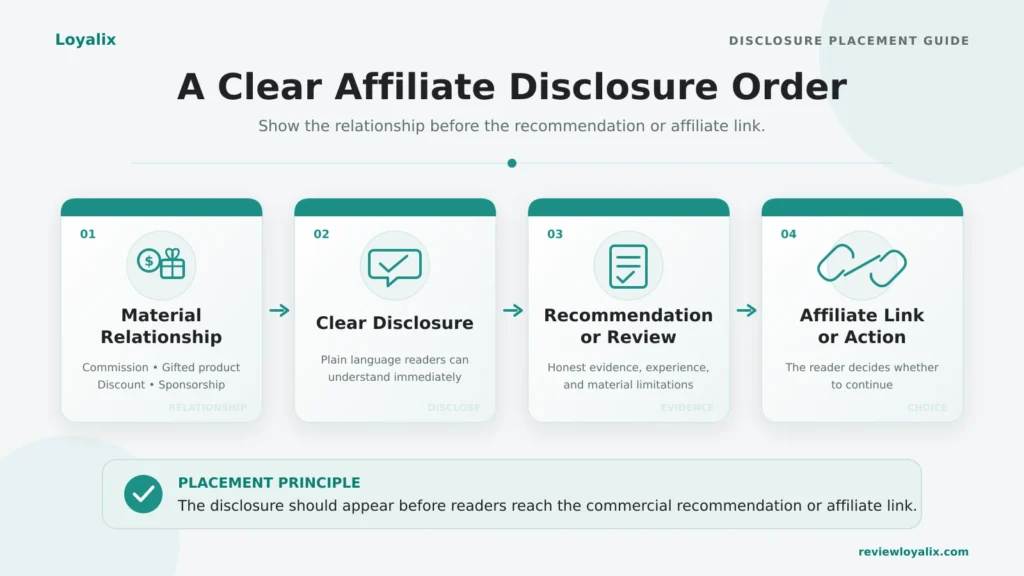
Placement should follow the reader’s path. A person should receive the relevant information before or when encountering the recommendation, not after clicking the affiliate link or reaching the end of the article.
Place the Main Disclosure Near the Beginning
For an article built around affiliate products, place a clear disclosure near the top, before the first affiliate link and before the first meaningful recommendation. Do not hide it after a long introduction, below the Table of Contents, or behind a Read More control if readers can encounter commercial content first.
Keep It Visually Noticeable
Use readable text, sufficient contrast, ordinary spacing, and a position that remains visible on mobile. A disclosure should not be smaller, lighter, or less prominent than surrounding text. Avoid placing it inside a rotating slider, collapsed accordion, cookie notice, or footer that many readers will never open.
Connect Mixed Content to Specific Links
When an article is mainly educational, and only selected links are commercial, the main disclosure may need help from a nearby label or a consistent identifier. Explain the identifier before the first use, then apply it consistently to every relevant link. A symbol without an explanation is not self-explanatory.
Keep a Site-Wide Disclosure Page as Supporting Information
A dedicated disclosure page can explain the publisher’s general approach, types of relationships, editorial standards, and contact information. It supports transparency but does not replace a disclosure inside the article or beside the recommendation. A reader should not need to search the menu or footer to discover why a link is commercial.
Affiliate Disclosure Examples for Different Content Types
Product Review
Place the relationship disclosure before the review begins or before the first product link. Separately explain how the product was obtained and whether it was tested directly.
Comparison Article
Disclose whether some or all compared products use affiliate links. If the commission model differs among products, do not imply that every listing has the same relationship. Keep the comparison criteria consistent whether a commission is available or not.
Tutorial or Resource Guide
If a tutorial teaches a process and recommends a tool inside the steps, place a short disclosure before the first commercial recommendation. Do not wait until a resources section at the end if readers encounter the link earlier.
Deal List or Buying Guide
When the page is primarily commercial, make its advertising nature clear immediately. Depending on the applicable rules and presentation, a direct Ad label may be more appropriate than a soft general notice. Do not describe an affiliate-funded list as independent if commercial arrangements influence inclusion or prominence.
Email or Newsletter
Put the disclosure in the email itself, before or close to the first affiliate recommendation. A disclosure on the website does not automatically cover a message read entirely inside an inbox. Test the email on mobile because previews, clipped text, and image blocking can change what readers see.
How to Disclose Affiliate Relationships on Social Media
Social posts are frequently viewed outside the creator’s profile, and captions may be shortened. Place the disclosure at the beginning or before the promotional statement where it is visible without opening extra text. Use the platform’s branded-content tool when required, but do not assume that the tool replaces a clear disclosure in the content.
Facebook and Instagram Feed Posts
Start with a clear label such as Ad or Sponsored, followed by a direct explanation when useful. Avoid placing the disclosure after several lines, after a group of hashtags, or only in the first comment.
Stories and Temporary Visual Content
Place the disclosure on the image or video itself. Use a readable size, strong contrast, and enough screen time for a person to notice and understand it. Keep the disclosure away from buttons, captions, profile overlays, and interface elements that may cover it.
Short Posts and Limited Space
When space is limited, a clear label such as Ad or #Ad at the beginning is usually stronger than an abbreviation. The disclosure still needs to match the actual relationship. A unique discount code can suggest a relationship, but it may not clearly explain that the creator is paid.
Video, Podcast, and Live Content Disclosures
Recorded Video
Disclose the relationship inside the video, not only in the description. Use spoken and on-screen disclosure early enough that viewers receive the information before the endorsement or link instruction. Repeating the disclosure may be appropriate in a long video or when viewers can enter at different points.
In the description, place a written disclosure before or close to the affiliate links. Do not bury it below equipment lists, unrelated links, or a long group of hashtags.
Podcast and Audio Content
State the relationship aloud before or as the recommendation begins. Add a written disclosure to show notes that contain affiliate links. The spoken and written disclosures serve different listening and browsing paths.
Live Streams
A single disclosure at the beginning may be missed by viewers who join later. Repeat it periodically and consider a persistent on-screen label when the format allows.
The description or event page should also explain the relationship before viewers enter the stream.
Free Products, Sponsorships, and Discount Codes
Commercial relationships should be described accurately rather than grouped under one generic affiliate notice.
| Relationship | What the audience should understand | Example starting point |
|---|---|---|
| Affiliate commission | The publisher can be paid when a qualifying action follows the link or code. | Ad disclosure: We receive a commission on qualifying purchases through marked links. |
| Paid sponsorship | The brand paid for the content or placement. | Ad: Brand paid for this post. |
| Free product | The brand provided the product without normal payment. | Ad: Brand provided this product free for review. |
| Discounted access | The creator received a price reduction or special access. | Disclosure: Brand provided discounted access for this evaluation. |
| Loaned product | The creator used the product temporarily and must return it. | Disclosure: Brand loaned this product for testing, and it will be returned. |
| Travel or event support | The company paid for relevant travel, accommodation, admission, or hospitality. | Ad: Brand paid for travel and accommodation for this event. |
One piece of content can involve more than one relationship. For example, a creator may receive a free product and also use affiliate links. Disclose both facts because they answer different questions.
Affiliate Links and SEO Link Attributes
Reader-facing disclosure and technical link qualification solve different problems. The disclosure explains the relationship to a person. A link attribute gives a search engine information about the nature of the link. One does not replace the other.
Google Search Central recommends marking paid or sponsored links with rel=”sponsored”. You can still use nofollow, but sponsored is the purpose-specific value for advertisements and paid placements.
A Practical HTML Example
<a href="https://merchant.example/product" rel="sponsored">View the product</a>The attribute does not make a claim truthful, create a reader disclosure, or confirm compliance with a program. It is part of technical link management. The visible article still needs plain-language disclosure where required.
Program Terms Platform Rules and Local Requirements
An affiliate publisher may need to satisfy several layers of requirements at the same time: local law, rules affecting the audience, affiliate-program terms, network policies, platform advertising tools, and search-engine link guidance. Following one layer does not guarantee compliance with the others.
Before publishing, review the current agreement rather than relying on a remembered rule or another creator’s example. The Loyalix guide to affiliate program terms explains how to record promotional restrictions, disclosure clauses, brand rules, attribution conditions, and update dates.
Build a Repeatable Affiliate Disclosure Workflow
A repeatable process reduces the risk of forgetting a disclosure when content moves between an article, newsletter, video, and social post.
| Step | Action | What to verify |
|---|---|---|
| 1 | Record the Relationship | Write down whether the content involves commission, sponsorship, free access, a loan, discount, employment, ownership, travel, or another material connection. |
| 2 | Identify Every Content Format | List the places where the recommendation will appear: website, email, Facebook, Instagram, video, podcast, live stream, downloadable file, or another channel. |
| 3 | Check the Applicable Rules | Open the current program terms, platform policy, and relevant official guidance for the audience and location. |
| 4 | Choose Plain Language | State what the publisher receives and what action can generate the benefit. Remove abbreviations and insider terminology. |
| 5 | Place the Disclosure Before Engagement | Make the relationship visible before or beside the recommendation, affiliate link, code, or call to action. |
| 6 | Add Technical Link Qualification | Apply the appropriate sponsored or nofollow attribute where relevant, without treating it as a reader disclosure. |
| 7 | Test the Real Viewing Path | Check desktop, mobile, email preview, app view, collapsed captions, Stories overlays, video descriptions, and link destinations. |
| 8 | Record Approval and Review Date | Save the wording, relationship, approver, source rules, and next review date so future updates can be checked efficiently. |
If AI assists with repurposing content, require the same disclosure to remain visible in every output and review it manually. The responsible AI workflow for affiliate marketing can help separate research, drafting, verification, and final human approval.
Common Affiliate Disclosure Mistakes
| Mistake | Why it matters |
|---|---|
| Relying Only on a Footer or Disclosure Page | Readers may never visit it before encountering the commercial recommendation. |
| Placing the Disclosure After the Affiliate Link | The reader learns about the relationship only after the relevant decision point. |
| Using Industry Shorthand | Terms such as affiliate, collab, or commissionable may not explain payment to an ordinary reader. |
| Hiding the Disclosure Behind More | Collapsed captions and truncated introductions can make the relationship invisible. |
| Using Tiny or Low-Contrast Text | A technically present disclosure may still be difficult to notice or read. |
| Assuming the Audience Already Knows | A person may see one post without knowing the creator’s previous relationships. |
| Treating a Discount Code as Self-Explanatory | The code may show a connection without explaining that the creator is compensated. |
| Using the Platform Label Alone | A built-in tool may be helpful or required but may not communicate every relationship clearly. |
| Forgetting New Formats | A blog disclosure does not automatically appear in an email, video, Story, downloadable PDF, or social repost. |
| Believing Disclosure Fixes Weak Content | Transparency does not excuse unsupported claims, invented experience, or hidden limitations. |
Clear disclosure can support trust, but the entire recommendation still needs to respect the reader. For related editorial guidance, see How to Improve Affiliate Conversions Without Being Pushy.
Affiliate Disclosure for Beginners Checklist
Use this checklist before publishing content that includes affiliate links, sponsorships, gifted products, discounts, or another material relationship.
Frequently Asked Questions
Do I need an affiliate disclosure if nobody buys through the link?
Yes, when a disclosure is otherwise required. The relevant issue is the commercial relationship and the possibility of compensation, not whether a particular post ultimately produces an approved commission.
Is a site-wide affiliate disclosure page enough?
Usually it should be treated as supporting information, not the only disclosure. Place a clear notice inside the relevant article or close to the recommendation so readers do not need to search the site.
Can I write only “affiliate link” beside a link?
That phrase may not tell an ordinary reader that the publisher receives money. A direct label such as “paid link” or “Ad,” or a plain-language commission statement, is usually clearer. Check the rules that apply to the audience and platform.
Where should an affiliate disclosure appear in a blog post?
Place it near the beginning, before the first affiliate link or meaningful recommendation. In mixed editorial content, identify the relevant commercial links or sections clearly at the point where readers encounter them.
Do I need a disclosure in every social media post?
A new post may reach people who never saw an earlier disclosure. When a post contains or supports a commercial recommendation, include the relevant disclosure in that post rather than relying on a profile biography or previous content.
Does a free product require disclosure?
A free, discounted, or loaned product can be a material connection. Explain what the company provided, even when no cash payment was made and even when the product is returned after testing.
Is the platform “Paid Partnership” label enough?
Use platform tools when required, but review whether the label is clear, visible, and specific enough for the relationship. Official guidance may expect a disclosure within the content as well.
Should affiliate links use sponsored or nofollow?
Google recommends rel="sponsored" for advertisements and paid placements. The nofollow value remains available, but sponsored describes the commercial purpose more specifically. Neither attribute replaces the visible disclosure to readers.
Can I use one disclosure for a blog article, video, and social post?
You can maintain consistent core wording, but each format needs placement suited to how people encounter it. A website notice does not automatically cover a video, email, Story, live stream, or social caption.
Final Thoughts
A good affiliate disclosure should not feel like an interruption added after the content is finished. It is part of the information a reader needs to evaluate the recommendation fairly.
Begin by identifying the real relationship. Describe it with ordinary words. Put the disclosure before or close to the commercial recommendation, adapt it to the format, and check the final mobile view. Keep a general disclosure page for additional detail, but do not make the reader search for the central fact.
Beginners do not need complicated legal language. They need an accurate process they can repeat. Start with one audience, one useful piece of content, one carefully reviewed program, and one clear disclosure. The Loyalix guide on starting affiliate marketing with no experience can help place disclosure inside a wider, responsible beginner workflow.
Reader trust is not protected by a label alone. It is protected when the disclosure, evidence, recommendation, and business practices all tell the same honest story.