Lifestyle Inflation: How Higher Spending Can Slow Financial Progress
Earning more money can create a welcome sense of relief.
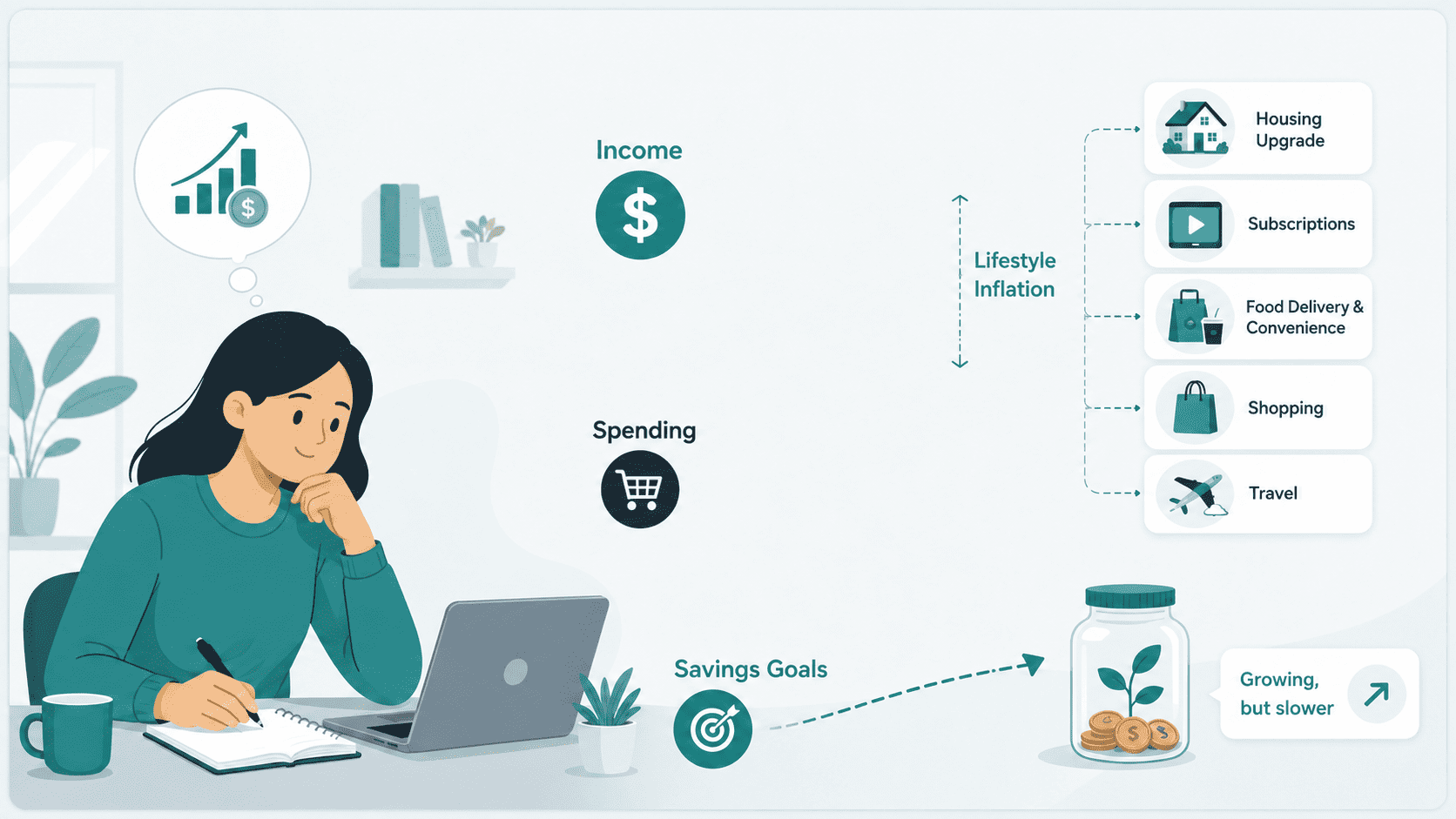
You may finally have more room in your budget, more choices, and a greater ability to improve your daily life. You may upgrade your home, buy better-quality products, use more convenient services, travel more often, or spend more freely without checking every small purchase.
Some of these changes may be useful and completely reasonable.
However, when spending automatically increases every time income grows, it can become difficult to make meaningful financial progress. Even with a higher income, you may still feel that there is never enough money left for savings, debt repayment, an emergency fund, or long-term goals.
This pattern is often called lifestyle inflation or lifestyle creep.
Lifestyle inflation does not mean that enjoying your money is wrong. It also does not mean that every lifestyle improvement should be avoided.
The real issue is whether higher spending is intentional and sustainable—or whether it is quietly absorbing most of your additional income before that income can support your future.
This guide explains what lifestyle inflation is, why it happens, how to recognize it, and how to manage it without making your life feel unnecessarily restricted.
What Is Lifestyle Inflation?
Lifestyle inflation happens when your expenses increase as your income increases.
As you begin earning more, purchases and services that once felt optional may gradually become part of your normal lifestyle.
For example, you may:
- order food more often;
- upgrade your phone more frequently;
- choose a more expensive car;
- move into a more costly home;
- add new subscriptions;
- travel more often;
- buy more expensive clothing;
- pay for additional convenience services.
One lifestyle improvement may not create a problem by itself.
The change becomes lifestyle inflation when several new expenses gradually become normal and begin using most—or all—of the additional income you earn.
Imagine that your monthly income increases by $400. If your regular spending also increases by approximately $400, your financial position may not improve very much.
You are earning more, but you may not be:
- saving more;
- reducing debt faster;
- building a larger emergency fund;
- investing for long-term goals;
- creating more flexibility in your budget.
This is why a higher income does not automatically create greater financial security.
Income matters, but what you do with that income matters too.
Why Does Lifestyle Inflation Happen?
Lifestyle inflation is rarely the result of one dramatic financial decision.
It usually develops gradually through many small choices.
A Higher Income Feels Like Permission to Spend More
After earning more, it is natural to feel that you can finally afford things you previously delayed.
You may want to reward yourself for your work or make life more comfortable.
There is nothing automatically wrong with this. The difficulty begins when every increase in income is treated as money that is immediately available for additional spending.
Without a clear plan, the new income can disappear into everyday expenses surprisingly quickly.
Convenience Becomes Part of the Normal Routine
Convenience can save time and reduce stress.
Food delivery, ride services, premium subscriptions, cleaning services, faster shipping, and other paid conveniences can all be useful.
However, convenience costs can become difficult to notice when they happen regularly.
A service that began as an occasional solution may gradually become a weekly or daily expense.
Social Comparison Influences Spending
People often compare their lifestyle with friends, colleagues, family members, or people they follow online.
You may feel pressure to upgrade your home, clothes, phone, travel, or social activities because similar spending appears normal around you.
The problem is that you rarely know another person’s complete financial situation.
Their income, debt, savings, responsibilities, and long-term goals may be very different from yours.
Recurring Expenses Feel Less Visible
A single purchase is usually easy to notice.
Recurring costs can be more difficult to see because they become part of the background of your budget.
A new subscription, larger car payment, more expensive phone plan, or higher housing cost may feel manageable individually. But several recurring upgrades can significantly reduce your monthly flexibility.
Financial Goals Are Not Clearly Defined
When future goals are unclear, present spending often feels more important.
It is easier to spend an additional $100 today when that money does not already have a specific purpose.
However, if the same $100 is connected to an emergency fund, debt repayment, education, a future home, or another meaningful goal, the decision may feel different.
Clear goals help you understand what you are choosing between.
Common Signs of Lifestyle Inflation
Lifestyle inflation can be difficult to notice because each individual change may appear reasonable.
Here are several signs that your spending may be increasing faster than your financial progress.
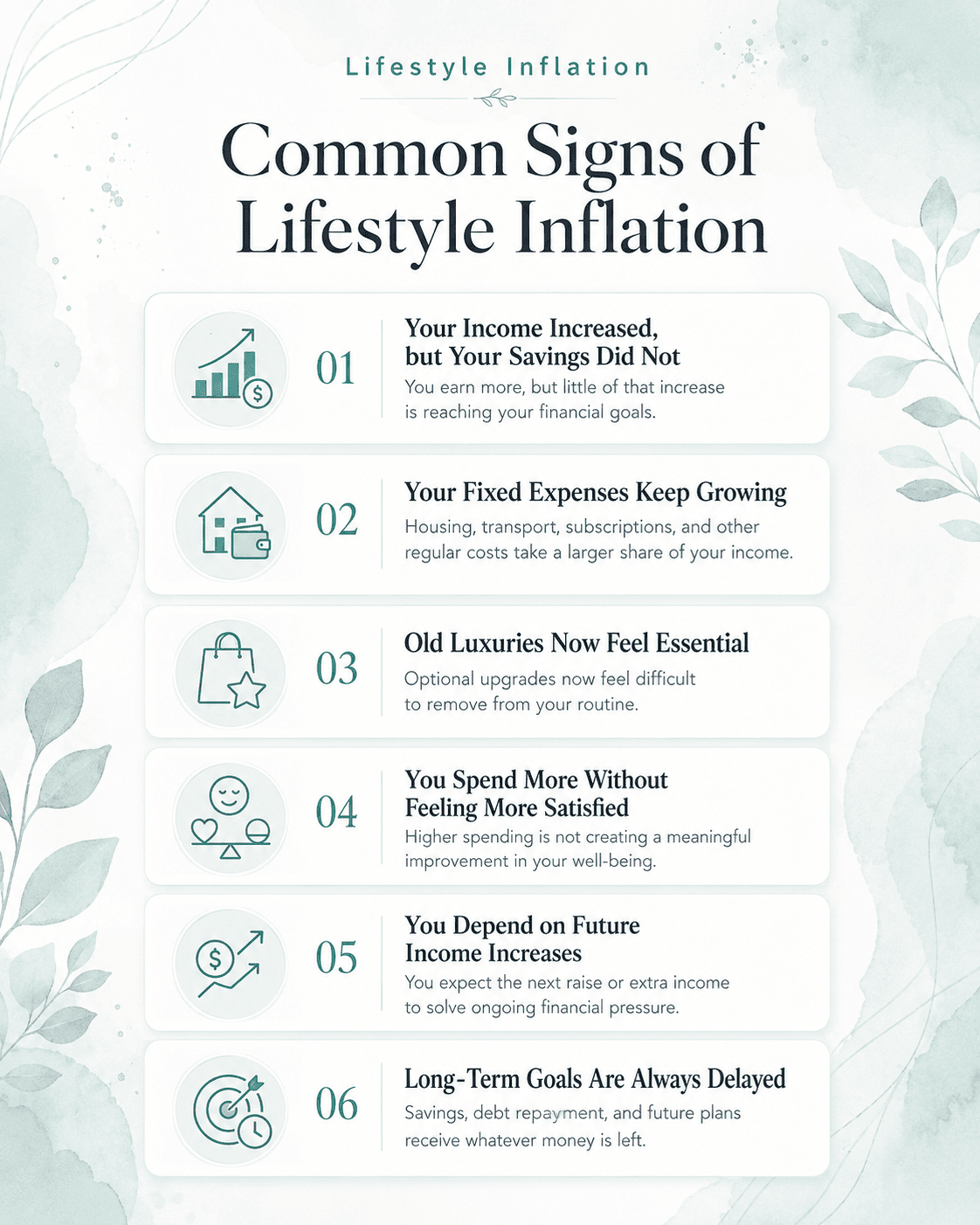
Your Income Increased, but Your Savings Did Not
You earn more than before, but your savings have not grown with your income. This can be a sign that extra income is being absorbed by higher spending.
Your Fixed Expenses Keep Growing
Housing, transport, phone, subscriptions, insurance, memberships, or loan payments can take a larger share of your income and make your budget less flexible. Understanding your fixed and variable expenses can help you identify which costs have gradually become recurring commitments.
Old Luxuries Now Feel Essential
Spending that once felt optional may now feel difficult to remove. This often happens when upgrades quietly become part of your normal routine
You Spend More Without Feeling More Satisfied
Your lifestyle costs more, but the extra spending does not create a meaningful improvement in your well-being. Some upgrades feel exciting at first and then quickly become normal.
You Depend on Future Income Increases
You may expect the next raise or extra income source to solve financial pressure. But if spending keeps rising, the same pressure can continue.
Long-Term Goals Are Always Delayed
Savings, debt repayment, and future goals often receive whatever money is left at the end of the month. As a result, progress stays slower than expected.
How Lifestyle Inflation Can Slow Financial Progress
Lifestyle inflation does not always create an immediate crisis.
Its effects can be gradual, which is one reason it is easy to ignore.
Less Money Reaches Your Goals
Every new recurring expense competes with savings, debt repayment, investing, and other priorities.
If all additional income goes toward lifestyle upgrades, your goals may not move forward even though you are earning more.
Your Budget Becomes Less Flexible
Higher fixed expenses can make it harder to adjust during a difficult month.
A more expensive home, car, phone contract, or collection of subscriptions may be affordable while income remains stable. But they can create pressure if your income changes or an unexpected expense appears.
An emergency fund can provide some protection, but regularly increasing expenses may also make that fund harder to build.
Unexpected Costs Become More Difficult to Handle
When most of your income is already committed, there may be little room for repairs, medical costs, family needs, or other unplanned expenses.
This can increase reliance on credit cards or borrowing.
Major Goals Take Longer
Lifestyle inflation can delay goals such as:
- building financial security;
- repaying high-interest debt;
- creating a business;
- changing careers;
- buying a home;
- funding education;
- preparing for retirement;
- reducing working hours.
The problem is not always that you cannot afford these goals.
Sometimes the problem is that smaller lifestyle expenses are repeatedly receiving priority first.
A Higher Income May Still Feel Insufficient
If expectations rise at the same speed as income, financial satisfaction can remain unchanged.
You may earn more but still feel that you need the next increase before you can begin saving seriously.
This cycle can continue for years unless you pause and create a more intentional plan.
Lifestyle Inflation vs Healthy Lifestyle Improvements
Not every increase in spending is lifestyle inflation.
Some expenses can improve safety, health, comfort, opportunity, or quality of life in meaningful ways.
The goal is not to keep your lifestyle exactly the same forever.
The goal is to understand why you are spending more and whether the decision fits your priorities.
| Healthy lifestyle improvement | Possible lifestyle inflation |
|---|---|
| Moving to safer or more suitable housing | Choosing a much more expensive home mainly because income increased |
| Paying for necessary healthcare | Adding expensive wellness services without reviewing their value |
| Buying reliable equipment for work | Frequently upgrading devices that still work well |
| Paying for education or useful skills | Buying courses repeatedly without using them |
| Using convenience services during a demanding period | Making every convenience service a permanent expense |
| Planning meaningful travel within your budget | Using debt to maintain a travel lifestyle you cannot comfortably afford |
| Replacing a vehicle that is no longer reliable | Increasing the car payment after every income increase |
A useful question is:
Does this expense meaningfully improve my life, or has it simply become the next expected upgrade?
There is no universal answer. A healthy spending decision should reflect your income, responsibilities, values, and goals—not someone else’s lifestyle. The needs, wants, and goals framework can help you evaluate these choices without treating every want as a mistake.
There is no universal answer.
A healthy spending decision should reflect your income, responsibilities, values, and goals—not someone else’s lifestyle.
A Simple Lifestyle Inflation Example
Consider a person whose monthly income increases from $2,000 to $2,400.
Before the increase, their budget may look like this:
| Category | Before income increase |
|---|---|
| Essential and fixed expenses | $1,300 |
| Flexible spending | $400 |
| Financial goals | $200 |
| Buffer | $100 |
| Total | $2,000 |
After the income increase, several lifestyle costs grow:
- housing and regular bills increase by $100;
- delivery, shopping, subscriptions, and entertainment increase by $220;
- financial goals increase by only $40;
- the monthly buffer increases by $40.
The new budget may look like this:
| Category | After income increase |
|---|---|
| Essential and fixed expenses | $1,400 |
| Flexible spending | $620 |
| Financial goals | $240 |
| Buffer | $140 |
| Total | $2,400 |
The person now earns $400 more each month.
However, only $40 of the additional income is going directly toward long-term financial goals.
This example does not mean the new spending is automatically irresponsible. Some of it may be valuable.
It simply shows how a meaningful income increase can create only a small improvement in financial progress when spending grows at nearly the same speed.
How to Manage Lifestyle Inflation Without Feeling Restricted
Managing lifestyle inflation does not require removing every enjoyable expense.
A more sustainable approach is to become intentional about which upgrades matter and how much of your growing income should support your future.
Track What Actually Changed
Start by comparing your current spending with an earlier month or year.
Look at:
- housing;
- transport;
- groceries;
- eating out;
- subscriptions;
- shopping;
- travel;
- personal care;
- convenience services;
- debt payments;
- savings.
Do not begin by judging or cutting.
First, create an accurate picture.
Before changing your budget, review what you are actually spending rather than what you think you should be spending. The Consumer Financial Protection Bureau recommends using your real account and payment history to create a more accurate picture of your expenses.
The Loyalix guide on how to track your spending can help you complete this step using a simple method.
Give Part of Every Income Increase a Purpose
Before changing your lifestyle, decide how part of the additional income will be used.
For example, you might divide an increase between:
- current needs;
- enjoyment;
- emergency savings;
- debt repayment;
- long-term savings;
- education or business development.
There is no percentage that works for everyone.
The important step is to make the decision before the additional income becomes part of normal spending.
You can also automate a transfer to savings after each payday. The Consumer Financial Protection Bureau explains that automatic recurring transfers can make it easier to build a consistent savings habit over time.
Review New Recurring Costs Carefully
A one-time purchase affects your budget once.
A recurring expense affects every future month until you cancel or change it.
Before accepting a new monthly cost, ask:
- How much will this cost over one year?
- Does it replace another expense?
- Will I use it regularly?
- Would I still choose it if my income did not increase?
- Does it reduce the amount available for an important goal?
This is especially important for housing, vehicles, subscriptions, memberships, insurance upgrades, phone plans, and financed purchases.
Choose Upgrades That Matter Most
You do not need to avoid every improvement.
Instead, identify which upgrades provide the greatest value.
For example, you may decide that better housing is important but frequent technology upgrades are not. You may value travel but prefer to reduce shopping. You may gladly pay for a service that saves several hours each week while keeping other expenses simple.
Intentional spending allows you to enjoy your money without allowing every category to expand at the same time.
Protect Some Enjoyable Spending
A financial plan that removes all enjoyment may be difficult to maintain.
Create a realistic amount for flexible spending and use it without unnecessary guilt.
The purpose of managing lifestyle inflation is not to make life smaller.
It is to prevent automatic spending from making your future choices smaller.
Our guide on how to reduce variable expenses without feeling restricted explains how to review flexible costs while keeping the parts of your budget that still add value.
Build Goals Into Your Budget
Do not wait until the end of the month to see whether money remains.
Include your goals when you create your simple budget.
A budget is a plan for how your income will be used. Consumer.gov explains that a budget can help you plan monthly spending and save for goals or unexpected expenses.
Your financial goals can begin with small amounts.
Consistency is usually more useful than repeatedly waiting for the perfect month.
Change One Pattern at a Time
Trying to reverse every lifestyle upgrade immediately can feel discouraging.
Choose one area first.
You might:
- cancel one unused subscription;
- reduce delivery orders;
- delay a device upgrade;
- set a travel savings amount before booking;
- redirect part of a raise to savings;
- review one large recurring expense;
- create a weekly personal spending limit.
One realistic adjustment is easier to maintain than a complete lifestyle reset.
Identify Your Lifestyle Inflation Triggers
Lifestyle inflation is easier to manage when you understand what causes your spending to increase.
Your triggers may include:
- receiving a raise;
- comparing yourself with others;
- stress or exhaustion;
- wanting to reward yourself;
- using convenience automatically;
- upgrading because something newer is available;
- treating every additional income payment as spending money.
Use the free Loyalix worksheet to review your patterns and choose one realistic change for the next 30 days.
Download the Lifestyle Inflation Triggers Checklist
This beginner-friendly worksheet will help you:
identify where your lifestyle costs have increased;
recognize emotional and practical spending triggers;
review recurring expenses;
choose one spending pattern to adjust;
create a realistic 30-day action.
Free PDF • 2 pages • No sign-up required
Final Thoughts
Lifestyle inflation is not about enjoying life too much.
It is about spending increases that happen automatically and quietly consume the financial progress that a higher income could create.
Some lifestyle improvements are meaningful. They may support your safety, health, family, work, comfort, or personal goals.
The important question is whether those improvements are intentional, affordable, and balanced with your future priorities.
Start by looking at what changed.
Compare your current expenses with your previous spending. Identify which upgrades still provide real value and which ones have simply become normal.
Then choose one small adjustment.
You might direct part of your next income increase toward savings, review a recurring expense, reduce one convenience habit, or give a financial goal a permanent place in your monthly budget.
Financial progress does not require perfect decisions.
It requires enough awareness to make your growing income support both your present life and your future.
That awareness is an important part of financial literacy: understanding your money, recognizing your habits, and making decisions that reflect what matters most to you.
FAQ
What is lifestyle inflation?
Lifestyle inflation is the gradual increase in spending that often happens when income grows. Expenses, upgrades, and conveniences that were once optional may slowly become part of a person’s normal lifestyle.
Is lifestyle inflation always bad?
No. Spending more is not automatically bad, especially when it improves health, safety, comfort, education, or quality of life. The concern is unplanned spending growth that prevents higher income from supporting savings and long-term financial goals.
What are common examples of lifestyle inflation?
Common examples include moving to more expensive housing, increasing car payments, ordering food more often, adding subscriptions, upgrading devices frequently, travelling more, or increasing shopping after receiving a raise.
How can I avoid lifestyle inflation?
Track how your expenses change, give part of every income increase a clear purpose, review new recurring costs carefully, include financial goals in your budget, and choose lifestyle upgrades intentionally.
Can I enjoy my money and still make financial progress?
Yes. A realistic financial plan can include enjoyable spending. The goal is not to remove everything you like, but to balance present enjoyment with savings, financial stability, and future priorities.
Why does earning more not always improve financial security?
A higher income may not create greater financial security when spending increases at the same rate. Progress depends on how much income remains available for savings, debt repayment, emergencies, and long-term goals.